Ripple SEC Lawsuit: Final Verdict, Implications for XRP, and What Comes Next

For five years, the fate of XRP was tied to a high-stakes legal battle between Ripple Labs and the U.S. Securities and Exchange Commission (SEC). It wasn't just about one company; it was about whether digital assets could be traded freely or if every token sale needed government approval. On August 22, 2025, that uncertainty finally ended. The Second Circuit Court of Appeals approved the dismissal of the case, cementing a landmark ruling that changed how regulators view crypto in America.
If you hold XRP, follow crypto markets, or work in fintech, this isn't just history-it's your new operating manual. The resolution didn't just save Ripple from billions in penalties; it created a clear path for institutional adoption, sparked a wave of ETF approvals, and forced the SEC to rethink its entire enforcement strategy. Here is exactly what happened, why it matters, and where things stand now in late 2025.
The Core Dispute: Was XRP a Security?
To understand the impact, you have to look at the heart of the conflict. The SEC sued Ripple in December 2020, claiming that Ripple sold $1.3 billion worth of unregistered securities. Their argument relied on the Howey Test is a legal framework used to determine if an investment contract qualifies as a security. Under this test, if people invest money expecting profits from the efforts of others, it’s a security.
Ripple argued differently. They claimed XRP was a currency, similar to Bitcoin or Ethereum, designed for fast cross-border payments, not an investment vehicle. For nearly five years, courts debated this distinction. The turning point came in July 2023 when Judge Analisa Torres issued a partial summary judgment. She made a crucial distinction that still defines the industry today:
- Institutional Sales: Direct sales to hedge funds and sophisticated investors were deemed securities violations because buyers relied heavily on Ripple’s promotional efforts.
- Programmatic Sales: Sales to retail traders on public exchanges were not securities. Buyers there had access to market data and weren't relying on Ripple’s promises alone.
This "contextual" approach was revolutionary. Before this, many assumed a token was either a security or it wasn’t, period. The court said no-an asset’s status depends on how it is sold. This nuance saved XRP from being banned from U.S. exchanges, allowing trading to continue legally for everyday users.
The Final Resolution: Settlement and Penalties
The legal tug-of-war continued until August 2025. Instead of dragging on with appeals, both parties agreed to a Joint Stipulation of Dismissal. This means they settled out of court, but the terms were strict enough to satisfy the regulator while giving Ripple breathing room.
Ripple paid a civil penalty of $125,035,150. While that sounds like a lot, consider the context: the SEC initially sought over $2 billion in disgorgement and penalties. Paying roughly 10% of the initial claim allowed Ripple to avoid existential risk. More importantly, the settlement included an injunction prohibiting future violations of securities registration laws, meaning Ripple must comply with rules going forward but faces no retroactive bans on past retail sales.
| Aspect | Detail |
|---|---|
| Final Penalty | $125 million USD |
| Legal Precedent | XRP is not a security per se; status depends on transaction context |
| Date of Dismissal | August 22, 2025 |
| Impact on Exchanges | U.S. exchanges can legally list XRP for retail trading |
| Institutional Sales | Must comply with securities registration requirements |
Market Reaction: Price Surges and Institutional Confidence
Markets hate uncertainty, and they love clarity. When the dust settled in mid-2025, the reaction was immediate. In July 2025, right before the final dismissal was formalized, XRP hit an all-time high of $3.42, up 480% in a single month. Trading volume exploded to $28.7 billion, compared to just $4.9 billion the previous month.
Why such a jump? Two main factors drove this:
- Regulatory Certainty: With the threat of delisting gone, major U.S. exchanges welcomed XRP back into their ecosystems. This reopened liquidity channels that had been blocked for years.
- Institutional Entry: Big players don't gamble on ambiguous assets. Once the court confirmed XRP wasn't automatically a security, hedge funds and asset managers felt safe entering the market. Chainalysis data shows institutional ownership of XRP rose from 22% in late 2024 to 37% by September 2025.
Social sentiment mirrored this shift. Analysis of Reddit and Twitter discussions showed a 320% increase in positive mentions following the August 2025 resolution. Even skeptics acknowledged that the worst-case scenario-total banishment from U.S. markets-had been avoided.
The ETF Wave: A New Era for XRP Investment
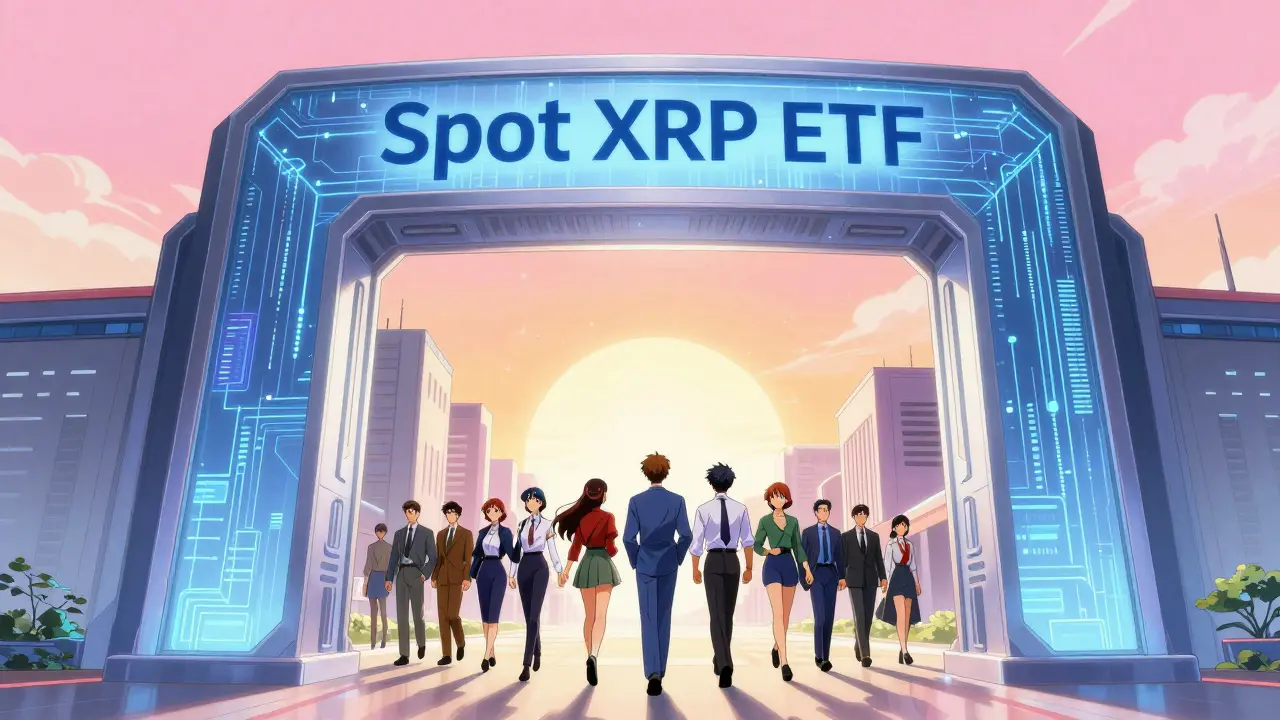
Perhaps the most significant implication of the lawsuit’s end is the rise of Spot XRP ETFs. For years, investors wanted easy, regulated ways to buy exposure to XRP without holding private keys. The SEC rejected these applications repeatedly, citing the ongoing lawsuit.
With the case closed, the door swung open. On July 15, 2025, the ProShares Ultra XRP ETF became the first SEC-approved exchange-traded fund tracking XRP price performance. Within its first month, it attracted $427 million in assets under management. By late 2025, eleven major firms-including Fidelity, VanEck, and ARK Invest-had filed their own applications.
Bloomberg Intelligence analysts projected a 95% probability of multiple XRP ETF approvals by year-end 2025. They estimated total assets in these funds could reach $50 billion by Q2 2026. This isn't just hype; it represents a structural shift in how capital flows into crypto. Retail investors who prefer traditional brokerage accounts now have a compliant way to participate in XRP’s growth.
Strategic Shifts: Ripple’s Business Model Post-Lawsuit
Ripple didn't just survive; it adapted. Freed from the distraction of litigation, the company accelerated its enterprise partnerships. One notable move involved transferring over 126 million XRP tokens to Evernorth Holdings as part of a merger deal. These tokens were locked and exchanged for shares, effectively reducing circulating supply and aligning incentives with long-term corporate value.
This strategy reflects a broader trend. Since January 2025, Ripple has reduced available XRP supply by approximately 1.2 billion tokens through strategic partnerships and escrow releases. Analysts predict this could decrease circulating supply by 15-20% over the next five years, potentially creating upward price pressure due to scarcity.
On the technical side, Ripple’s On-Demand Liquidity (ODL) service saw massive growth. In Q3 2025, ODL processed $15.3 billion in cross-border payments-a 210% quarterly increase. It now serves 127 financial institutions across 38 countries. The low cost ($0.0002 per transaction) and speed (1,500 TPS) of the XRP Ledger provides a decentralized blockchain infrastructure supporting fast, low-cost transactions and smart contracts via Flare Network integration. make it attractive for banks tired of slow SWIFT transfers.
Broader Regulatory Impact: Beyond Ripple
The Ripple case didn't exist in a vacuum. Its precedent rippled outward, affecting other crypto companies facing SEC scrutiny. For example, Coinbase’s ongoing litigation referenced the Ripple ruling to argue that certain tokens listed on its platform should not be classified as securities. Similarly, settlements with other projects began incorporating the "transactional context" framework established by Judge Torres.
New SEC Chairman Paul Atkins, appointed in early 2025, launched "Project Crypto" to modernize regulations. He explicitly cited the Ripple case as a foundation for clearer guidelines. In August 2025, he promised comprehensive digital asset classification rules within 12 months. This suggests we may see a more predictable regulatory environment in 2026, reducing the fear-and-greed cycles that have plagued the industry.
Challenges and Criticisms Remain
Despite the victory, critics point out lingering issues. Some argue that XRP remains too centralized compared to Bitcoin or Ethereum, relying heavily on Ripple’s corporate success rather than pure decentralization. Others worry that the $125 million penalty sets a low bar for compliance, encouraging other companies to delay registration until forced into court.
Additionally, global regulation varies widely. While the U.S. moved toward clarity, jurisdictions like China maintain strict bans, and Europe’s MiCA framework imposes different reporting requirements. Ripple must navigate this fragmented landscape carefully as it expands internationally.
Is XRP considered a security after the Ripple lawsuit?
Not automatically. The court ruled that XRP is not a security per se. However, institutional sales directly from Ripple to sophisticated investors are treated as securities transactions requiring registration. Retail trades on public exchanges are not considered securities offerings.
How much did Ripple pay in fines?
Ripple paid a civil penalty of $125,035,150 as part of the settlement approved in August 2025. This amount represented approximately 10% of the initial damages sought by the SEC.
Can I buy XRP ETFs in the US?
Yes. Following the lawsuit resolution, several Spot XRP ETFs were approved in 2025, including the ProShares Ultra XRP ETF. Major asset managers like Fidelity and BlackRock also filed applications, expanding investor access.
What happened to the XRP price after the lawsuit ended?
XRP experienced significant volatility followed by strong gains. It reached an all-time high of $3.42 in July 2025, driven by renewed institutional interest and regulatory clarity. Prices stabilized between $2.80 and $3.20 in subsequent months.
Does the Ripple ruling affect other cryptocurrencies?
Yes. The "transactional context" framework established in the Ripple case influences how regulators evaluate other tokens. Cases involving Coinbase and Binance now reference this precedent to distinguish between primary market sales and secondary market trading.