Privacy Coins Banned on Australian Crypto Exchanges: What You Need to Know

Australians can still own privacy coins like Monero, Zcash, and Dash - but they can’t easily trade them on local exchanges. Since early 2025, every major Australian crypto platform has removed these coins from their listings. It’s not because they’re illegal to hold. It’s because the rules for exchanges changed - and they can’t comply without breaking privacy.
Why Privacy Coins Got Banned
Privacy coins are designed to hide transaction details. Unlike Bitcoin, where anyone can see who sent what to whom, Monero uses ring signatures and stealth addresses to scramble sender, receiver, and amount. Zcash uses zero-knowledge proofs to prove a transaction happened without revealing any details. These features make them appealing to users who value financial privacy - but they’re a nightmare for regulators. Australia’s financial watchdogs, ASIC and AUSTRAC, don’t ban coins outright. Instead, they force exchanges to choose: either stop offering privacy coins or risk losing their license. ASIC says exchanges must follow the same anti-money laundering (AML) rules as banks. AUSTRAC requires them to track every transaction, identify every user, and report suspicious activity. Privacy coins make that impossible. In 2025, 73 global exchanges delisted privacy coins - a 43% jump from 2023. Australia didn’t lead the charge, but it followed the trend hard. Binance, Kraken, and Poloniex removed these coins from their global platforms in early 2025. The reason? Pressure from regulators in the U.S., EU, and Canada. Australia’s move was less about creating new rules and more about enforcing existing ones.How the Ban Works
The ban isn’t a law. It’s a compliance requirement. Exchanges in Australia must be registered with AUSTRAC. To stay registered, they must prove they can identify users, monitor transactions, and report anything suspicious. Privacy coins break that system. So exchanges remove them. Here’s what that means for users:- You can still buy Monero or Zcash on international exchanges like KuCoin or Gate.io - but those platforms aren’t regulated in Australia.
- You can’t trade privacy coins on Australian platforms like CoinSpot, Swyftx, or Independent Digital Assets Exchange (IDAX).
- You can’t use Australian crypto ATMs to buy or sell privacy coins.
- You can’t deposit or withdraw privacy coins to/from Australian exchange wallets.
What’s Changing in March 2026
On March 31, 2026, AUSTRAC will expand its rules to cover all digital asset service providers - not just exchanges. That includes wallet providers, staking platforms, and even decentralized finance (DeFi) apps that handle Australian users. This isn’t a surprise. It’s the next step in a two-year crackdown. Since 2022, ASIC has taken legal action against platforms like Qoin and Finder Wallet for offering unlicensed financial services. In 2023, AUSTRAC canceled registrations for two exchanges that couldn’t prove they were tracking users properly. The March 2026 update means even if you use a non-Australian exchange, if you’re an Australian resident, your activity could still fall under AUSTRAC’s watch. That’s why many Australian users are now avoiding privacy coins entirely - not because they’re banned, but because the risks of using them have gone up.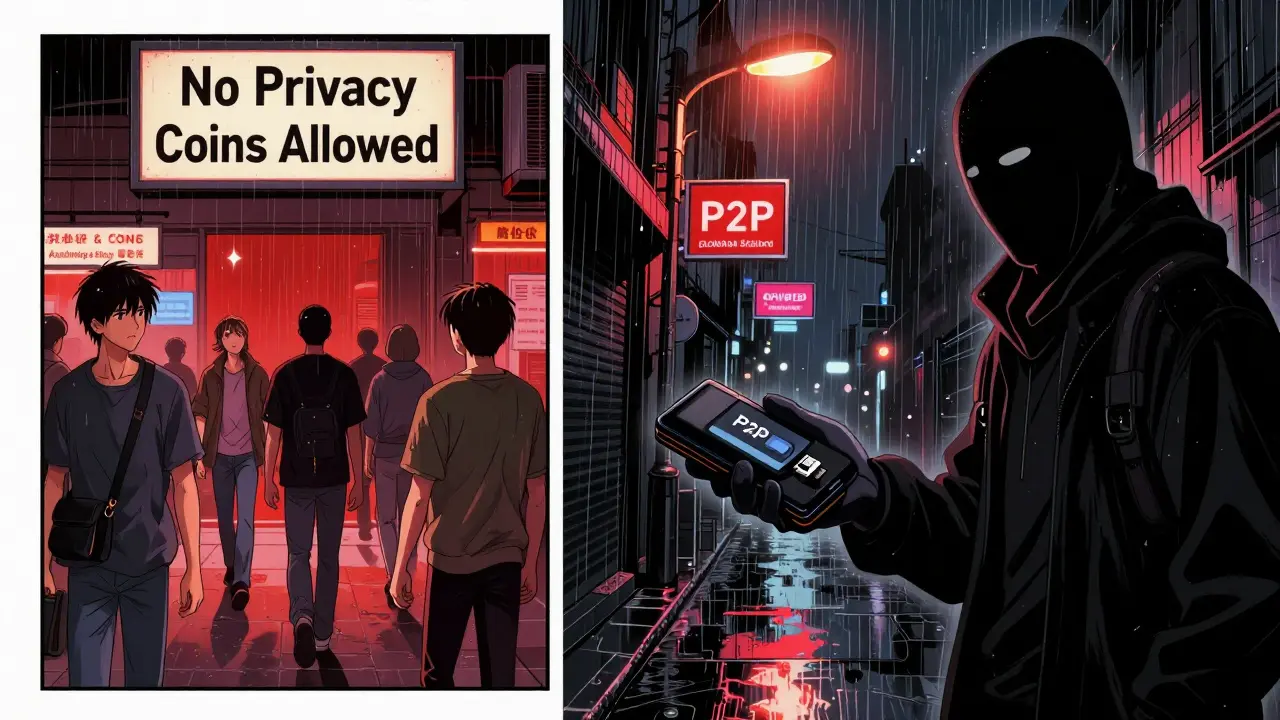
How Other Countries Compare
Australia’s approach is moderate compared to others:- Japan banned privacy coins outright in 2018. All licensed exchanges had to delist them.
- South Korea removed Monero and Zcash from its top five exchanges in Q1 2025.
- The European Union will ban anonymous crypto accounts and privacy coins starting July 2027.
- Switzerland and Liechtenstein still allow privacy coins - but only if exchanges meet strict KYC and AML standards.
Why Regulators Won’t Back Down
Law enforcement agencies say privacy coins make investigations nearly impossible. In 2024, the U.S. Internal Revenue Service offered a $625,000 bounty for anyone who could crack Monero’s privacy features. No one has claimed it yet - because the tech is that strong. Financial institutions hate the uncertainty. Banks refuse to process transfers from exchanges that still list privacy coins. Insurance companies won’t cover losses from P2P trades. Asset managers won’t touch them. That’s why institutional investors in Australia supported the ban - 78% of them, according to IDAX. Regulators argue that financial systems need transparency. They say privacy coins create safe havens for ransomware, drug sales, and tax evasion. Critics say that’s overstated - most criminal activity still happens on Bitcoin and traditional banking. But the narrative has stuck.
What Users Are Doing Now
Some Australians have moved to offshore exchanges. Others use P2P platforms. A few are experimenting with decentralized wallets and self-custody tools like hardware wallets and non-custodial wallets. But none of these options are easy. Reddit threads and local crypto forums are full of complaints:- “I bought Monero in 2023. Now I can’t sell it. I’m stuck.”
- “I tried LocalMonero. The price was 12% higher than on Binance. And the seller ghosted me.”
- “I’m not doing anything illegal. Why can’t I use my own money how I want?”
The Future of Privacy Coins in Australia
There’s no sign the ban will lift. If anything, it’s tightening. The March 2026 expansion of AUSTRAC’s powers will make it harder than ever to slip through the cracks. Some experts think privacy coins might adapt - by adding “compliant modes” where transaction data is hidden from the public but available to regulators with a warrant. But that would defeat the whole point. Privacy coins are built on the idea that no one should see your transactions - not even governments. For now, the message is clear: if you want to trade privacy coins in Australia, you’re on your own. No exchange will help you. No regulator will protect you. And if something goes wrong? You have no recourse. The ban isn’t about stopping crime. It’s about making compliance simple. And for Australian users, that means giving up privacy - not because they’re forced to, but because the system won’t let them keep it.Can I still own privacy coins in Australia?
Yes. Owning Monero, Zcash, or Dash is completely legal in Australia. The ban only applies to trading them through licensed exchanges. You can hold them in your own wallet, buy them on international platforms, or trade peer-to-peer.
Why can’t Australian exchanges list privacy coins?
Because they can’t meet AML and KYC requirements. Privacy coins hide transaction details, making it impossible for exchanges to identify users or report suspicious activity. If they tried to list them, AUSTRAC would cancel their license.
Will the ban be lifted after March 31, 2026?
No. The March 2026 update expands AUSTRAC’s oversight to all digital asset services, making compliance even stricter. There’s no indication regulators plan to reverse course. The trend is toward tighter control, not more freedom.
Can I use a non-Australian exchange to trade privacy coins?
Yes, but with risks. Exchanges like KuCoin or Gate.io still list privacy coins. However, they’re not regulated in Australia, so you won’t have consumer protections. If the platform gets hacked or shuts down, you have no legal recourse in Australia.
Are privacy coins illegal because they’re used for crime?
Not exactly. Privacy coins themselves aren’t illegal. But regulators argue their anonymity makes them too risky for regulated platforms. Even if only 1% of transactions are illicit, the compliance burden is too high. So exchanges remove them to avoid legal trouble.
What’s the difference between ASIC and AUSTRAC in this ban?
ASIC regulates financial products and services under the Corporations Act. AUSTRAC handles anti-money laundering and counter-terrorism financing rules. ASIC can sue platforms for offering unlicensed services. AUSTRAC can cancel an exchange’s registration if it fails AML checks. Together, they make compliance impossible for privacy coins.
Do other countries have the same ban?
Yes. Japan banned them in 2018. South Korea removed them in early 2025. The EU will ban them in 2027. Major global exchanges like Binance and Kraken delisted them from U.S. and European platforms too. Australia’s move aligns with global trends, not the other way around.
Can I use a VPN to access international exchanges?
Technically yes, but it doesn’t help. If you’re an Australian resident, AUSTRAC still considers you subject to its rules. Using a VPN won’t protect you from tax reporting, asset seizure, or future enforcement actions. It only adds complexity - not safety.
What happens if I buy privacy coins on a P2P platform and get scammed?
You have no protection. P2P platforms like LocalMonero aren’t regulated, so there’s no dispute process, no refund policy, and no way to recover funds. You’re on your own. That’s why most users avoid them - not because they’re illegal, but because they’re risky.
Is there any way privacy coins could return to Australian exchanges?
Only if they change their technology. If Monero or Zcash introduced a way to selectively reveal transaction data to regulators (with a warrant), exchanges might reconsider. But that would break their core privacy promise. Most developers won’t compromise on that - so a return is unlikely.





Comments
Pradip Solanki
March 22, 2026 AT 12:40Regulators are just scared of tech they can't control. Privacy coins aren't the problem, centralized banking is. You think Bitcoin's transparent? Try tracing $500M in stolen funds through a chain of混洗 services. Good luck with that. AUSTRAC is playing whack-a-mole with innovation.
Meanwhile, real criminals use SWIFT and shell corporations. But hey, let's ban the one thing that gives普通人 financial autonomy.
Brad Zenner
March 23, 2026 AT 11:45I've been tracking this since 2023. The real issue isn't privacy-it's compliance scalability. Exchanges can't afford the infrastructure to monitor Monero's ring signatures in real time. It's not ideological, it's operational. Most platforms just cut their losses.
That said, I get why users are frustrated. The system is rigged for institutions, not individuals.
Tony Phillips
March 24, 2026 AT 14:17I don't use privacy coins myself, but I respect the principle. If you're not doing anything illegal, why should you have to prove it? The burden of proof shouldn't be on the user.
It's sad that Australia's move is just following the herd. The EU’s 2027 ban is even worse. We're building a financial panopticon and calling it 'safety'.
Abhishek Thakur
March 25, 2026 AT 14:42ASIC and AUSTRAC are not enemies. They're following legal mandates. If you want privacy, use non-custodial wallets. But don't cry when you can't trade on CoinSpot. That's not a right-it's a service.
Jackie Crusenberry
March 27, 2026 AT 03:02So basically, they're saying 'you can own it, but you can't touch it'? That's not regulation. That's psychological warfare. I'm not even mad. I'm just... disappointed. Like, why are we doing this to ourselves?
YANG YUE
March 28, 2026 AT 04:33The irony is thick enough to spread on toast. We live in a world where your grocery card tracks your habits, your phone listens to your conversations, and your bank reports your coffee purchases-but if you try to hide one transaction from the state, you're a criminal.
Privacy isn't about crime. It's about dignity.
Anna Lee
March 30, 2026 AT 02:37I totally get it. It's frustrating to feel locked out. But here's the silver lining-you can still hold your coins in a hardware wallet. You're not losing your assets, just the convenience. And hey, maybe this is the push we need to learn self-custody for real. You got this! 💪
Shana Brown
March 31, 2026 AT 12:14I tried LocalMonero last month. Price was 14% higher than Binance. Seller ghosted me after I sent AUD. No recourse. No refund. Just silence.
So yeah, I get why people are scared. This isn't freedom-it's financial exile.
Marie Mapilar
April 1, 2026 AT 02:40I think a lot of people miss the point. It's not that privacy coins are bad. It's that exchanges are stuck between a rock and a hard place. They have to comply with AML rules or lose their license. It's a systemic issue, not a personal one.
Maybe the solution isn't banning coins-it's rethinking how compliance works. Like, what if regulators had a cryptographic backdoor for warrants? Not public, not backdoored-just auditable with court order?
But I know devs won't go for that. And honestly? I respect that.
Dominic Taylor
April 1, 2026 AT 08:42The EU’s MiCA framework is the real story here. Australia’s move is just a ripple. Once MiCA kicks in, even offshore exchanges will have to KYC Australian users. It’s not about where you trade-it’s about where you live. The regulatory net is global now. You can’t outsource your compliance.
And before you say 'I’ll use a VPN'-good luck explaining that to the ATO during an audit.
Shelley Dunbrook
April 3, 2026 AT 01:44Ah yes. The classic 'you can own it, but you can't trade it' paradox. It's like being told you can own a car, but you're not allowed to drive on any public road. The state doesn't ban the object-it bans the infrastructure that makes it useful.
Brilliant strategy. Truly.
Aman Kulshreshtha
April 3, 2026 AT 16:28In India, we still have Monero on CoinDCX. But we're not regulated like Australia. We have different rules. Here, the government doesn't care as long as you pay tax. Maybe that's the real issue-not privacy, but tax compliance.
Leona Fowler
April 5, 2026 AT 03:19I know it's hard, but don't give up. Use a Ledger. Buy on KuCoin. Store in a cold wallet. Learn how to do P2P safely. It's a learning curve, but you're not alone. Many of us are doing the same thing. You're building resilience. That's worth more than convenience.
Misty Williams
April 6, 2026 AT 23:25If you're using privacy coins, you're either a criminal or a naive idealist. There's no middle ground. Regulators aren't overreaching-they're protecting the system from decay. Tax evasion, drug trafficking, ransomware-these aren't hypotheticals. They're daily headlines. And privacy coins are the perfect tool for all of it.
Annette Gilbert
April 8, 2026 AT 22:58Oh wow. Australia finally did something right. I'm so proud. Can we ban all crypto now? Maybe then we can go back to the good old days of bank tellers and paper checks. #BringBackThe1990s
Mike Yobra
April 9, 2026 AT 03:31The real question isn't whether privacy coins should be banned. It's whether we've surrendered too much of our autonomy to institutions that can't be trusted. The banks that crashed in 2008? Still running the system. The regulators who ignored the FTX collapse? Still in charge.
So we punish the tool instead of fixing the system? Classic.
Mansoor ahamed
April 10, 2026 AT 09:59Hold in wallet. Buy on KuCoin. Done.
Jeannie LaCroix
April 11, 2026 AT 10:59I cried when I found out. I bought Monero in 2022 thinking it was the future. Now I’m stuck with a digital artifact. My portfolio is a museum. And the worst part? My friends think I’m some kind of crypto anarchist. I’m just someone who wanted privacy. Isn’t that normal?
Domenic Dawson
April 12, 2026 AT 23:18I’ve been helping people navigate this for months. The key is understanding the difference between ownership and access. You can still hold, send, and receive privacy coins-just not through regulated channels. That’s not a ban. It’s a shift. And if you’re willing to learn, you can still thrive. I’ve got a free guide if anyone wants it.
vu phung
April 14, 2026 AT 11:41The March 2026 expansion is the real kicker. Wallet providers, DeFi apps-they’ll all have to KYC Australians. That means even MetaMask users will be forced to self-report. This isn’t about crime. It’s about control. And once they have that data, they’ll use it. Mark my words.