Popular Rollup Solutions in 2025: Scaling Ethereum's Future

Imagine paying $50 in gas fees just to swap a few tokens. For a long time, that was the nightmare of using Ethereum during peak hours. Today, that's a memory. The secret to this shift is the rise of Rollup Solutions is a Layer 2 scaling technology that processes transactions off the main Ethereum chain while keeping security through cryptographic or fraud proofs . By moving the heavy lifting away from the mainnet, these solutions have pushed transaction costs from double-digit dollars down to a few cents.
By early 2025, rollups weren't just a niche experiment; they became the primary way people actually use Ethereum, handling about 83% of all non-bridged transactions. If you're a developer or a business owner, the question isn't whether to use a rollup, but which framework fits your specific needs. Whether you want the enterprise-grade stability of the OP Stack or the lightning-fast finality of ZKsync, the landscape has split into a few clear winners.
The Heavy Hitters: Dominant Rollup Frameworks
The market is currently led by four major frameworks. Each one offers a different trade-off between speed, cost, and ease of deployment.
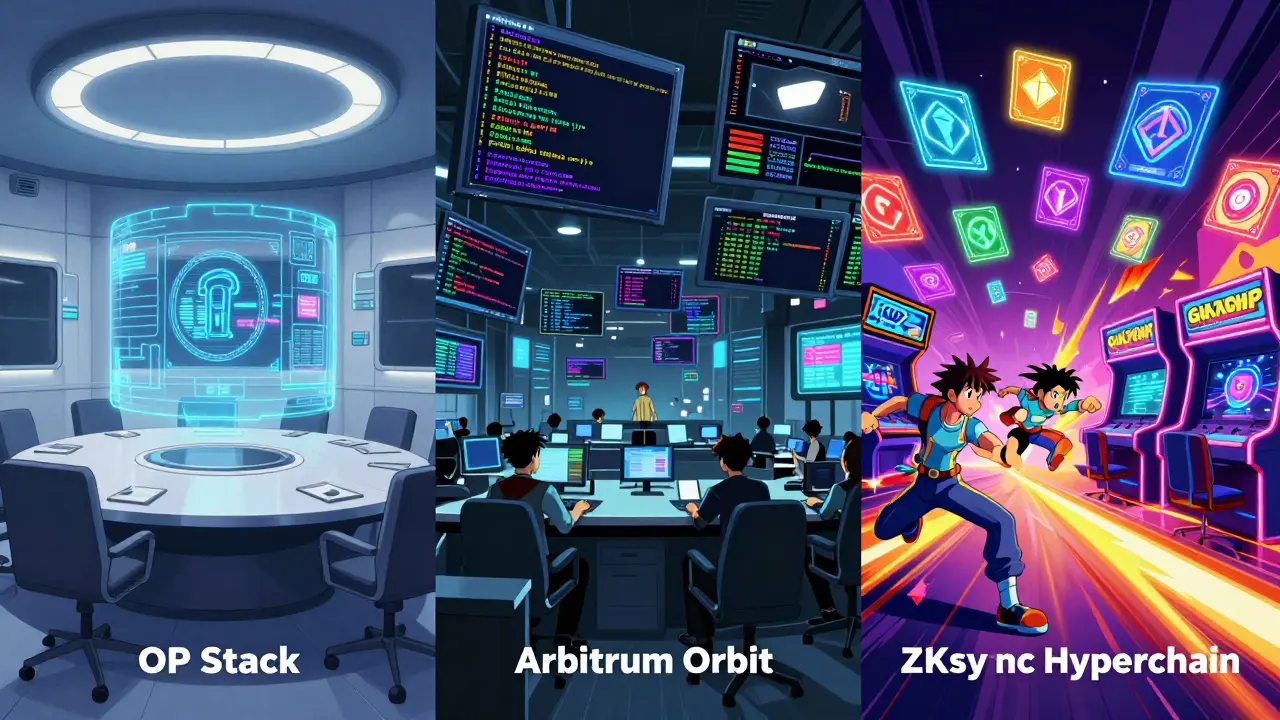
OP Stack is the current market leader, powering roughly 34% of all active rollups. It's a modular kit maintained by the Optimism Collective that lets you plug in different components like sequencers and fault proof systems. Because of its flexibility, it's the top choice for big companies-about 63% of Fortune 500 firms using blockchain prefer it. However, it's not a "set it and forget it" tool; running a custom OP Stack chain usually requires a dedicated engineering team, which can cost upwards of $750,000 a year in salaries.
Arbitrum Orbit is the DeFi powerhouse. With the Stylus upgrade launched in January 2025, Orbit chains aren't limited to Solidity. Developers can now write smart contracts in Rust and C++, making these chains about 3.2x faster for complex financial operations. This is why 7 of the top 10 DeFi protocols, including Aave and Uniswap, have flocked here. The downside? The 7-day challenge period for withdrawals can be a bit of a headache for users who want their funds instantly.
ZKsync Hyperchain is where gaming and NFTs live. Using zkEVM technology, it achieves 98.7% equivalence with the Ethereum Virtual Machine but offers much faster finality (3-7 minutes). If you're processing millions of NFT trades a day, like Immutable X does, this is the go-to. The trade-off is the hardware; the provers required for ZK rollups are beefy, often needing 128GB of RAM and 32 cores, which bumps up operational costs by about 40-60% compared to optimistic rollups.
Polygon CDK has carved out a massive niche in emerging markets, especially in Southeast Asia and Latin America. It's designed for low-cost infrastructure, with average transaction fees around $0.035. It's a lean, efficient system that allows for rapid deployment of zkEVM and zkProver variants.
| Framework | Best For | Avg. Transaction Cost | Deployment Cost (Approx) | Key Feature |
|---|---|---|---|---|
| OP Stack | Enterprise/General | $0.01 - $0.18 | 1.2 ETH | Modular Architecture |
| Arbitrum Orbit | DeFi/High Performance | $0.01 - $0.18 | 0.5 ETH | WASM Support (Rust/C++) |
| ZKsync Hyperchain | Gaming/NFTs | $0.01 - $0.18 | 2.3 ETH | Near-instant Finality |
| Polygon CDK | Emerging Markets | $0.035 | 1.8 ETH | Ultra-low Cost |
Rollup-as-a-Service (RaaS): No More Six-Week Deployments
In the past, launching your own rollup was a grueling 6-to-8-week engineering project. Now, we have Rollup-as-a-Service (RaaS), which turns blockchain deployment into something closer to launching a website on Shopify. Providers like Conduit have stripped away 92% of the technical complexity. You can now deploy a chain in under 15 minutes for a monthly subscription fee (around $299/month plus gas).
Then there are specialized needs. For example, if you're running a weekend gaming tournament or a flash NFT drop, you don't need a permanent chain. AltLayer offers "ephemeral chains." These are temporary, high-throughput environments that exist only as long as the event lasts. During the Duckchain NFT drop, this tech handled 1.2 million transactions in just 47 minutes without a single stutter.
While RaaS makes entry easy, there's a growing concern about centralization. Many of these "one-click" chains rely on a single sequencer node. If that node goes down or decides to censor a transaction, the chain stalls. This is why Taiko is gaining traction with its "based sequencing," where the sequencer runs directly on the Ethereum mainnet. It's more expensive (gas costs rise by about 18%), but it removes the single point of failure that plagues other RaaS options.
Choosing Your Path: A Practical Guide
Deciding which solution to use depends on your "job to be done." If you're a startup founder who needs to prove a concept by next Tuesday, go with a no-code platform like Asphere or Conduit. You'll be up and running in minutes, and the learning curve is now only a few weeks rather than months.
If you're building a professional DeFi protocol that needs to handle complex logic, Arbitrum Orbit's support for Rust via Stylus is a game-changer. You get the speed of WASM without losing the security of the Ethereum ecosystem. On the other hand, if you're building a game where players expect instant feedback when they mint an item, ZKsync's parallelized proving in Hyperchain v2.0 is your best bet, as it has slashed proof generation times by over 60%.
Keep an eye on the calendar. The upcoming Pectra upgrade in September 2025 is expected to boost rollup throughput by up to 35% by increasing validator balance limits. This means that whichever solution you pick today will likely get a free performance boost by the end of the year.
What is the difference between Optimistic and ZK rollups?
Optimistic rollups (like OP Stack and Arbitrum) assume transactions are valid and only check them if someone challenges a batch, which leads to a "challenge period" (often 7 days) before you can withdraw funds to mainnet. ZK rollups (like ZKsync and Polygon CDK) use mathematical proofs to prove validity instantly, meaning no challenge period and faster finality, though they require more computing power to generate those proofs.
Are RaaS providers safe to use for production?
For most startups, yes. They drastically reduce time-to-market. However, for high-value enterprises, the main risk is sequencer centralization. If your RaaS provider's sequencer fails, your chain stops. To mitigate this, look for providers moving toward decentralized sequencing or based sequencing models like Taiko.
How much does it actually cost to start my own rollup?
It varies wildly. Using a RaaS provider like Conduit can start at around $299/month. If you're deploying a standalone framework, the initial ETH cost ranges from 0.5 ETH for Arbitrum Orbit to 2.3 ETH for ZKsync Hyperchain, plus the ongoing cost of paying for data availability on Ethereum.
Can I write contracts in languages other than Solidity?
Yes, thanks to the Arbitrum Stylus upgrade. You can now use Rust and C++ on Orbit chains, which allows for much higher performance in complex calculations compared to traditional Solidity contracts.
Will rollups eventually replace the Ethereum mainnet?
Not replace, but they'll handle almost all the activity. The current trajectory suggests that by 2028, 95% of all transactions will happen on rollups, while the mainnet serves as the ultimate settlement layer and security provider.
Next Steps for Developers
If you're just starting out, don't try to build a rollup from scratch-it's a rabbit hole that takes months to master. Start with a RaaS provider to get your app logic working first. Focus on your dApp's user experience, as 78% of current job postings in this space care more about application logic than the underlying protocol.
If you're moving from a testnet to a production environment, audit your sequencer setup. If you're using a single-node sequencer for the sake of speed, have a backup plan for what happens if that node goes offline. As the ecosystem matures toward 2026, the focus is shifting from "how do we scale" to "how do we make these scales decentralized and interoperable."





Comments
Lela Singh
April 10, 2026 AT 09:55Absolute game changer! 🚀 The speed of these rollups is just electric and it's wildly exciting to see the barriers to entry crumbling for new devs!
Samson Selleck
April 10, 2026 AT 11:15The naive assumption that RaaS solves the bottleneck ignores the systemic fragility of centralized sequencers. One must analyze the trade-off between the ephemeral convenience of a Conduit-style deployment and the rigorous security guarantees of based sequencing. The current discourse lacks a sophisticated understanding of data availability layers and the precarious nature of the trust assumptions being made by these "one-click" enthusiasts.
Will Dixon
April 11, 2026 AT 14:07i think its cool how we can use rust now. makes it way easier for ppl who dont know solidity to get in the game.
jennelle williams
April 12, 2026 AT 19:46so much better than $50 gas fees
Rima Dinar
April 12, 2026 AT 20:58I really feel like the transition to these Layer 2 solutions is providing such a wonderful bridge for people who were previously intimidated by the cost of Ethereum, and it is so heartening to see how frameworks like Polygon CDK are specifically targeting emerging markets so that everyone, regardless of their economic background, can participate in the decentralized future we've all been dreaming about for years.
Alan Seiden
April 14, 2026 AT 04:52Typical American-centric optimism. Most of these "innovations" are simply precarious layers of complexity designed to mask the inherent inefficiency of the base layer. It is an embarrassment that we rely on such fragmented solutions rather than a proper, sovereign architecture.
Artavius Edmond
April 14, 2026 AT 10:22I'm with the folks who love the RaaS model, honestly! Just makes everything so much more accessible for the little guy starting a project. Total vibe shift for the industry.
daniella davis
April 16, 2026 AT 01:29Omg please, actully believeing that a 15 minute deploy is "enterprise grade" is just laughable. I've seen better architecture in a middle school project and the lack of focus on the actual security trade-offs here is just so typical of this whole trend lol.
ssjuul z
April 17, 2026 AT 11:06Let's keep the energy positive! The tools are evolving and that's a win for everyone. The modularity of the OP Stack is exactly what we need to scale. ⚡️
Hope Johnson
April 19, 2026 AT 08:13It is fascinating to consider whether the move toward these fragmented rollup ecosystems is merely a technical necessity or if it reflects a deeper philosophical shift in how we perceive ownership and trust in a digital space, as we move away from a single monolithic source of truth and toward a constellation of interconnected but sovereign layers that must somehow balance the paradox of decentralized security with the human desire for instantaneous gratification and seamless user experiences.
william manes
April 21, 2026 AT 06:24US tech is winning again! 🇺🇸 Keep it moving! 🚀💰
Heather Warren
April 22, 2026 AT 16:43I agree that starting with a RaaS provider is a great way to test your application logic before committing to a more complex infrastructure. It allows you to iterate quickly and find your product-market fit without getting bogged down in the technical weeds of sequencer setup.
Rebecca Violette
April 24, 2026 AT 12:04i just feel like no matter what we use the fees will just go back up and we'll all be broke again anyway lol why even try
Jason Davis
April 24, 2026 AT 23:28The Stylus upgrade is a massive win. Being able to use Rust means we can finally implement complex math for DeFi without it costing a fortune in gas or lagging the whole chain. Its a bit of a learning curve but totally worth it if your app needs real performance.
EDOZIEM MICHAEL
April 24, 2026 AT 23:29everything is just a flow of energy and these rollups are just the new river we swim in no need to overthink the tech just enjoy the ride
Swati Sharma
April 25, 2026 AT 13:14I think combining the zkEVM capabilities of Polygon CDK with a more decentralized sequencer would solve the trust issues while maintaining that high throughput and low latency that emerging markets require for real-world adoption of smart contracts.
Emily H
April 27, 2026 AT 01:03The distinction between optimistic and zero-knowledge rollups is explained with commendable clarity here. It is reassuring to see that the industry is moving toward more efficient finality without compromising the underlying security of the Ethereum mainnet.
Scott Fenton
April 27, 2026 AT 18:55I would suggest that developers carefully evaluate the hardware requirements for ZK rollups. While the finality is impressive, the operational overhead for provers is significant and may be prohibitive for smaller teams without substantial funding.
Terrance Hausmann
April 28, 2026 AT 17:08It really just comes down to what you're building and who you're building it for, which is why the diversity in these frameworks is so vital for the ecosystem to grow in a healthy way where no single entity has a monopoly on the scaling solution.
Lane Montgomery
April 29, 2026 AT 17:53Just use Conduit and stop overthinking.
Akshay Gorad
May 1, 2026 AT 16:44The comparison table is quite useful for a quick overview of the current landscape.
Agnessa Dale
May 3, 2026 AT 12:44It is so exciting to think about the Pectra upgrade in September! A 35% boost in throughput is going to make these apps feel even smoother for everyone.
logan bates
May 4, 2026 AT 15:40As long as it keeps the US competitive in the global tech race, I'm all for it.
aletheia wittman
May 6, 2026 AT 02:58can u imagine if the sequencer just crashes and we all lose our money omg i actually cant deal with that stress right now lollll