What is Polyhedra Network (ZKJ) Crypto Coin?
You have likely seen headlines about blockchains talking to each other. It sounds useful, but most bridges feel risky. Polyhedra Network tries to fix that fear by removing trust assumptions entirely.
Polyhedra Network is a blockchain infrastructure layer built on zero-knowledge proofs to secure connections between different digital ledgers. While many projects promise "interoperability," Polyhedra focuses specifically on cryptographic verification rather than relying on human operators or validator nodes to watch the transaction. Its native token, ZKJ, powers the network’s operations and allows holders to participate in governance.
The crypto market moves fast. As of early 2026, the technology behind Polyhedra has evolved significantly. You aren't just dealing with another speculative asset; you are looking at foundational software for how the internet of value connects. If you hold assets across multiple chains, understanding how this system works matters for your security.
The Problem With Standard Bridges
Most cross-chain bridges work like a bank transfer. You deposit funds on one chain, wait for a trusted middleman, and receive an equivalent asset on another chain. That middleman creates a single point of failure. If the validators get hacked, or if they decide to run away with funds, users lose everything.
History shows this isn't theoretical. High-profile hacks of bridge protocols have stolen hundreds of millions of dollars because the security relied on centralized keys. Polyhedra Network attacks this weakness directly. Instead of trusting a person or group, you trust mathematics.
Imagine trying to prove you are over 18 years old. In the traditional web, you show your physical ID card. This reveals your name, address, and birthday. A zero-knowledge proof changes that scenario. You generate a cryptographic receipt that says "I am over 18" without revealing any personal identity. Zero-Knowledge Proofs (ZKPs) act as this digital receipt mechanism within cryptography.
Understanding zkBridge Technology
The flagship product is the zkBridge. It functions differently from competitors like Wormhole or Multichain. Those networks often depend on an oracle network feeding data to the destination chain. Polyhedra generates a mathematical proof on the source chain that validates the state change.
| Feature | Traditional Bridge | Polyhedra zkBridge |
|---|---|---|
| Security Model | Multisig or Guardian Nodes | Cryptographic Proof Verification |
| Trust Assumption | Must trust validators | Trustless (Code verified) |
| Speed | Fast but centralization risk | Optimized via ZK compression |
| Privacy | Public transaction trails | Optional privacy features |
When you move tokens from Ethereum to a new chain, zkBridge verifies the original transaction mathematically. This means no third party holds your custody. Even if the operator controlling the bridge goes offline, the protocol continues to function based on the validity of the proofs generated.
This architecture supports not just tokens, but also messages and credentials. A user could theoretically prove ownership of a domain on one chain to unlock a service on another without exposing their wallet address. This capability expands beyond simple swapping into full Web3 interoperability.
ProofCloud and Scalability
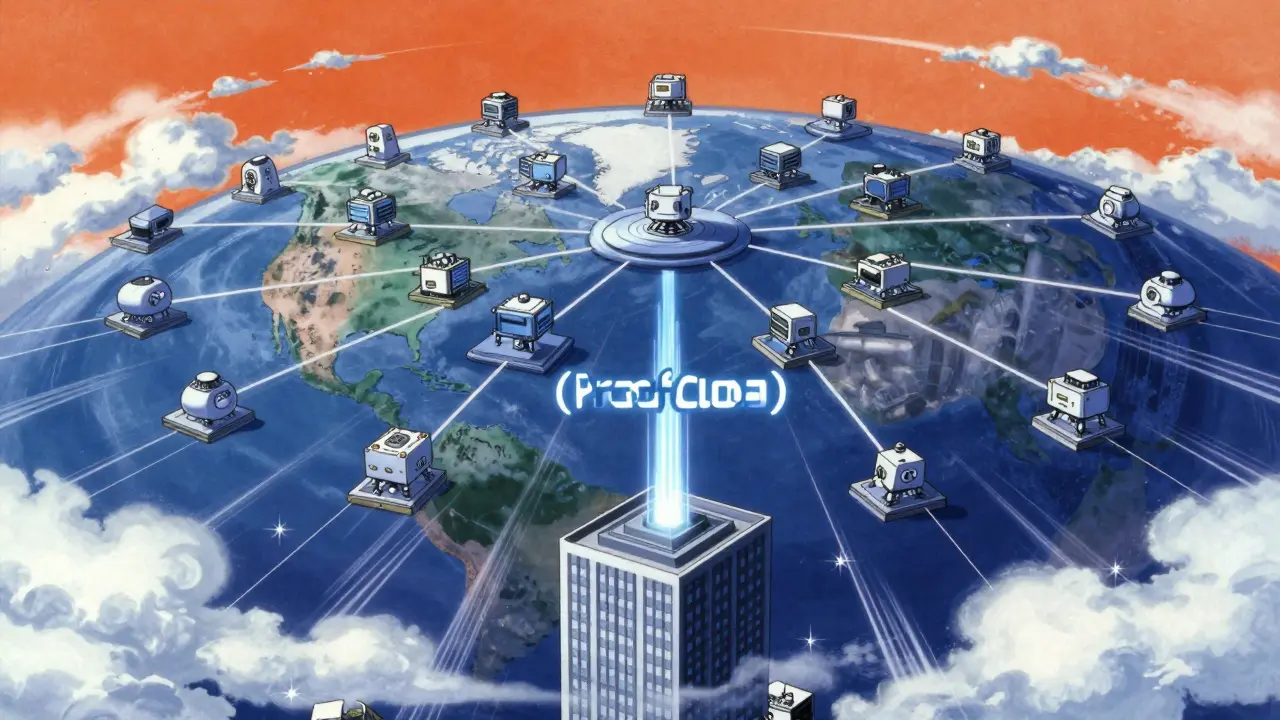
Interoperability is only half the battle. Blockchains also struggle with speed. Scaling solutions exist, but they can become bottlenecks themselves. ProofCloud is a decentralized network designed to solve this.
It essentially outsources the heavy computation required to generate zero-knowledge proofs. Without this cloud, every user would need their own powerful computer to create a proof. ProofCloud provides a marketplace where miners (called provers) compete to generate these proofs efficiently.
This helps applications scale. Imagine a popular game running on a ZK-Rollup. Every batch of transactions needs a proof. ProofCloud ensures those proofs are generated quickly so the game doesn't lag. It complements the bridge by ensuring the underlying chains can handle the volume coming through.
Tokenomics and ZKJ Utility
The ZKJ Token serves three primary purposes within the ecosystem. First, it covers transaction fees. Users pay fees to utilize the bridge and cloud services, keeping the network sustainable.
Second, it governs the platform. Holders vote on parameter changes, like fee rates or upgrades to the consensus logic. Third, staking rewards active participation. Unlike proof-of-work coins that require massive electricity, ZKJ utilizes a staking mechanism similar to Ethereum 2.0.
- Supply Cap: The maximum total supply is fixed at 1 billion tokens.
- Circulating Supply: As of late 2025, approximately 340 million to 370 million tokens were in circulation.
- Utility: Gas for operations, staking for security, voting power for protocol decisions.
Staking creates economic alignment. When you lock your tokens, you contribute to the security of the network. Longer lock periods generally yield higher returns. This incentivizes long-term holding rather than quick flipping.
Market Context and Volatility
You cannot ignore the risks when investing in smaller-cap infrastructure projects. Polyhedra Network has shown significant price swings. For instance, data from late 2025 showed a period where the price collapsed by over 90% in a short timeframe. While specific reasons vary, high-beta assets react strongly to macro sentiment shifts.
The market capitalization typically hovers in the tens of millions range, far below giants like Bitcoin or Ethereum. This positions it as a niche player in the grand scheme of things. However, niche does not mean useless. Many top-tier projects started exactly this way before scaling.
Investors often compare it to established infrastructure layers like Chainlink CCIP or LayerZero. Here, the differentiation is vital. Chainlink uses Oracle nodes (trusted sets), while Polyhedra pushes for pure math verification. If the industry shifts heavily toward regulatory scrutiny of "privacy tools," there is a risk. But the utility here isn't just hiding data; it's securing movement of data.
Future Outlook: Web2 Integration
The roadmap looks beyond just connecting crypto chains. There is a clear push toward Web2 integration. This involves proving real-world assets or off-chain data on-chain securely.
Imagine linking a digital certificate from a university hosted on the World Wide Web to a blockchain credential. Polyhedra's tech aims to facilitate this "real world asset" onboarding. As governments look to tokenize real estate or supply chain items, the infrastructure to prove ownership becomes critical.
This expansion means the user base grows from just crypto natives to traditional enterprises. If the company executes on partnerships with legacy systems, the demand for ZKJ tokens could outpace current expectations. Conversely, delays in adoption could leave the token stranded in the lower ranks of market listings.
Is ZKJ Worth Your Attention?
If you are building a dApp that requires cross-chain logic, Polyhedra offers a robust set of developer tools. If you are an investor, the narrative relies on the success of ZK-tech becoming the standard for security. It solves a genuine pain point-bridge hacks-but faces stiff competition from older protocols that have deeper liquidity.
Diversify your approach. Don't put everything into early-stage infrastructure tokens. Look at the technology stack first. Does the solution genuinely remove a security vulnerability? In this case, replacing custodial trust with cryptographic proof is a significant advancement in the space.




Comments
Lisa Walton
March 29, 2026 AT 06:08Oh great another zero knowledge project claiming security while everyone else gets hacked.
Addy Stearns
March 29, 2026 AT 15:40We live in an era where digital identity is fragmented.
Bridges represent the connective tissue of this new web.
Most solutions rely on faith rather than fact.
Human guardians introduce a point of failure that cannot be removed.
Mathematical proofs offer a different path forward entirely.
They remove the element of human discretion from the equation.
Trustless systems are the only way to achieve true sovereignty.
History teaches us that centralized intermediaries always fail eventually.
This protocol attempts to bypass that inevitable collapse.
The technology shifts the burden from people to mathematics.
Verification becomes automated and constant rather than periodic.
Security is baked into the state transition itself.
We see a move away from custodial models in infrastructure.
Interoperability requires robust standards to function safely.
ZKJ seems poised to lead that charge effectively.
Justin Garcia
March 30, 2026 AT 13:35You sound like you never invested in crypto during the crash and lost everything.
Alex Kuzmenko
March 31, 2026 AT 00:56I think this tech is super safe cause math doesnt lie unlike guys running nodes.
Michael Nadeau
March 31, 2026 AT 10:45The philosophical underpinning of verification without revelation is profound.
Leah Lara
March 31, 2026 AT 21:47Just another token hoping to get lucky in a bull run.
Disha Patil
April 1, 2026 AT 02:06Why does everyone ignore the risk that smart contracts still have bugs even with proofs.
Justin Smith
April 1, 2026 AT 16:14Your understanding of zero knowledge proofs is clearly lacking technical depth.
Zackary Hogeboom
April 2, 2026 AT 14:35I love how this expands beyond just swapping tokens into actual messaging.
Shubham Maurya
April 3, 2026 AT 19:48🚀🚀 Finally someone talking real security 🙌💯 Stop ignoring the innovation here 😤🔥
Ashley Stump
April 5, 2026 AT 16:17Deep state control of the ledger through false security narratives.
Markus Church
April 5, 2026 AT 21:46It is imperative to understand the distinction between privacy and security.
Cara Boyer
April 7, 2026 AT 03:25Thry know we are being watched by these crypto protocols :-( Beware the trap!
Raymond K
April 9, 2026 AT 02:19Keep grinding on learning these new things it really helps your portfolio growth :)
Jamie Riddell
April 10, 2026 AT 15:33lets all try to remain calm and look at the facts before getting scared
Tiffany Selchow
April 11, 2026 AT 15:54Probably another foreign scheme trying to undermine our dollar reserves.
athalia georgina
April 12, 2026 AT 22:50its so compicated i wish they would make it easier to understnad honestly
joshua kutcher
April 14, 2026 AT 14:55Its okay to feel overwhelmed by the technical details sometimes though.
Chris R
April 15, 2026 AT 21:55We need to remember the long term vision behind decentralized infrastructures.
Justin Smith
April 16, 2026 AT 22:43The supply cap mechanics actually favor long term holders significantly.