What is Joule (JOULE) Crypto Coin? Token Utility, Price & Risks Explained

Buying a cryptocurrency because the name sounds cool or scientific is a fast way to lose money. You might have seen Joule (JOULE) listed on an exchange and wondered if it’s the next big thing in decentralized finance. The problem? There is significant confusion surrounding this ticker symbol. When you search for "Joule," you are likely looking at two completely different projects that happen to share the same name and ticker: one built on the EOS blockchain focused on community referrals, and another called Kinetic Protocol running on the Flare Network.
If you’re holding JOULE tokens or thinking about buying them, you need to know exactly which version you’re interacting with. One is a lending utility token; the other is a referral-based social token. Mixing them up could lead to buying the wrong asset entirely. This guide breaks down both implementations, their actual use cases, current market reality as of mid-2026, and the risks involved.
The Two Faces of JOULE: A Tale of Two Tokens
In the crypto world, ticker collisions aren’t uncommon, but they are dangerous for investors. The JOULE ticker currently represents two distinct entities. Understanding the difference is your first job-to-be-done before clicking "buy."
1. Kinetic Protocol (Flare Network) This is the more technically complex project. Here, JOULE serves as the governance and utility token for Kinetic, a lending protocol. It lives on the Flare Network, a blockchain known for its ability to bring data from other chains into smart contracts. If you see JOULE trading against FLR (Flare’s native token) or USDT on decentralized exchanges like Blazeswap, you are likely looking at this version.
2. Joule Index (EOS Blockchain) This project operates on the EOS blockchain. It markets itself as a global community platform where users earn tokens through referrals and by participating in a "Global Popularity Index." This version focuses less on DeFi mechanics and more on a multi-level marketing-style growth model where users teach merchants to accept payments and refer new members.
Most major tracking platforms like CoinMarketCap and MEXC currently associate the JOULE ticker with the Kinetic Protocol on Flare. However, older data or specific regional exchanges might still list the EOS-based version. Always check the contract address. For the Flare-based JOULE, the contract address is typically 0xE6505f92583103AF7ed9974DEC451A7Af4e3A3bE. If the address doesn't match, you're not buying what you think you are.
Kinetic Protocol: How JOULE Works on Flare
Let’s look closer at the Kinetic implementation, as this is where most institutional interest lies. The core value proposition here isn’t just speculation; it’s utility within a lending ecosystem.
Kinetic allows users to lend and borrow assets. But here’s the twist: it uses Flare’s unique technology stack to handle assets that don’t natively exist on the Flare chain. Think about Bitcoin (BTC), Dogecoin (DOGE), or XRP. These tokens live on their own blockchains. Normally, you can’t easily use them as collateral in a loan on a different network without wrapping them through complex bridges.
Kinetic solves this using two key technologies:
- FTSO (Flare Time Series Oracle): This provides accurate, decentralized price feeds. It ensures that the value of your BTC collateral is updated in real-time, preventing manipulation.
- FAssets: This technology enables the representation of non-native tokens on Flare. It allows the protocol to recognize and lock value from external chains securely.
In this system, JOULE acts as the governance token. Holders can vote on protocol parameters, such as interest rates or supported assets. It also functions as a utility token, potentially used for fee discounts or staking to secure the network. The goal is to create a decentralized financial primitive that lets you leverage the value of your Bitcoin or Dogecoin without selling it, all while staying within the security bounds of the Flare ecosystem.
| Feature | Kinetic (Flare Network) | Joule Index (EOS) |
|---|---|---|
| Primary Function | Lending/Borrowing Governance | Referral Rewards & Social Index |
| Blockchain | Flare Network | EOS |
| Key Technology | FTSO Oracles, FAssets | Multi-level Referral System |
| User Activity | Providing liquidity, borrowing | Teaching merchants, referring users |
| Risk Profile | Smart Contract Risk, Market Volatility | Ponzi-like Structure Concerns, Low Liquidity |
Joule Index: The EOS-Based Community Model
The second iteration, Joule Index, takes a very different approach. Built on EOS, it emphasizes human interaction over code complexity. The platform claims to offer practical ways to earn tokens backed by Bitcoin reserves, though the mechanics are heavily tied to user acquisition.
Here’s how the earning model works:
- Merchant Onboarding: Users teach local merchants to accept JOULE as payment. In return, they earn a fraction (1/10th) of the transaction fees generated by those merchants.
- Referral Commissions: If you refer someone who then refers others, you earn commissions. Specifically, you get 1/5th of the 2% transaction fee from your direct referrals’ activities.
- Global Popularity Index: Users trade on the popularity levels of public figures. Traders take long or short positions, creating a real-time global consensus on fame. Participants earn fees based on these trades.
While this sounds accessible, it carries significant red flags. The income generation relies entirely on active trading and continuous recruitment. The platform explicitly states that commissions are not automatic money-making schemes but rewards for promoting the technology. However, the structure resembles multi-level marketing (MLM). If new user growth stalls, the flow of transaction fees-and thus the rewards-dries up. Additionally, the claim of being "backed by Bitcoin reserves" requires careful verification of audits, which are often scarce in such niche projects.
Market Reality: Price, Volume, and Volatility
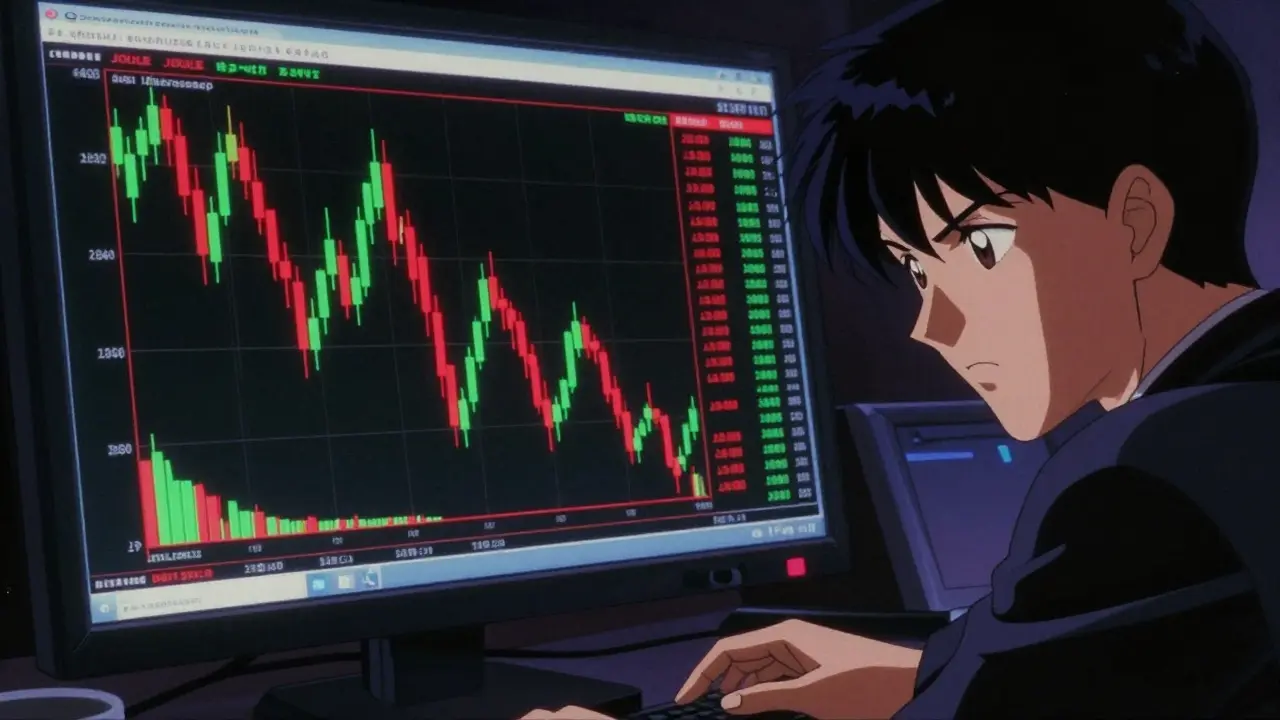
Let’s talk numbers. As of June 2026, the JOULE token has experienced extreme volatility. This is typical for low-cap altcoins, but the magnitude here is staggering.
The token hit an all-time high (ATH) of approximately $0.067 USD in late 2024. Since then, it has crashed by over 99%, trading in the fractions of a cent. Recent data shows prices hovering around $0.0005 to $0.0006 USD. While this looks terrible compared to the peak, it represents a massive recovery from its all-time low of $0.000046 USD in November 2025-a gain of nearly 974% from that bottom.
However, don’t let the percentage gain fool you. We are talking about tiny absolute values. The market capitalization is negligible, ranking JOULE outside the top 5,000 cryptocurrencies. Daily trading volume is often below $1,000 USD across all pairs. This indicates extremely low liquidity.
Low liquidity means two things:
- Slippage: If you try to sell a large amount of JOULE, you could crash the price significantly because there aren’t enough buyers.
- Manipulation Risk: With thin order books, it’s easier for whales to pump or dump the price artificially.
Trading pairs are primarily found on decentralized exchanges (DEXs) like SparkDEX v3 and Blazeswap on the Flare network. You won’t find JOULE on major centralized exchanges like Coinbase or Binance. This limits accessibility and adds another layer of risk for average investors.
Key Risks You Must Understand
Before you allocate even a small portion of your portfolio to JOULE, consider these critical risks:
- Identity Confusion: The biggest risk is buying the wrong token. Ensure you are connecting to the correct contract address on the right network (Flare vs. EOS).
- Smart Contract Vulnerabilities: Both projects rely on smart contracts. If there is a bug in Kinetic’s lending logic or Joule Index’s referral calculator, funds could be lost. Audits from reputable firms are essential but often missing or outdated for smaller projects.
- Regulatory Uncertainty: Projects with referral-based income models (like Joule Index) often attract scrutiny from regulators who may classify them as unregistered securities or pyramid schemes. Lending protocols (like Kinetic) face regulatory pressure regarding interest-bearing products.
- Project Longevity: The 99% drop from ATH suggests that early hype has faded. Without strong adoption metrics (Total Value Locked for Kinetic, active merchant count for Joule Index), the project may struggle to survive long-term.

How to Verify What You Are Buying
To protect yourself, follow these steps:
- Check the Contract Address: Copy the official contract address from the project’s verified website or GitHub. Paste it into a block explorer (like FlareScan or Etherscan for EOS) to verify the token details.
- Analyze Liquidity: Look at the depth of the order book on DEXs. If you can’t buy or sell $100 worth without moving the price by 5% or more, proceed with caution.
- Read the Whitepaper: Don’t just skim the marketing page. Read the technical documentation. For Kinetic, understand how FAssets work. For Joule Index, understand the exact commission structure.
- Monitor Community Sentiment: Join their Discord or Telegram. Are developers answering technical questions? Or is it just people posting screenshots of profits? The latter is a bad sign.
Final Thoughts on JOULE
Joule (JOULE) is not a blue-chip cryptocurrency. It’s a high-risk, speculative asset split between two very different experimental models. The Kinetic protocol on Flare offers genuine technological innovation in cross-chain lending, which could be valuable if DeFi adoption grows. The Joule Index on EOS offers a controversial social-commerce model that depends heavily on continuous user growth.
If you’re interested in decentralized finance, Kinetic’s integration with Flare’s oracle technology is worth studying as a case study in interoperability. If you’re looking for passive income, be extremely wary of the referral-based promises of the EOS version. Never invest more than you can afford to lose, and always double-check that you’re interacting with the correct contract. In crypto, ambiguity is usually a warning sign, not a feature.
Is JOULE coin safe to buy?
Safety depends on which JOULE token you mean. The Kinetic protocol on Flare involves smart contract risks, while the Joule Index on EOS has structural risks similar to MLM schemes. Both have low liquidity and high volatility, making them unsuitable for conservative investors. Always verify the contract address before purchasing.
What is the difference between Kinetic and Joule Index?
Kinetic is a DeFi lending protocol on the Flare Network that uses JOULE for governance and utility in cross-chain loans. Joule Index is a community platform on the EOS blockchain that rewards users for referring members and teaching merchants to accept payments. They are separate projects with different goals and technologies.
Where can I buy JOULE tokens?
JOULE is primarily traded on decentralized exchanges (DEXs). For the Flare-based token, you can find it on Blazeswap and SparkDEX v3. You will need a wallet compatible with the Flare Network or EOS, depending on which version you want. It is generally not available on major centralized exchanges like Coinbase.
Why did JOULE price drop so much?
Like many altcoins, JOULE experienced a significant correction after its initial hype cycle. It dropped over 99% from its all-time high due to broader market downturns, low liquidity, and potentially shifting investor interest away from niche referral-based or early-stage DeFi projects. The recent recovery from lows reflects speculative trading rather than fundamental stability.
Does JOULE have any real-world utility?
Yes, but it varies by implementation. Kinetic’s JOULE has utility in governing a lending protocol that enables borrowing against non-native assets like Bitcoin on the Flare Network. Joule Index’s JOULE is used for transactions within its merchant network and for trading on its Global Popularity Index. Neither has widespread mainstream adoption yet.