What is EthereumPoW (ETHW) crypto coin?
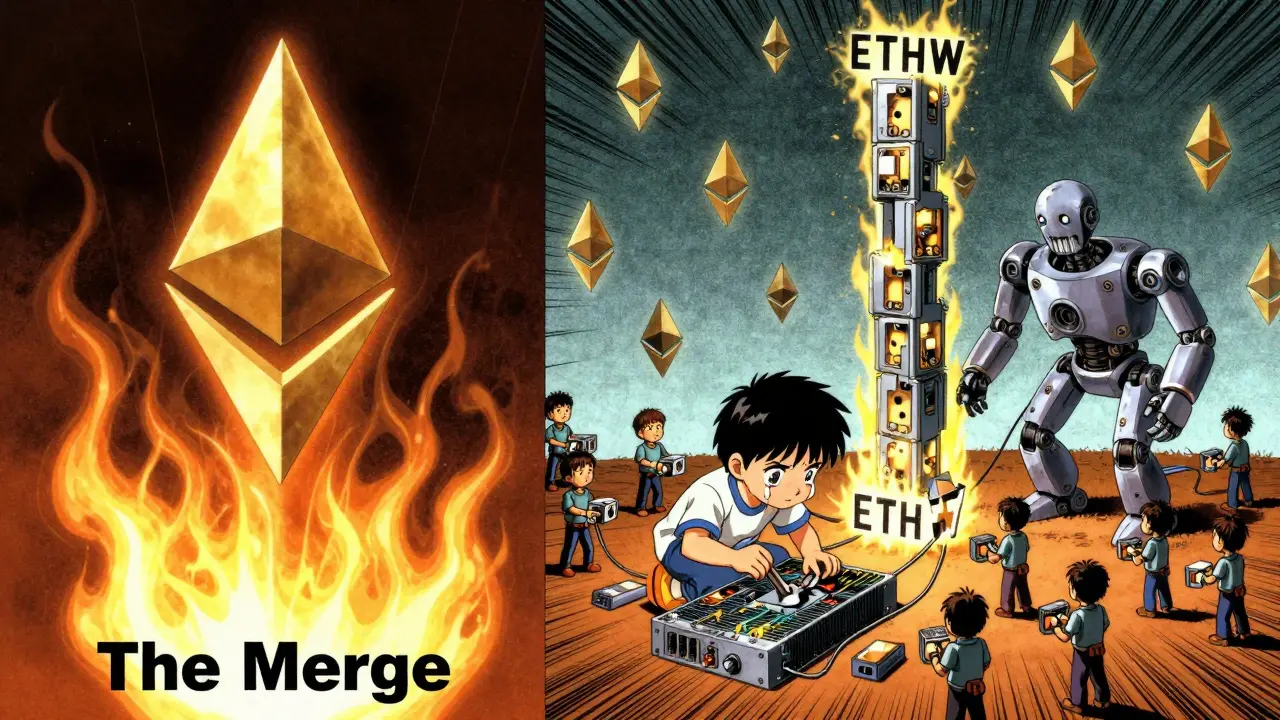
EthereumPoW (ETHW) isn't just another cryptocurrency. It's a direct result of one of the biggest shifts in crypto history - when Ethereum abandoned mining forever. On September 15, 2022, Ethereum completed The Merge, switching from proof-of-work to proof-of-stake. For millions of miners who had spent thousands on GPUs, this was a disaster. Their rigs suddenly became useless. That’s when EthereumPoW was born - a community-driven fork designed to keep Ethereum’s original mining system alive.
Why EthereumPoW Exists
Before The Merge, Ethereum was mined using GPUs. Miners around the world ran rigs with NVIDIA and AMD cards, securing the network and earning rewards. When Ethereum moved to proof-of-stake, those miners lost their income. No more block rewards. No more transaction fees. Just silence. ETHW stepped in to give them a lifeline. It wasn’t created by a big company or a VC. It was built by miners - led by figures like Chandler Guo and backed by mining pools like Flexpool and 2Miners. The fork happened exactly at Ethereum block 15,537,393. Every transaction, every smart contract, every wallet address from before The Merge was copied over. ETHW didn’t try to reinvent Ethereum. It just kept it running as it was - proof-of-work, GPU-minable, and open to anyone with a decent graphics card.How ETHW Works
ETHW uses the same Ethash algorithm as pre-Merge Ethereum. That means you still need a powerful GPU to mine it. ASICs aren’t the main players here - unlike Bitcoin, where ASICs dominate, ETHW is still friendly to individual miners. A single NVIDIA RTX 3080 or better can still earn rewards, though profitability depends heavily on electricity costs. The block time is still around 13-15 seconds, just like old Ethereum. Block rewards are 2 ETHW per block, plus whatever transaction fees are attached. As of early 2024, the circulating supply sits at about 107.8 million ETHW. That’s less than Ethereum’s original supply because some ETH that got staked during The Merge couldn’t be claimed on the PoW chain. Gas fees on ETHW are incredibly low - averaging just 5 Gwei. Compare that to Ethereum’s 20-50 Gwei, and you’ll see why some developers still use it for cheap testing or low-value dApps. Transaction speeds are slower, though. While Ethereum confirms in 15 seconds, ETHW often takes 45 seconds or more, especially during spikes in usage.How ETHW Compares to Ethereum and Ethereum Classic
It’s easy to confuse ETHW with Ethereum Classic (ETC). Both are proof-of-work forks of Ethereum, but they’re not the same. Ethereum Classic has a fixed supply cap of 210 million ETC and has been around since 2016, after the DAO hack. It’s more stable, with higher hashrate (12 TH/s vs ETHW’s 1.2 TH/s) and way more dApps - over 100 active ones, compared to ETHW’s 12. ETC also has stronger exchange support and more developer activity. Ethereum, on the other hand, is now a proof-of-stake chain. You can’t mine it anymore. To participate, you need to stake 32 ETH. That’s expensive and centralized - most staking happens through centralized exchanges. ETHW’s whole point is to avoid that. It keeps mining decentralized. Here’s a quick comparison:| Feature | EthereumPoW (ETHW) | Ethereum (ETH) | Ethereum Classic (ETC) |
|---|---|---|---|
| Consensus | Proof-of-Work | Proof-of-Stake | Proof-of-Work |
| Block Time | 13-15 seconds | 12-14 seconds | 13-15 seconds |
| Block Reward | 2 ETHW | 0 ETH (staking rewards only) | 2.56 ETC |
| Gas Fee (avg) | 5 Gwei | 20-50 Gwei | 8 Gwei |
| Hashrate | 1.2 TH/s | ~1,000 TH/s | 12 TH/s |
| Active dApps | 12 | 5,800+ | 100+ |
| Market Cap (Q2 2024) | $105M | $412B | $5.8B |
Who Uses ETHW and Why
Most ETHW holders are miners. According to Nansen analytics, 82% of ETHW addresses belong to mining pools or individual miners. That’s not surprising - the coin exists to serve them. There’s very little institutional or enterprise use. No major DeFi protocols, no NFT marketplaces, no Web3 apps are built on it. Some people still mine ETHW because:- They already own GPU rigs and don’t want to sell them at a loss.
- They believe in decentralized mining as a check against centralized control.
- They use it to test smart contracts cheaply - low fees make it ideal for experimentation.
Problems and Risks
ETHW faces serious challenges:- Low security: With only 1.2 TH/s hashrate, it’s vulnerable to 51% attacks. Ethereum Classic has 10x more. A single mining pool could theoretically take over.
- Limited adoption: Only 12 dApps are active. No major wallets or DeFi platforms support it natively.
- Exchange instability: BingX, the most active exchange for ETHW, has delisted it without warning. Users report sudden liquidity drops and withdrawal delays.
- Declining miner base: Monthly active addresses dropped from 1.2 million in late 2022 to 87,000 in mid-2024. The network is shrinking.
- No innovation: ETHW can’t upgrade without consensus. Unlike Ethereum, which evolves constantly, ETHW is stuck in 2022. Even EIP-1559 (a fee-burning upgrade) is delayed.

Can You Mine ETHW Today?
Technically, yes. But should you? If you already have a GPU mining rig sitting idle, and your electricity is cheap, you might still make a little money. But don’t buy new hardware hoping to profit. The ROI is negative for most setups. Even with top-tier GPUs like the RTX 4090, you’d need to mine for over a year just to cover the cost of the card - assuming prices don’t drop further. Setting up a wallet is easy. Just add the ETHW RPC endpoint (https://mainnet.ethereumpow.org) to MetaMask. You can send, receive, and even interact with the few dApps that still run on it. But don’t expect DeFi yields or NFT trading. The ecosystem is barely alive.
The Future of ETHW
The outlook isn’t promising. Galaxy Digital predicts ETHW has only a 35% chance of surviving past 2026. Outlier Ventures called its future “insurmountably challenging.” It’s not that ETHW is broken. It’s that it has no reason to exist anymore. Ethereum’s move to proof-of-stake wasn’t just technical - it was economic. The value shifted. Miners lost their market. ETHW is a monument to a past that’s over. Some will keep mining it out of loyalty. Others will use it as a test network. But unless something drastic changes - a new use case, a major partnership, a price surge - ETHW will keep fading. It’s a ghost chain, running on borrowed time.Final Thoughts
EthereumPoW isn’t a competitor to Ethereum. It’s a relic. A protest. A last stand for decentralized mining. If you’re a miner who lost everything in The Merge, ETHW might still feel meaningful. If you’re an investor looking for growth, it’s a trap. It’s a fascinating experiment in digital resilience - but resilience alone doesn’t create value. ETHW proves that even the most technically perfect fork can die if the world moves on without it.Is EthereumPoW (ETHW) still being mined?
Yes, ETHW is still being mined, but the number of active miners has dropped sharply since 2022. As of mid-2024, the network’s hashrate is around 1.2 TH/s, down from over 1.8 TH/s in late 2022. Mining profitability is extremely low, requiring cheap electricity (under $0.07/kWh) and modern GPUs to break even. Most miners have switched to other coins or shut down their rigs entirely.
Can I use ETHW with MetaMask?
Yes, you can use ETHW with MetaMask. Simply add the EthereumPoW network manually using the RPC URL: https://mainnet.ethereumpow.org. Set the chain ID to 10001, symbol to ETHW, and block explorer to https://ethw.blockscout.com. Once configured, you can send, receive, and interact with ETHW-compatible dApps. However, most DeFi platforms and NFT marketplaces don’t support it.
How is ETHW different from Ethereum Classic (ETC)?
Both ETHW and ETC are proof-of-work forks of Ethereum, but they have different origins and goals. ETHW is a direct fork of Ethereum right after The Merge, preserving the pre-Merge state. ETC dates back to 2016 after the DAO hack and has its own development path. ETC has a higher hashrate, more dApps, a larger market cap, and better exchange support. ETHW’s only unique feature is its direct link to Ethereum’s post-2022 history - but that’s fading fast.
Is ETHW a good investment?
As an investment, ETHW is extremely risky. Its market cap is under $110 million, and its price has dropped over 95% since its peak in late 2022. There’s no institutional adoption, minimal developer activity, and declining mining rewards. It’s not a growth asset - it’s a niche project for miners. Only consider buying ETHW if you understand it’s a speculative bet on a dying ecosystem, not a long-term value play.
Why did Ethereum abandon proof-of-work?
Ethereum moved to proof-of-stake to solve three major problems: energy use, centralization, and scalability. Proof-of-work mining consumed more electricity than entire countries, and mining was becoming dominated by large pools and ASIC manufacturers. Proof-of-stake reduced energy use by over 99%, allowed more people to participate (with just 32 ETH), and paved the way for future upgrades like sharding. The Merge was a strategic decision to make Ethereum more sustainable and scalable - even if it left miners behind.




Comments
PIYUSH KOTANGALE
March 11, 2026 AT 15:49ETHW is basically the last standing campfire of decentralized mining. 🥹 I respect the grit, but let’s be real - no one’s getting rich here anymore.
ann neumann
March 13, 2026 AT 07:57This isn’t just about mining - it’s about control. They took away our rigs and our freedom. They said it was for the planet, but who really benefits? Big exchanges. Big staking pools. Big banks. ETHW is the only thing keeping the soul of crypto alive. They don’t want you to know this. They don’t want you to mine. They want you to trust. And trust is just another word for control.
Lindsay Girvan
March 13, 2026 AT 19:57Lol at people still mining ETHW. You’re paying to run a toaster that only makes toast once a week.
Anshita Koul
March 14, 2026 AT 00:06I remember the night of The Merge... I sat there, staring at my 3080s, wondering if I’d ever see a return. ETHW didn’t just save my hardware - it saved my dignity. Mining isn’t about profit anymore. It’s about principle. And yes, I still mine. Even if I lose $5 a day. I’m not giving up. Not to them.
Mara Alves Mariano
March 15, 2026 AT 21:48America built the internet. China built the chips. Europe built the rules. And who’s left mining ETHW? Indians. And you wonder why this coin’s dead? It’s not the tech - it’s the people. No big players. No vision. Just a bunch of guys with overheated GPUs and too much time.
Tina Keller
March 16, 2026 AT 07:01I used to run a 6-GPU rig. Now I keep one idle just to stay connected. ETHW isn’t profitable - it’s a ritual. Like tending a grave. But hey, if you’ve got spare electricity and no other use for your GPU, why not? It’s cheaper than therapy.
Zephora Zonum
March 17, 2026 AT 02:16The fact that people still think ETHW has any value is a joke. ETC has 10x the hashrate, 10x the dApps, and 50x the liquidity. ETHW is a ghost town with a blockchain. You’re not preserving decentralization - you’re preserving irrelevance. Get over it.
Tom Jewell
March 17, 2026 AT 03:57There’s something poetic about ETHW. It’s like a folk song sung in a language everyone forgot. No one’s listening anymore. But the singer still sings. Not for fame. Not for coins. Just because the song had meaning once. And maybe - just maybe - someone out there still remembers.
Anthony Marshall
March 17, 2026 AT 17:29Stop acting like ETHW is a revolution. It’s a nostalgia trip. If you want real decentralization, mine Monero. Or even Ravencoin. ETHW is just Ethereum’s corpse with a battery pack. Wake up. The future isn’t in your garage rig.
vasantharaj Rajagopal
March 17, 2026 AT 20:01From a technical standpoint, the Ethash algorithm remains intact, and the fork’s consensus mechanism is functionally equivalent to pre-merge Ethereum. However, the economic incentives are non-optimal due to reduced network security and liquidity constraints. The marginal utility of mining ETHW is negative for most participants under standard electricity cost assumptions.
Grace van Gent-Korver
March 19, 2026 AT 06:01I just moved to the US from India. My dad still mines ETHW. He says it’s like keeping his old motorcycle running - doesn’t make sense, but it feels right. I don’t get it. But I love him for it.
William Montgomery
March 20, 2026 AT 22:55If you’re still mining ETHW, you’re either delusional or a martyr. Either way, stop pretending this is a smart choice. You’re not saving crypto. You’re just wasting electricity and time.
vishnu mr
March 21, 2026 AT 16:11ethw is still alive? i thought it died last year 😅 i got a 3070 sitting in my room still... maybe i should try again? anyone have the rpc link? i forgot lol
Allison Davis
March 22, 2026 AT 20:15For anyone still mining: use NiceHash or Hiveon to auto-switch to the most profitable coin. ETHW should be a fallback, not a primary. Your rig’s lifespan is finite - don’t burn it out for a ghost chain.
karan narware
March 24, 2026 AT 04:47So... you’re telling me that after all this, the last stand of decentralization is being held by a bunch of guys in India, using electricity cheaper than their morning chai? How poetic. And how tragic.
Adam Ashworth
March 25, 2026 AT 09:14I used to think ETHW was a joke. Then I met a miner in Pune who said, ‘I don’t mine for money. I mine because I still believe in the dream.’ I shut up. And I still check the chain every week. Just in case.