What is DOJO Protocol (DOAI)? A Guide to the Solana AI & DePIN Token

Artificial intelligence needs massive computing power, and big tech companies currently hoard most of it. That bottleneck is exactly what DOJO Protocol aims to fix. Launched on July 29, 2024, this project sits at the intersection of two booming crypto trends: AI infrastructure and Decentralized Physical Infrastructure Networks (DePIN). Built on the Solana blockchain, DOJO Protocol creates a marketplace where anyone with spare GPU power can rent it out to AI developers, while data providers can monetize their information securely.
The native fuel for this ecosystem is the DOAI token. If you are wondering whether this is just another hype-driven coin or a legitimate piece of infrastructure, the answer lies in its architecture. Unlike traditional cloud providers that charge premium rates, DOJO attempts to democratize access to high-performance computing by incentivizing hardware owners directly. However, like many early-stage projects in this sector, it comes with significant volatility and execution risks that you need to understand before diving in.
How DOJO Protocol Works
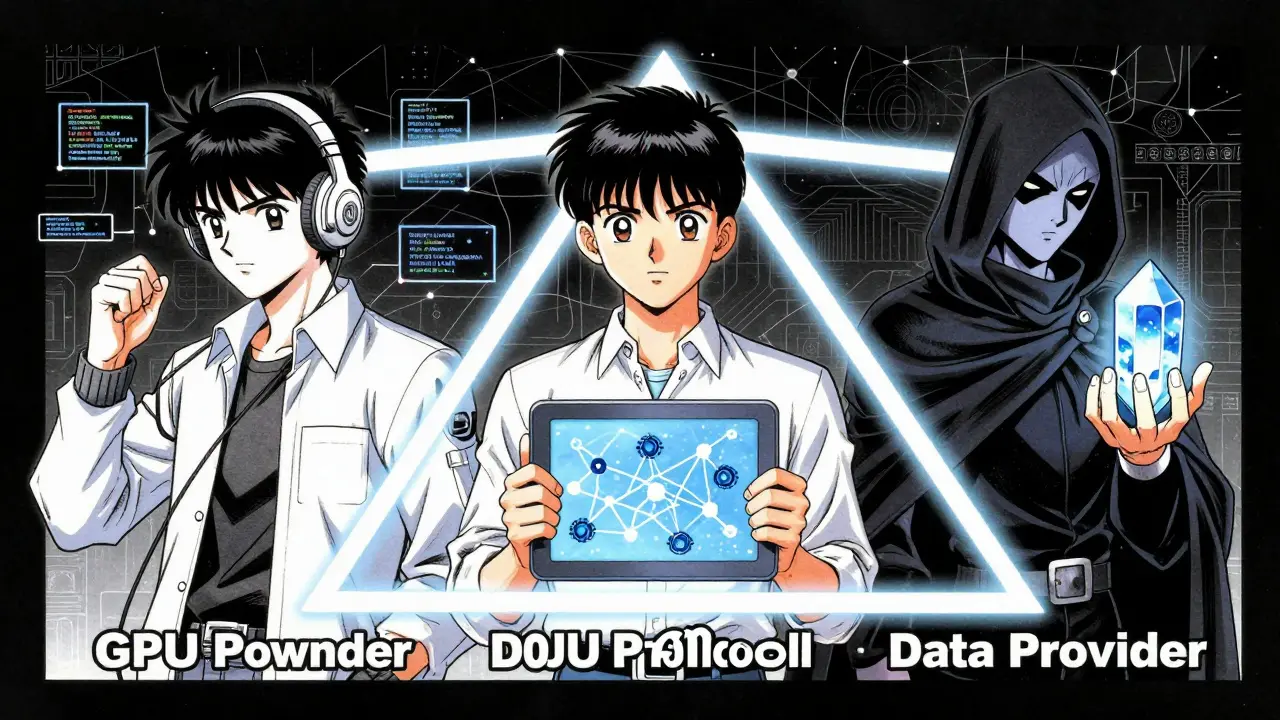
To understand DOJO, you have to look past the buzzwords and see the actual mechanics. The protocol operates as a decentralized hub connecting three main groups: AI developers who need compute power, GPU owners who have idle hardware, and data providers who hold valuable datasets. Instead of relying on centralized servers from giants like AWS or Google Cloud, DOJO uses blockchain smart contracts to facilitate these transactions transparently.
The core technology relies on an "intent-centric" approach. This means users specify what they want to achieve-such as training a specific neural network model-and the network automatically routes that task to available GPUs. This system boosts efficiency because it doesn't require manual matchmaking between buyers and sellers. The entire process happens on Solana, which provides the necessary speed and low transaction fees to handle frequent micro-transactions between participants.
Key Components of the Ecosystem
DOJO Protocol isn't just one app; it's a suite of tools designed to support the full lifecycle of AI development. Here is how the main components break down:
- DojoGPU: This is the decentralized platform for renting out GPU power. If you own a graphics card, you can contribute your resources to the network. In exchange, you earn DOAI tokens. It works similarly to other DePIN projects but focuses specifically on AI training workloads rather than general rendering.
- Data Economy App: Data is the new oil for AI, but it’s often siloed or expensive. This application allows users to trade and monetize AI-grade data. Providers can sell datasets, labeling efforts, or model outputs directly to developers using DOAI tokens.
- DojoVPN: Security and privacy are critical when handling sensitive AI models and data. DojoVPN provides secure, private access to the network. Users pay for enhanced services with DOAI tokens, ensuring that all transactions remain transparent yet tamper-proof.
Tokenomics and Supply Details
The economics of any crypto project dictate its long-term viability. For DOJO Protocol, the native asset is the DOAI token. Understanding its supply dynamics is crucial for assessing potential value changes.
The maximum supply of DOAI is hard-capped at 1,000,000,000 (1 billion) tokens. There is no inflationary mechanism beyond this limit. However, the circulating supply has varied significantly depending on the date and data source. Early reports in late 2024 showed a circulating supply around 26 million DOAI, while later snapshots from mid-2025 indicated figures closer to 835 million DOAI. This rapid increase suggests aggressive token emissions, unlocks, or liquidity injections during the project's growth phase.
| Attribute | Value |
|---|---|
| Max Supply | 1,000,000,000 DOAI |
| Circulating Supply (Mid-2025 Estimate) | ~835,560,000 DOAI |
| All-Time High Price | $0.03607 |
| Network | Solana |
It is important to note that detailed vesting schedules for team allocations, investors, and ecosystem funds have not been widely disclosed in public summaries. This lack of transparency regarding token distribution is a common risk factor in early-stage crypto projects.
Market Performance and Volatility
If you are looking at DOAI from a trading perspective, prepare for extreme volatility. The token reached an all-time high of approximately $0.03607 shortly after its launch. However, prices in the crypto space can swing wildly, especially for smaller-cap assets.
By mid-2025, spot prices reported by various exchanges dropped significantly, hovering around $0.0000107 to $0.0000109. This represents a drawdown of over 99% from its peak. More concerning than the price drop itself is the liquidity situation. At certain points, 24-hour trading volume fell to single-digit USD values (e.g., $5.40 on some platforms). Low liquidity means you might struggle to sell large amounts of DOAI without crashing the price further. Always check real-time depth charts on exchanges like KuCoin, Gate.io, or Raydium before entering a position.
DOJO vs. Competitors in the AI Crypto Space
You won’t find DOJO operating in a vacuum. The market for decentralized AI infrastructure is crowded. How does it stack up against established players?
| Project | Primary Focus | Base Chain | Key Differentiator |
|---|---|---|---|
| DOJO Protocol | AI Training & Data Monetization | Solana | Integrated Data Economy App + VPN |
| Render Network (RNDR) | GPU Rendering & AI | Ethereum/Solana | Strong enterprise adoption in graphics |
| io.net | Distributed GPU Clusters | Solana | Focus on aggregating heterogeneous GPUs |
| Akash Network (AKT) | Decentralized Cloud Compute | Cosmos | General-purpose cloud marketplace |
| Bittensor (TAO) | Machine Learning Subnets | Substrate | Incentivizes model output quality |
While Render and Akash have larger market caps and more extensive technical documentation, DOJO differentiates itself by combining compute leasing with a dedicated data marketplace and privacy layer (DojoVPN) all within the Solana ecosystem. This "all-in-one" approach could be appealing if executed well, but it also increases the complexity of the project compared to specialized competitors.
Risks and Considerations
No investment is without risk, and DOJO Protocol presents several red flags that require careful consideration:
- Lack of Audits: As of late 2024 and into 2025, there were no widely cited independent security audits from firms like CertiK or Trail of Bits. For a protocol handling financial transactions and potentially sensitive data, this is a significant gap.
- Anonymous Team: The founding team remains largely pseudonymous or semi-anonymous. While common in crypto, it reduces accountability compared to projects with publicly named founders and legal entities.
- Low Liquidity: With trading volumes sometimes dipping below $10 per day on certain venues, exiting positions quickly can be difficult and costly due to slippage.
- Regulatory Uncertainty: Like most utility tokens, DOAI faces unclear regulatory status in jurisdictions like the US and EU. Future regulations could impact its availability on exchanges.
How to Get Started with DOAI
If you decide to participate in the DOJO ecosystem, here is the practical path forward:
Acquiring DOAI Tokens: You can buy DOAI on centralized exchanges such as KuCoin, Gate.io, or MEXC. These platforms typically require KYC (Know Your Customer) verification. Alternatively, you can use decentralized exchanges (DEXs) on Solana, such as Raydium. To do this, you’ll need a Solana-compatible wallet like Phantom or Solflare, funded with SOL to cover transaction fees.
Providing GPU Power: If you want to earn DOAI by contributing compute, you will need to run the DojoGPU client software. Specific hardware requirements (like minimum VRAM or CUDA cores) haven't been extensively detailed in public marketing materials, so check the official documentation for compatibility guides before setting up your node.
Using the Services: Once you hold DOAI, you can use it to pay for GPU leases via DojoGPU, purchase privacy features on DojoVPN, or trade datasets on the Data Economy App. Keep in mind that the maturity of these applications varies, and user interfaces may still be under active development.
Is DOJO Protocol a safe investment?
Like any early-stage cryptocurrency, DOJO Protocol carries high risk. Factors such as low liquidity, lack of independent security audits, and extreme price volatility make it speculative. Only invest what you can afford to lose, and always conduct your own research.
What is the difference between DOJO Protocol and Render Network?
Render Network focuses heavily on GPU rendering for graphics and visual effects, though it is expanding into AI. DOJO Protocol is built specifically for AI training workloads and includes additional components like a data marketplace and a VPN service, all running on the Solana blockchain.
Can I earn DOAI tokens by sharing my internet connection?
No. DOJO Protocol primarily rewards users for contributing GPU or CPU computing power for AI training tasks through DojoGPU. It does not focus on bandwidth sharing like some other DePIN projects.
Where can I buy DOAI tokens?
DOAI is available on centralized exchanges like KuCoin, Gate.io, and MEXC. You can also trade it on decentralized exchanges such as Raydium if you have a Solana wallet.
What is the total supply of DOAI?
The maximum supply of DOAI is capped at 1,000,000,000 (1 billion) tokens. The circulating supply fluctuates based on token releases and market activity.
Does DOJO Protocol have a whitepaper?
Yes, the project has a whitepaper that outlines its focus on AI data monetization and decentralized GPU training. However, detailed technical specifications and audit reports are less prominent in public sources compared to larger competitors.
Why is DOJO Protocol built on Solana?
Solana offers high throughput and very low transaction fees, which are essential for a network that handles frequent micro-transactions between GPU providers, AI developers, and data traders.