Verifiable Credentials with DID: The Future of Self-Sovereign Identity
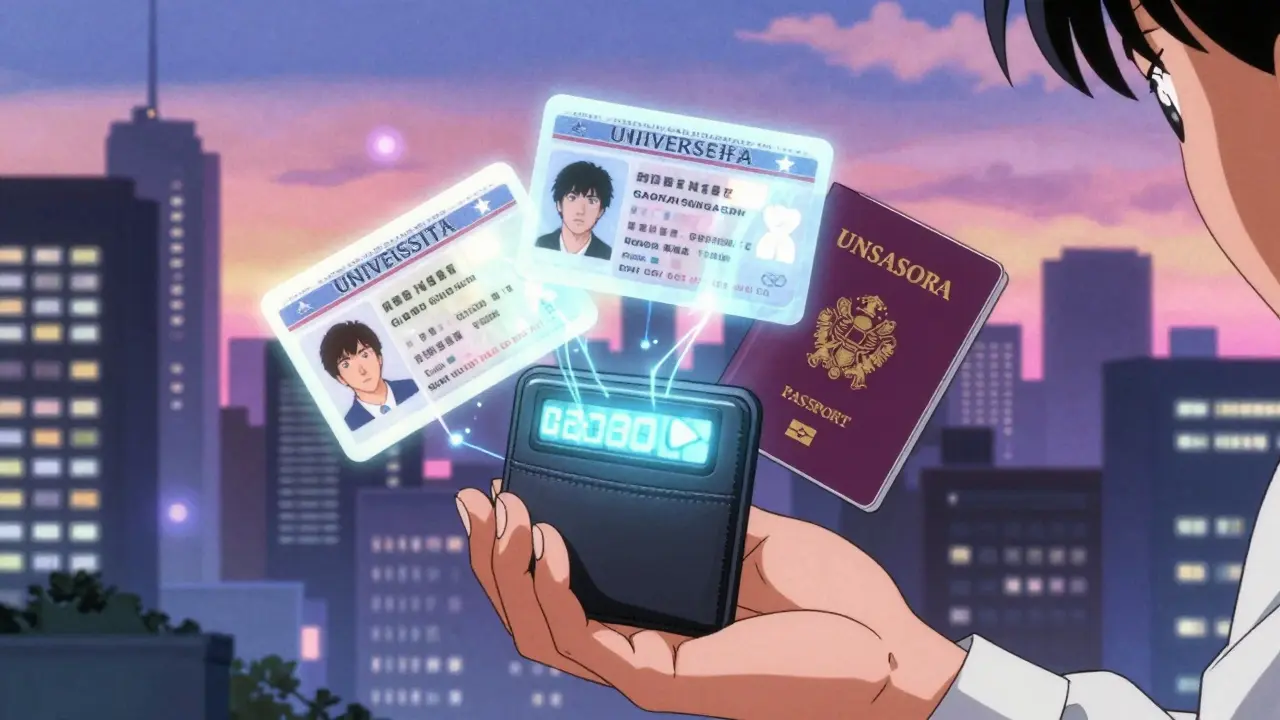
Imagine showing your driver’s license, university degree, or passport without handing over a single piece of paper-or logging into a government portal. What if you could prove you’re over 18, or that you’ve completed a course, without revealing your full name, address, or birth date? That’s not science fiction. It’s verifiable credentials with DID, and it’s already changing how we prove who we are online.
What Exactly Are Verifiable Credentials and DIDs?
Verifiable Credentials (VCs) are digital versions of real-world documents-like diplomas, licenses, or employee badges-but they’re cryptographically signed and impossible to fake. Think of them like a digital stamp from a trusted source that says, “Yes, this person really has this qualification.” The catch? You own them. No company, no government server holds them for you. You keep them in your digital wallet. That’s where Decentralized Identifiers (DIDs) come in. A DID is a unique, blockchain-agnostic identifier that doesn’t rely on any central authority. Unlike your email or social media handle, which are controlled by companies like Google or Meta, a DID is yours alone. It’s a string likedid:ion:EiBv5z9...q8X7 that points to a public key. This key lets others verify that a credential really came from you-or from someone you trust.
Together, VCs and DIDs form the backbone of self-sovereign identity. You’re not just a username in a database. You’re a verified entity with control over your own data.
How Do They Actually Work?
There are three players in this system: the Issuer, the Holder, and the Verifier.- Issuer: This could be your university, your employer, or even a city government. They create the credential and sign it using their private key. The credential includes claims-like “Jane Doe graduated from Victoria University in 2024”-and links to a DID that identifies the issuer.
- Holder: That’s you. You receive the credential in your digital wallet (like a mobile app). It’s stored securely, encrypted, and only shared when you choose.
- Verifier: When you need to prove something-say, to rent a car or apply for a loan-you present the credential. The verifier checks the digital signature, confirms the issuer’s DID is legitimate, and validates that the credential hasn’t been tampered with. No phone call. No database lookup. Just math.
Why This Is Better Than Passwords or Centralized Systems
Right now, most digital identity relies on centralized systems. You log into a website with a password. That site stores your data. If they get hacked, your info leaks. If they go out of business, you lose access. If they change their rules, you’re locked out. With VCs and DIDs:- No more passwords: You don’t need to remember 17 different ones. Your DID and wallet do the work.
- No more data hoarding: Companies don’t collect your personal info just to verify it. You decide what to share.
- Privacy by default: You can prove you’re 21 without showing your birth date. You can prove you’re an employee without revealing your employee ID number. This is called selective disclosure-and it’s built into the standard.
- Instant verification: A university can verify your degree in seconds. No waiting for transcripts. No faxing. No fees.

Real-World Uses Already Happening
This isn’t theoretical. It’s live.- Academic credentials: Universities in Canada, Japan, and New Zealand are issuing digital diplomas using VCs. Employers scan a QR code and instantly verify the graduate’s degree-without contacting the school.
- Travel and border control: The European Union is piloting digital identity wallets for travelers. At airport kiosks, you prove your identity and visa status using your phone. No passport stamp needed.
- KYC for crypto and banking: Instead of uploading your ID to 10 different crypto exchanges, you get one verifiable KYC credential from a trusted issuer. You share it with any exchange that accepts it. No repeated paperwork. No risk of your documents being leaked.
- Membership and access: Gym memberships, alumni networks, private Discord servers-all can be verified with a single credential. No login. No username. Just proof.
What About Blockchain? Do You Need It?
A common myth: VCs need blockchain. They don’t. DIDs can be stored on blockchains like Ethereum or ION (a blockchain built specifically for DIDs), but they can also live on HTTP servers, peer-to-peer networks, or even centralized databases-as long as they’re immutable and verifiable. The key is not where the DID is stored, but how it’s resolved. Think of it like this: Your driver’s license doesn’t need a blockchain to be valid. It just needs to be hard to forge and easy to check. VCs work the same way. Blockchain is one tool for anchoring DIDs to make them tamper-proof and globally resolvable. But it’s not the only one. Some systems use blockchain to record credential revocation status-like a public list of canceled licenses. Others use simple status lists published over HTTPS. The choice depends on the use case, not ideology.
Privacy Superpowers: Zero-Knowledge Proofs and Selective Disclosure
The most powerful feature of VCs isn’t just that they’re secure-it’s that they’re private. Let’s say you want to rent an apartment. The landlord asks: “Are you over 18?” With traditional methods, you’d show your ID. They see your full name, birth date, address, photo, passport number. All of it. With VCs and zero-knowledge proofs (ZKPs), you can prove you’re over 18 without revealing your birth date at all. The system mathematically confirms the claim is true-without exposing the underlying data. This isn’t sci-fi. It’s already in development. The W3C is working on standards for ZKP-based presentations. Companies like Sovrin and Microsoft’s ION are building wallets that support it. Selective disclosure means you control the data. You don’t give away more than you have to. That’s not just convenient. It’s a human right.Challenges Still Ahead
This isn’t a magic bullet. Adoption is slow.- Complexity: Most people don’t understand cryptography. Wallets need to be as simple as Apple Wallet.
- Fragmentation: Not all issuers use the same DID methods. Some use did:web. Others use did:ion. Interoperability is improving, but it’s not seamless yet.
- Revocation: What if your credential is stolen or revoked? Status lists and blockchain anchoring help, but real-time revocation is still tricky.
- Regulation: Governments are slow to adopt. Without legal recognition of VCs as valid proof, adoption stays limited.
What’s Next?
The next five years will be critical. We’ll see:- More governments issuing digital birth certificates and national IDs as VCs.
- Major universities moving away from paper transcripts.
- Wallets built into smartphones-Apple, Google, and Samsung integrating VC support into their operating systems.
- Enterprise systems like SAP and Salesforce supporting VC-based authentication.
Are Verifiable Credentials the same as NFTs?
No. NFTs are unique digital assets stored on a blockchain, often used for art, collectibles, or access tokens. Verifiable Credentials are identity attestations that prove claims about a person or entity. While both are cryptographically verifiable, VCs aren’t stored on-chain by default and focus on privacy and selective disclosure. Some NFTs can include VCs as metadata, but they serve different purposes.
Do I need a blockchain wallet to use Verifiable Credentials?
You need a digital wallet, but not necessarily a blockchain wallet. Many VC wallets are standalone apps that store credentials securely using encryption and local keys. Some integrate with crypto wallets, but most are designed for everyday use-like storing a digital driver’s license or university badge. Think of it like Apple Wallet, but for your identity.
Can Verifiable Credentials be forged or copied?
No-not if they’re properly issued. Each credential is cryptographically signed by the issuer using their private key. If someone tries to alter the data, the signature breaks. The verifier checks the signature against the issuer’s public key (linked to their DID). Even if you copy the credential file, it won’t verify unless the original issuer’s signature is valid. This makes forgery practically impossible.
Who issues Verifiable Credentials?
Any trusted entity can issue them: universities, governments, employers, professional associations, even community groups. The key is that the issuer must have a DID and a verifiable public key. For example, Victoria University of Wellington can issue a VC for your degree. Your employer can issue one for your job role. The system doesn’t care who they are-only that they’re trustworthy and their DID is resolvable.
What happens if I lose my phone with my Verifiable Credentials?
Just like losing your physical wallet, you lose access-but not control. Most wallets allow you to back up your credentials using encrypted recovery phrases or cloud backups (with your own encryption key). If your phone is stolen, you can revoke compromised credentials and reissue them through your issuer. Your DIDs remain yours because they’re tied to your private keys, not your device.
Is this technology legally recognized?
In some places, yes. The European Union’s eIDAS regulation already recognizes digital identities based on W3C standards. Estonia, Japan, and parts of Canada accept VCs for official transactions. In New Zealand, pilot programs are underway. Legal recognition is growing, but it’s still patchy. The W3C standard itself doesn’t have legal force-but it’s being adopted into national frameworks worldwide.





Comments
rachael deal
January 1, 2026 AT 02:34This is the kind of tech that actually makes me excited about the future. No more sharing my whole ID just to prove I’m 21. I’ve been using a VC for my university credential, and it’s insane how fast employers verify it. No emails, no calls, just a scan. Finally, something that respects your privacy.
Also, the fact that you can revoke credentials if your phone gets stolen? Game changer.
Ian Koerich Maciel
January 2, 2026 AT 22:28While the technical architecture is elegant, I remain cautious about real-world adoption. The average user does not comprehend public-key cryptography, nor should they be expected to. The UX must be as seamless as unlocking a phone with facial recognition-no menus, no keys, no recovery phrases.
Moreover, the legal recognition gap is not a minor hurdle; it’s a chasm. Without statutory equivalence to physical documents, this remains a niche tool for early adopters, not a societal infrastructure.
That said, the W3C standard is the most promising framework we’ve seen. I hope governments move faster.
Alex Strachan
January 3, 2026 AT 02:49So let me get this straight-we’re replacing passwords with… more passwords? Just ones you can’t reset?
Jk. Kinda. This is actually kind of brilliant. I used to have to upload my diploma to 5 different job sites. Now I just tap my phone. No more ‘Please send transcript in PDF format’ emails. I’m sold.
Also, zero-knowledge proofs? That’s like magic. I feel like I’m in a cyberpunk novel. 😎
Elisabeth Rigo Andrews
January 4, 2026 AT 20:35Let’s be honest-this is just blockchain rebranded as ‘identity.’ You think governments are going to let individuals control their own data? They’ll co-opt it, mandate it, and turn it into a surveillance tool under the guise of ‘security.’
And don’t get me started on ‘selective disclosure.’ That’s just privacy theater. If you can prove you’re over 18, you can also prove you’re 21, 25, 30… and eventually, they’ll build behavioral profiles from the metadata you *do* reveal.
This isn’t liberation. It’s a more sophisticated cage.
Phil McGinnis
January 5, 2026 AT 08:04Another Silicon Valley fantasy. You want to replace passports with phone apps? What happens when the power grid goes down? When the server’s down? When your battery dies?
We already have a working system: paper documents, human verification, physical security. It’s low-tech, but it’s reliable. This? It’s fragile. And it’s being pushed by people who’ve never held a real passport in their hands.
Also, who’s to say the ‘trusted issuers’ won’t be the same corporations we’re trying to escape? You think Apple or Google won’t monetize this? They already are.
Joydeep Malati Das
January 7, 2026 AT 05:06The elegance of this model lies in its minimalism. No central authority. No data silos. Just cryptographically verifiable assertions, owned by the individual.
What’s often overlooked is the scalability of the W3C data model. It’s designed for global interoperability-not just between systems, but across legal jurisdictions. This isn’t just about convenience; it’s about enabling cross-border mobility without bureaucratic friction.
For developing nations, where identity infrastructure is fragmented or non-existent, this could be transformative. A farmer in Bihar could prove his land ownership or educational attainment without relying on corrupt registries.
Yes, UX is a challenge. Yes, revocation is imperfect. But the foundation is sound. The rest is implementation.
Raja Oleholeh
January 7, 2026 AT 21:04India needs this. No more fake degrees. No more bribes to get certificates. Just scan and verify. Done.
Also, if my Aadhaar gets hacked, at least my VC is encrypted. That’s a win.
Daniel Verreault
January 9, 2026 AT 16:14Just tried the new Sovrin wallet beta. It’s… kinda clunky? Like, I had to manually add the issuer’s DID registry. Why can’t it just auto-discover? But once it worked? I verified my certification in 3 seconds. No portal. No login. Just… boom.
Also, I legit cried when I realized I didn’t have to email my university again for a transcript. That’s not tech-that’s dignity.
Also, can we please stop calling it ‘blockchain identity’? It’s not. Stop it. 😅
Brandon Woodard
January 11, 2026 AT 03:46People are acting like this is some radical new invention. It’s not. It’s just the logical endpoint of everything we’ve been building since PKI.
What’s new is the cultural shift: identity as a user-owned asset, not a corporate asset. That’s the revolution.
And yes, it’s going to take decades to roll out. But every time a university issues a VC, every time a bank accepts one, we’re eroding the old system. Slowly. But surely.
Rick Hengehold
January 12, 2026 AT 22:57Finally. I’m tired of being a data point. This lets me control what’s shared. No more ‘we need your birth date for age verification’ when all I need to prove is I’m over 18.
And if my wallet gets compromised? I revoke. Done. No waiting for customer service. No phishing scams. Just math.
Andy Reynolds
January 13, 2026 AT 07:57I’ve been teaching this to my undergrads. Their eyes light up when they realize they don’t have to give their entire life story to get a job. One student used a VC to prove she was a certified nurse-without revealing her SSN or home address. The employer was stunned.
This isn’t just tech. It’s a new kind of trust. One that doesn’t require surveillance. One that doesn’t require begging for access.
Let’s make this mainstream. Not because it’s cool. Because it’s right.
Jacky Baltes
January 13, 2026 AT 14:59There’s a philosophical layer here that rarely gets discussed. Identity, in this model, becomes performative rather than possessive. You are not defined by the data you hold, but by the claims you choose to assert.
This reorients the entire social contract. Power shifts from institutions to individuals-not through force, but through protocol.
It’s not just about cryptography. It’s about ontology. Who are we, when we’re no longer defined by the systems that collect us?
Ryan Husain
January 15, 2026 AT 12:20Just had a meeting with our HR team. We’re piloting VCs for employee onboarding. No more collecting copies of diplomas, licenses, or background checks. We verify directly. Faster. Safer. Cheaper.
And the best part? Employees love it. They feel respected. Not like data to be harvested.
This is the future of work. And it’s already here.
Adam Hull
January 16, 2026 AT 04:50Oh, wonderful. Another ‘decentralized’ solution that requires you to manage your own keys, understand cryptographic signatures, and pray your wallet doesn’t glitch. Meanwhile, the same people pushing this are the ones who built Facebook’s data harvesting empire.
It’s not liberation. It’s outsourcing responsibility to the user while keeping all the control.
And don’t even get me started on ‘zero-knowledge proofs.’ That’s just math-speak for ‘we’re hiding what we’re still collecting.’
Give me a break.