What is Towns (TOWNS) crypto coin? The decentralized messaging protocol explained
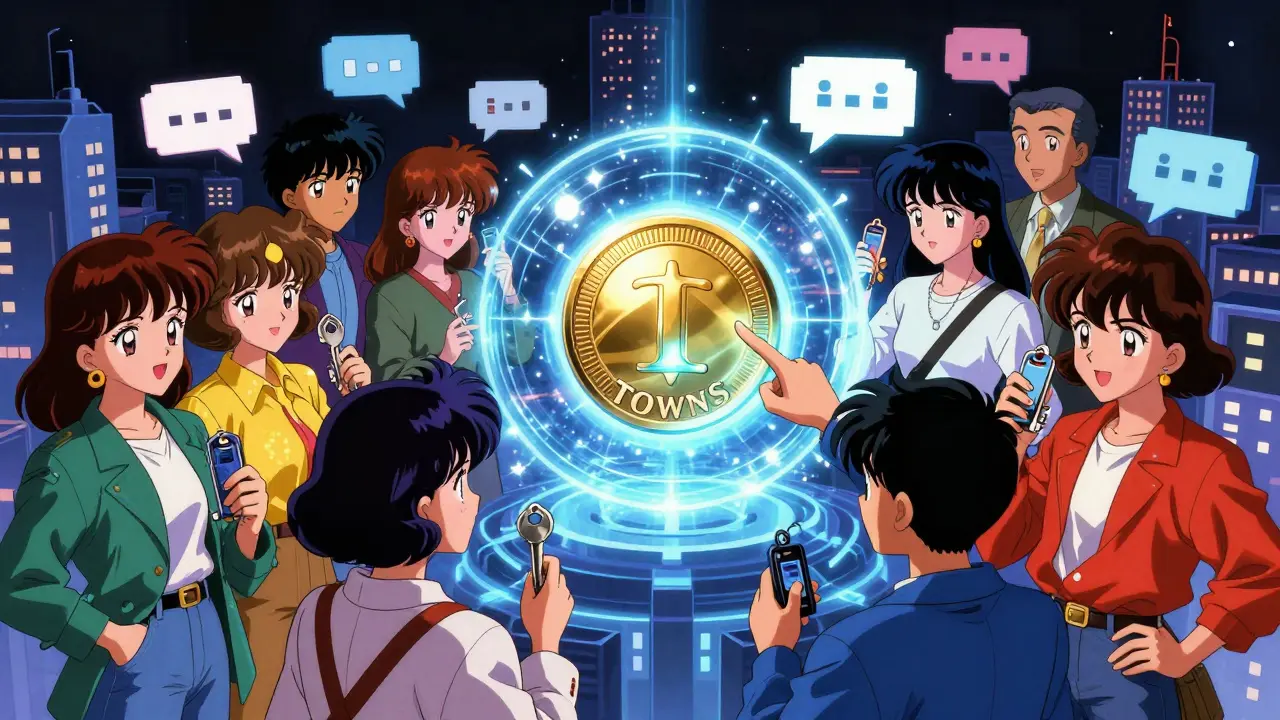
The TOWNS crypto coin isn’t just another token on the blockchain. It’s the fuel for a completely new kind of messaging system-one where your private chat groups are owned by you, not a company. Unlike WhatsApp or Discord, where the platform controls your data and can shut down your group anytime, Towns lets you build and fully own your communication space as a digital asset. This isn’t theoretical. It’s live, running on the Base blockchain, and already being used by real communities. Towns Protocol, the system behind TOWNS, was built by the same team that created Houseparty, the social video app that once had millions of users. They know how people communicate. Now, they’re rebuilding that experience on blockchain tech, with privacy and ownership baked in from day one. At its core, Towns lets you create something called a "Space." Think of it like a private group chat, but instead of being hosted on a server owned by a corporation, each Space is a unique NFT-an ERC-721 token-stored directly on the Base blockchain. That means you, the creator, hold the keys. You decide who can join, what they can do, and even how much they pay to be part of it. Want to turn your book club into a paid community? You can. Need to give moderators special powers? Done. Want to let your DAO vote on who gets in? Easy. All messages inside these Spaces are end-to-end encrypted. Not just "we encrypt" like some apps claim-this means even the servers that deliver your messages can’t read them. The protocol uses a network of decentralized Stream Nodes to route messages. These aren’t owned by Towns. They’re run by independent operators around the world, paid in TOWNS tokens. That’s how the system stays decentralized: no single company controls the flow of data. The TOWNS token itself is an ERC-20 token on Ethereum, but it’s bridged over to Base for everyday use. Why? Because Base is faster and cheaper. Transactions on Ethereum can cost $5 or more. On Base, they cost pennies. That’s critical when people are sending hundreds of messages a day across dozens of Spaces. There are roughly 10 billion TOWNS tokens in circulation as of early 2026, with a max supply capped at just over 15 billion. The token distribution is split into three main buckets: 57% goes to the community through grants, airdrops, and rewards; 35% is allocated to the team and investors (with long vesting schedules); and 8% is reserved for Node Operators who keep the network running. That’s not just a giveaway-it’s an incentive structure. The more people stake TOWNS to support Stream Nodes, the more secure and reliable the network becomes. Here’s where it gets interesting: TOWNS isn’t just a currency. It’s a governance tool. Token holders vote on changes to the protocol. Should inflation go up or down? Should new features be added? Should rewards for Node Operators change? All of these decisions are made by the community, not a CEO or board. This is how Web3 projects aim to work-decentralized, transparent, and community-led. You can earn TOWNS tokens by using the platform. Participate in active Spaces. Help test new features. Run a Stream Node. Stake your TOWNS to a Space you believe in. The protocol rewards participation. As of February 20, 2026, the price hovers around $0.0037, with daily trading volume exceeding $7 million across exchanges like Binance, where it’s listed under the Seed Tag for early adopters. Compare this to Telegram or Signal. Those apps are free, yes-but you don’t own your group. They can change their terms overnight. They can sell your data. They can ban you without warning. Towns removes that risk. Your Space is yours. It’s on-chain. It’s immutable. You can even sell it, transfer it, or let a DAO take over. Developers are already building on top of Towns. One group created a Space that integrates with Uniswap, letting members trade tokens directly inside their chat. Another built a governance tool that lets DAOs vote on proposals without leaving their Space. This isn’t just messaging-it’s programmable community infrastructure. The protocol’s economic model is designed to last. Inflation starts at 8% per year but gradually drops to 2% over 20 years. Rewards are paid out every two weeks to Node Operators and their delegators. That steady drip of incentives keeps the network alive, even if the token price dips. It’s not about speculation. It’s about building something that lasts. Towns Protocol doesn’t need to be popular to succeed. It just needs to be useful. A small group of 50 people running a private investment club, a team of 200 developers building a Web3 app, a DAO managing a $10 million treasury-all of them need secure, owned communication. Towns gives them that. And the TOWNS token? It’s the glue that holds it all together. This isn’t a coin that promises to make you rich. It’s a tool that empowers communities to take back control of their digital spaces. And that’s a revolution worth paying attention to.

Comments
George Suggs
February 21, 2026 AT 04:46This is actually kind of beautiful. Not because it’ll make anyone rich, but because it finally gives people real ownership over their digital spaces. No more corporate gatekeepers.
McKenna Becker
February 22, 2026 AT 21:01Ownership isn’t just a buzzword. It’s the difference between a home and a rented apartment. Towns turns chat into property.
Jan Czuchaj
February 23, 2026 AT 06:14I’ve watched a lot of Web3 projects come and go. Most are just rebranded social media with a token attached. But Towns feels different. It’s not trying to replace WhatsApp-it’s trying to replace the idea that communication has to be owned by someone else. The Stream Nodes are genius. Decentralized routing isn’t sexy, but it’s the backbone of real privacy. And the economic model? 57% to the community? That’s not an airdrop-it’s a covenant. This isn’t about speculation. It’s about building infrastructure that outlives the hype cycle. The fact that it’s on Base makes it usable. $5 gas fees kill adoption. Pennies? That’s how you get real daily use. And the NFT Spaces? That’s the killer feature. You don’t just join a group-you inherit a digital asset. You can sell it. You can pass it down. You can let a DAO take over. That’s not tech. That’s culture.
Lilly Markou
February 24, 2026 AT 23:17The level of structural thought behind this protocol is staggering. The alignment of incentives between node operators, community members, and governance participants is not merely clever-it is ethically coherent. One cannot overstate the significance of end-to-end encryption enforced at the protocol layer rather than as an afterthought. This is not software. This is a social contract encoded in immutable ledger.
Tracy Peterson
February 26, 2026 AT 18:39I’ve been waiting for this since 2017. No more ‘we’re not selling your data’ lies. If your group is on-chain, they can’t take it away. This is the future.
Felicia Eriksson
February 26, 2026 AT 22:48I’m not into crypto, but I love this idea. My book club is 12 people. We’ve been on Discord for years. What if we just owned it? No ads. No algorithm. Just us.
Jeff French
February 28, 2026 AT 04:46Stream Nodes as a decentralized relay layer is the real innovation here. Most projects focus on the token or the UI. Towns optimized the transport layer. That’s why it’ll scale. The Base bridge isn’t a workaround-it’s a strategic necessity. Low friction = high adoption. This is how you build infrastructure that survives bear markets.
KingDesigners &Co
March 1, 2026 AT 10:52This is what happens when you let engineers design social apps instead of marketers. No gamification. No notifications. Just pure, unmediated connection. I respect this. 🙏
aaron marp
March 1, 2026 AT 23:24The 8% inflation drop to 2% over 20 years is the quiet masterpiece here. It’s not about pumping the price. It’s about sustaining the network. Most tokens burn or hyperinflate. This one gently decays like a living ecosystem. That’s wisdom.
Dianna Bethea
March 3, 2026 AT 18:08I run a small DAO. We’ve been using Towns for 3 months. Our governance votes are now happening inside our Space. No external tools. No logging in. Just a message, a vote, and it’s on-chain. It’s changed how we work. We’re not techies. We’re just people who want to make decisions together. This works.
Alyssa Herndon
March 4, 2026 AT 11:17I don’t trust crypto. But I trust ownership. If my chat group is mine, I’ll use it. If it’s owned by a company, I’ll leave. Simple.
Tracy Whetsel
March 6, 2026 AT 06:58I’m so tired of being told I need to ‘join the movement’ to have a private space. This isn’t a movement. It’s a right. And now it’s on-chain. Thank you.
Phillip Marson
March 7, 2026 AT 20:23They took the whole ‘your data is the product’ model and flipped it on its head. Now the product is your space. The token is just the grease. I’m not buying TOWNS. I’m buying autonomy. And that’s worth more than any price chart.
Ifeanyi Uche
March 8, 2026 AT 22:30this sounds like another scam where rich guys get rich and we get left with a useless nft chat app lol
precious Ncube
March 9, 2026 AT 01:33If you need a blockchain to have a private chat, you’re doing it wrong. This is overengineered vanity. Real privacy is silence, not on-chain NFTs.
Amita Pandey
March 10, 2026 AT 07:21The ontological shift from centralized communication platforms to decentralized, token-gated, NFT-based spaces represents a paradigmatic rupture in the sociotechnical architecture of digital interaction. One must interrogate whether the economic incentives embedded within the protocol genuinely enable democratic governance or merely replicate existing power structures under the guise of decentralization.
Molley Spencer
March 11, 2026 AT 09:19TOWNS? More like TOWNS of debt. 15B supply? That’s a rug pull waiting to happen. And ‘community grants’? That’s just the team’s backdoor. I’ve seen this script before. The real innovation is how they package the same old pump-and-dump in Web3 jargon.
John Fuller
March 12, 2026 AT 21:17So what? I use Signal. It’s free. It’s private. Why do I need to buy a token to chat with my friends?
Dana Sikand
March 12, 2026 AT 22:19I’ve been in online communities for 20 years. I’ve seen the same patterns repeat. Power grabs. Bans. Censorship. This is the first time I’ve seen a system that doesn’t just promise change-it builds it into the code. I’m not a crypto person. But I’m a community person. And this? This is the future I’ve been waiting for.
Robert Conmy
March 14, 2026 AT 18:21The fact that you can sell your Space like an asset? That’s not innovation. That’s capitalism with a blockchain sticker. You’re turning friendships into real estate. That’s not liberation. It’s commodification.
Lucy Simmonds
March 15, 2026 AT 10:38I’ve been researching this and I’m convinced: this is a CIA project. They want to track private groups under the guise of ‘ownership’. The NFTs are spyware. The ‘Stream Nodes’? That’s just a honey trap. Don’t fall for it.
Patrick Streeb
March 16, 2026 AT 21:10The technical architecture of Towns Protocol demonstrates a commendable alignment with the principles of decentralization and user sovereignty. The use of ERC-721 for Spaces and the delegation of message routing to independent Stream Nodes is both elegant and robust. One might reasonably posit that this represents one of the most mature implementations of community-owned infrastructure to date.
Tracy Peterson
March 18, 2026 AT 08:04To the person who said ‘Signal is fine’-you’re right. But Signal can shut you down tomorrow. Towns can’t. That’s the difference between convenience and control.
Alyssa Herndon
March 19, 2026 AT 17:30I think about it this way: if I can’t leave my chat group without losing it forever, then I’m not free. Towns lets me walk away-and take my space with me.
Robert Conmy
March 20, 2026 AT 16:34So you’re saying owning your chat is more important than not paying for it? That’s a weird priority.