Real Estate Security Tokens Explained: How Blockchain Is Changing Property Ownership

Imagine owning a piece of a Manhattan office building for just $100. Not a whole floor. Not a single unit. Just a tiny slice-like owning a share of a stock, but in bricks and mortar. That’s what real estate security tokens do. They turn physical property into digital shares you can buy, sell, and trade on blockchain networks. And unlike crypto speculation, these aren’t gamble coins. They’re regulated financial instruments backed by real assets.
What Exactly Are Real Estate Security Tokens?
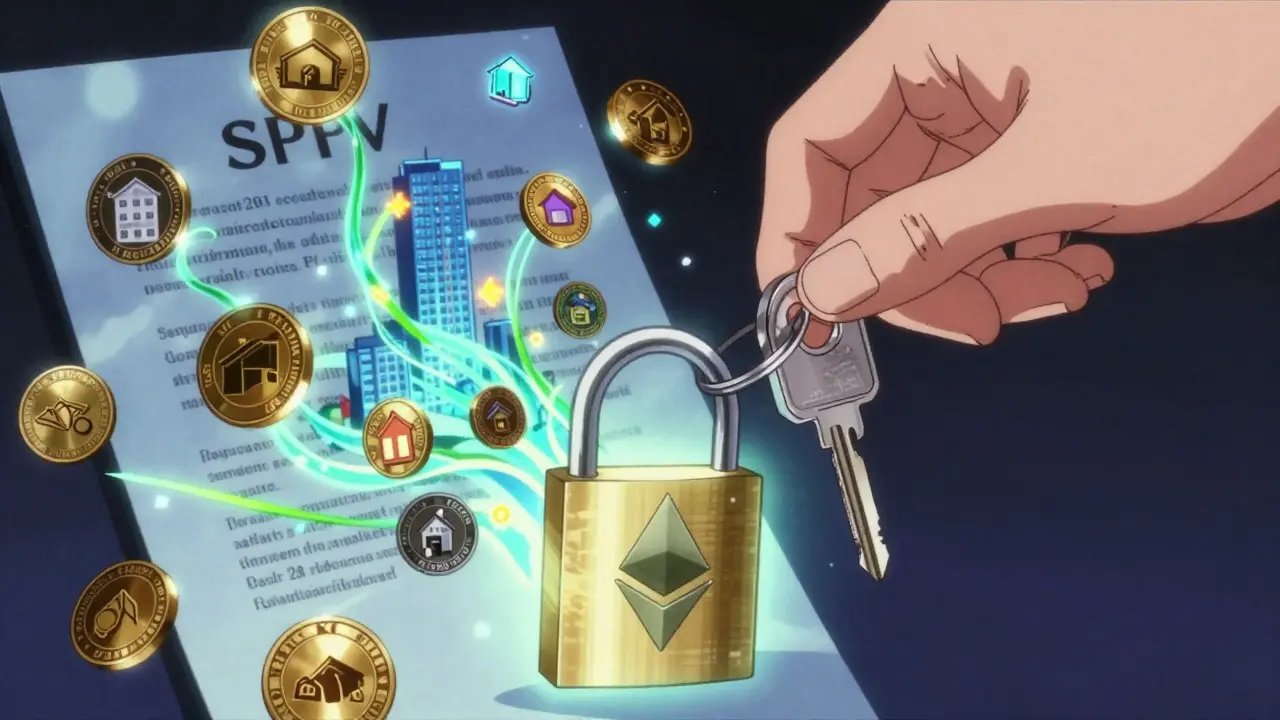
Real estate security tokens are digital representations of ownership in a property or a group of properties. They’re not just digital files. They’re legally recognized securities, meaning they fall under the same rules as stocks or bonds. When you buy one, you’re not buying a piece of land-you’re buying a share in a legal entity (usually a Special Purpose Vehicle or SPV) that owns the real estate. This distinction matters. A utility token gives you access to a service, like a login key for an app. A security token gives you a financial right: a share of rental income, a claim on future profits from a sale, or even voting rights on major decisions. The U.S. Securities and Exchange Commission (SEC) uses the Howey Test to determine if something is a security. If investors put money into a common enterprise expecting profit from others’ efforts, it’s a security. Real estate tokens almost always pass this test.How Tokenization Works: From Building to Blockchain
The process starts with a legal structure. A company or sponsor creates an SPV-a separate legal entity that buys and holds the property. This keeps the asset clean, clear, and legally isolated. Then, the SPV issues digital tokens, typically on the Ethereum blockchain using the ERC-20 standard. Each token represents a percentage of ownership in the SPV. Smart contracts handle the rest. These are self-executing pieces of code that enforce rules automatically. For example, if a tenant pays rent, the smart contract can instantly split the cash flow among token holders. If someone wants to sell their tokens, the contract checks if they’re an accredited investor (as required by law) before allowing the transfer. No middlemen. No escrow accounts. No paper trails. Custody is another key piece. You can hold your tokens in your own crypto wallet-like a digital bank account-or use a regulated custodian that insures your assets and handles compliance checks. Some platforms even let you link your tokens to traditional bank accounts for easy cash-outs.Types of Real Estate Security Tokens
Not all tokens are the same. There are three main types:- Asset-Backed Tokens: These are tied directly to physical property. The value comes from the building itself-its rent, location, and condition.
- Equity Tokens: These give you ownership rights similar to shares in a company. You might get dividends, voting power on property management decisions, or a cut of the sale proceeds.
- Debt Tokens: These act like bonds. You lend money to the SPV and earn fixed interest payments. The property serves as collateral.
Why This Matters: Liquidity, Access, and Cost
Traditional real estate is illiquid. Selling a building can take months. You need $10,000 to $100,000 just to get in the door. And you’re stuck with whatever property you bought-no easy way to diversify. Security tokens change all that. With tokenization, you can invest $100 in a dozen different properties across the U.S., Europe, or Asia. You can sell your tokens in minutes on specialized trading platforms. And because the whole process is automated, transaction costs drop by 40-60%. No more paying lawyers to draft deeds or brokers to handle escrow. EY estimates that tokenization could turn the annual trading volume of commercial real estate from less than 0.5% to 15-20%. That’s like going from selling your car once every 20 years to selling it every few months.Regulation: The Make-or-Break Factor
This is where things get tricky. Just because it’s on a blockchain doesn’t mean you can ignore the law. The SEC doesn’t care if your asset is on a blockchain or on paper. If it’s a security, it’s regulated. In the U.S., issuers must comply with federal securities laws. Most use exemptions like Regulation D 506(c), which lets them advertise to accredited investors (people with over $1 million in net worth or $200,000+ in annual income). Others use Regulation A+, which allows non-accredited investors to participate but requires full disclosure and SEC review. In 2022, the SEC fined Blockstream $30 million for selling unregistered tokens. That wasn’t a warning. It was a message: compliance isn’t optional. Other countries are catching up. Switzerland’s FINMA has clear rules for security tokens. The EU’s MiCA regulation is still being finalized but will likely set a new standard. Meanwhile, 47 U.S. states have their own “Blue Sky” laws, meaning issuers must register separately in each one. That’s why most platforms focus on commercial properties-residential deals are too fragmented to scale.
Who’s Doing It Right?
A few platforms are leading the way:- INX: Launched a $22 million tokenized Manhattan apartment building in 2023 under Reg D 506(c). Used institutional-grade compliance tools.
- DigiShares: Focuses on the backend-legal templates, KYC/AML checks, and custody infrastructure. Used by banks and funds.
- RealT: Specializes in single-family homes in the U.S. Midwest. Lets anyone invest from $10.
- JPMorgan Chase: Completed a $50 million tokenized commercial property deal in Texas in September 2023 using its JPM Coin system.
Where It Falls Short
Despite the hype, real estate security tokens aren’t perfect. First, trading is limited. You can’t just sell them on Coinbase or Binance. They need to trade on SEC-registered Alternative Trading Systems (ATS), which are few and far between. Liquidity is still low. Second, the tech isn’t foolproof. Smart contracts can have bugs. If the code has a flaw, money can disappear. And if the legal entity behind the tokens gets sued or goes bankrupt, your tokens might be worthless-even if the property is fine. Third, most platforms are still new. Documentation varies wildly. Some offer full legal prospectuses. Others give you a one-page summary and hope you don’t ask questions. And let’s not forget: the average person still doesn’t understand crypto wallets, private keys, or blockchain. Education is the biggest barrier-not technology.What’s Next?
The market is growing fast. EY predicts the global real estate tokenization market could hit $16.3 trillion by 2030. That’s 7.1% of today’s total real estate value. The biggest catalyst? The SEC’s upcoming Digital Asset Securities Framework, expected in early 2024. If it gives clear rules for tokenized real estate, we’ll see a flood of new offerings. Long-term, experts believe adoption will happen in stages. First, institutional investors. Then, high-net-worth individuals. Finally, retail investors-once platforms make it as easy as buying a stock. For now, it’s still early. But the shift is real. Real estate is no longer just about owning a house or a building. It’s about owning a digital share of one. And that’s changing everything.Are real estate security tokens the same as cryptocurrency?
No. Cryptocurrencies like Bitcoin or Ethereum are digital currencies designed for peer-to-peer transactions or speculative trading. Real estate security tokens represent ownership in a physical asset and are regulated as financial securities. They’re not meant to be traded like memes or gambling bets-they’re investment tools with legal rights attached.
Can anyone invest in real estate security tokens?
It depends. Some offerings are open only to accredited investors (those meeting income or net worth thresholds under SEC rules). Others, especially those using Regulation A+, allow non-accredited investors to participate-but with limits on how much you can invest. Always check the offering’s disclosure documents before putting money in.
How do I get paid from a real estate security token?
Payments are automated through smart contracts. If the property generates rental income, the platform distributes dividends directly to your wallet on a set schedule-usually monthly or quarterly. If the property is sold, proceeds are distributed based on your token percentage. You’ll get notifications and transaction records on the blockchain.
What happens if the platform or sponsor goes out of business?
Your tokens represent ownership in the SPV-the legal entity that owns the property-not the platform. Even if the platform shuts down, the property still exists. The SPV can be managed by a new administrator or trustee. Your rights as a token holder are protected by law and the underlying legal structure, not by the app you used to buy the token.
Is this legal in New Zealand?
New Zealand doesn’t have specific rules for real estate security tokens yet, but they’re likely treated as financial products under the Financial Markets Conduct Act. If you’re a New Zealand resident, you can invest in overseas offerings-but you must comply with local tax and reporting rules. Always consult a financial advisor familiar with cross-border digital assets.
Can I use a real estate security token as collateral for a loan?
Some lenders are starting to accept tokenized assets as collateral, but it’s still rare. Most traditional banks don’t recognize them yet. However, decentralized finance (DeFi) platforms are experimenting with token-backed loans. This area is evolving quickly, but don’t assume you can use your tokens like a house title to get a mortgage.
What are the biggest risks of investing in tokenized real estate?
The biggest risks are regulatory changes, lack of liquidity, smart contract bugs, and platform failure. Also, if the underlying property is poorly managed or in a declining market, your returns suffer-even if the blockchain is flawless. Never invest more than you can afford to lose, and always verify the legal structure behind the tokens.





Comments
Kevin Karpiak
December 24, 2025 AT 17:51This is just Wall Street repackaging the same scam with blockchain buzzwords. You think a smart contract makes a building less risky? Lol.
Megan O'Brien
December 25, 2025 AT 14:09Tokenization? More like token-washing. You're telling me I can now invest $100 in a Manhattan building but still need to pass an accredited investor check? The system's still rigged.
Amit Kumar
December 25, 2025 AT 19:44In India, we dream of owning even a single room in Mumbai. Now someone says I can buy 0.001% of a New York tower for $100? This isn't democratization-it's digital colonialism. The rich get richer, the poor get a blockchain receipt.
Helen Pieracacos
December 26, 2025 AT 04:26Oh wow. So now instead of being locked into a 30-year mortgage, I can be locked into a 30-year smart contract with a 2% fee every time I want to cash out. Thanks for the upgrade.
Naman Modi
December 26, 2025 AT 10:27I'm not buying this. Blockchain? More like block-scam. Someone's gonna get hacked, disappear, and your 'ownership' becomes a .json file on a dead server. 😒
Sophia Wade
December 27, 2025 AT 23:36The metaphysical shift here is profound: property, once a tactile, territorial, and temporal anchor of human existence, is now reduced to a mutable ledger entry-a spectral claim on physical matter, mediated by algorithmic governance. We are not owning bricks. We are owning the *idea* of bricks.
Brian Martitsch
December 29, 2025 AT 01:38If you don't know what a private key is, you shouldn't be investing. Period. 🤦♂️
Rebecca F
December 30, 2025 AT 13:59Real estate tokens are the new NFTs for people who still believe in institutions
Lloyd Yang
January 1, 2026 AT 04:14I've been watching this space for years and honestly? This could be the most meaningful financial innovation since the mortgage-backed security-except this time, it might actually work. The automation of rent distribution alone? That’s a game-changer for small investors who can’t afford property managers. And the transparency? Imagine knowing exactly when your dividend hits your wallet, traceable on-chain, no middlemen skimming 15% off the top. It’s not perfect-yes, the tech can glitch, yes, regulation’s a mess-but the core idea? It’s beautiful. Imagine a grandma in Ohio investing $50 in a solar-powered apartment complex in Austin and getting monthly payouts without ever setting foot in Texas. That’s not finance. That’s justice.
Zavier McGuire
January 3, 2026 AT 01:41why do people think blockchain fixes everything its just a database with extra steps and if the spv goes under your tokens are just digital confetti
Sybille Wernheim
January 4, 2026 AT 05:28I just bought my first $100 token on RealT and got my first rent payout last week! It’s wild to see $2.47 hit my wallet from a house in Ohio. I’m not rich but I feel like I’m building something real. 🙌
Cathy Bounchareune
January 4, 2026 AT 22:54I live in a tiny apartment in Brooklyn and I’ve been researching this for months. It’s not about owning a building-it’s about owning a story. My $100 token is my piece of the American dream, even if it’s just a sliver of a duplex in Des Moines. I love that.
Ellen Sales
January 6, 2026 AT 03:12so you mean i can own part of a building without knowing how to use a wallet? cool. i guess ill just let the platform handle it. (ps i still think crypto is a pyramid)
Sheila Ayu
January 6, 2026 AT 06:04Wait-so if the SPV is legally separate, then who’s responsible if the building catches fire? Is the blockchain gonna pay for my ruined furniture? Who’s liable? Who’s insured? Who’s gonna fix the leaky roof? This is a legal nightmare waiting to explode!
Shubham Singh
January 7, 2026 AT 02:09The notion that tokenization reduces costs is statistically misleading. Compliance, legal structuring, and audit overhead for each SPV far outweigh any theoretical savings. This is financial theater for the tech-savvy elite.
Charles Freitas
January 7, 2026 AT 11:48You people are so naive. The SEC fined Blockstream $30M because they didn’t follow the rules. But guess what? Every single platform here is using the same loopholes. This isn’t innovation-it’s regulatory arbitrage with a fancy UI.
Vijay n
January 7, 2026 AT 23:03This is all a CIA operation to track your assets and control your wealth. They want you to think you own something but really you're just giving them your data. Blockchain is a trap. The government already owns your tokens before you even buy them
Alison Fenske
January 8, 2026 AT 06:23I think this is actually kind of beautiful. People who never had access to real estate are now getting a seat at the table. Even if it’s just a sliver. I hope this keeps growing.
Grace Simmons
January 8, 2026 AT 10:21The U.S. should lead this innovation, not let Europe and Switzerland dictate the rules. We have the capital, the legal infrastructure, and the market. Let’s not outsource financial sovereignty.
Collin Crawford
January 10, 2026 AT 00:49You’re ignoring the fact that 90% of these platforms are unregistered. They use Reg D 506(c) to skirt disclosure requirements. This isn’t democratization-it’s a regulatory shell game.
Jayakanth Kesan
January 10, 2026 AT 17:57I’ve been buying small tokens on RealT for a year now. It’s not life-changing money, but it’s passive income I didn’t have before. I don’t need to be rich to start. Just curious and patient.
Aaron Heaps
January 12, 2026 AT 16:38Liquidity is a myth. No ATS has enough volume to make this viable. You think you’re buying equity? You’re buying a paperweight with a QR code.
Tristan Bertles
January 13, 2026 AT 14:34I work with a fund that’s tokenizing warehouses in the Midwest. The real win isn’t the $100 investors-it’s the institutional buyers who can now diversify across 50 properties in 30 minutes. That’s the future. Retail is just the warm-up.
Earlene Dollie
January 14, 2026 AT 01:43I just got my first dividend and cried. Not because it was a lot-but because I finally felt like I belonged in this economy. This isn’t tech. This is hope.
Dustin Bright
January 14, 2026 AT 05:58i love how people act like this is new but its just stocks with better graphics 😊