Crypto Exchange Enforcement Actions and Fines in 2025: What Happened and Why It Matters
By mid-2025, the cryptocurrency industry had reached a turning point. After years of operating in a legal gray zone, major exchanges and related businesses were hit with record-breaking fines and criminal charges. The message was clear: regulators are no longer watching-they’re acting. And the cost of ignoring compliance isn’t just a fine anymore. It’s the end of your business.
OKX’s $500 Million Fall: A Case Study in Systemic Failure
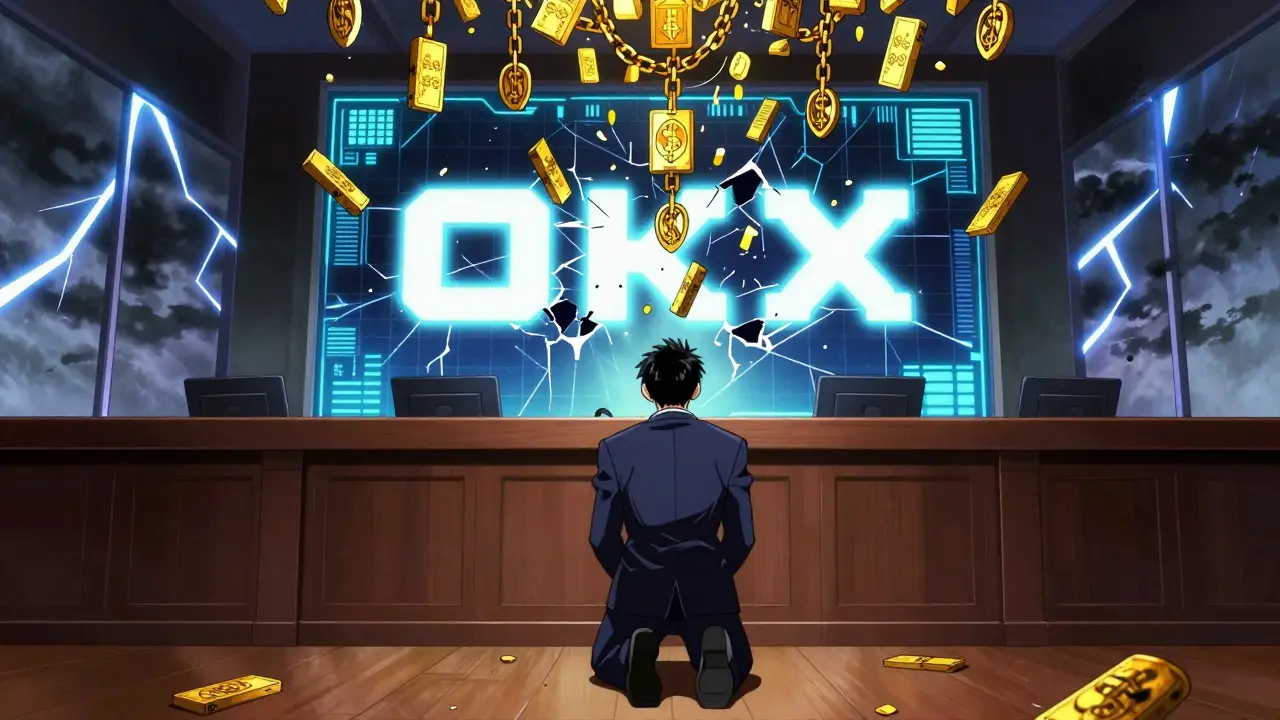
The biggest enforcement action of 2025 landed on February 24, when the U.S. Department of Justice fined OKX over $500 million. The exchange, based in the Seychelles and founded in 2017, had built a global user base by promising fast trades and low fees. But behind the scenes, its compliance systems were broken. The DOJ found that OKX had processed more than $5 billion in transactions that should have been flagged as suspicious. Customers from the U.S., where the exchange officially banned access, were told by staff how to fake their addresses and ID documents to keep trading. Internal emails showed employees coaching users on bypassing KYC checks. That’s not negligence-that’s intentional fraud. OKX didn’t just fail to monitor transactions. It didn’t screen for sanctioned individuals, didn’t report large cash flows, and never registered as a money services business with the U.S. Treasury. When the DOJ moved in, they didn’t just take money. They took control. OKX had to forfeit $420 million in illegal profits and pay an $84 million civil penalty. The company pleaded guilty. That’s rare. It means the evidence was undeniable.Market Manipulation: Bots, Wash Trades, and the New Target
It’s not just about money laundering. Regulators are now going after the mechanics of crypto markets themselves. The DOJ’s focus shifted to automated trading bots used to create fake volume. These bots execute trades between accounts controlled by the same person-known as wash trading-to make a coin look popular. That tricks new investors into thinking there’s real demand. In October 2024, 17 people were charged in Massachusetts for running these schemes. The targets? Mostly small, obscure tokens-meme coins with no real use case, just hype. The DOJ called it “systematic market manipulation,” and they’re not stopping there. What makes this different from past crackdowns is the venue. Massachusetts has become a hub for crypto prosecutions. Federal prosecutors there have built teams with forensic analysts who trace blockchain transactions down to individual wallet addresses. They don’t need to prove intent to defraud-just that the volume was artificially inflated. And they’re using data from exchanges themselves, often obtained through subpoenas or voluntary cooperation after other investigations.
SEC’s Crackdown: Ponzi Schemes and Unregistered Securities
While the DOJ goes after criminal conduct, the Securities and Exchange Commission (SEC) is focused on investor protection. In April 2025, Ramil Palafox, founder of PGI Global, was charged with running a $57 million Ponzi scheme. He promised investors 10% monthly returns from crypto and forex trading. But instead of trading, he used new investor money to pay earlier ones. He spent $12 million on luxury cars and private jets. The SEC didn’t just freeze assets-they froze his passport. Then came Unicoin. The SEC charged the company and three executives for selling unregistered securities under the guise of a cryptocurrency. Investors thought they were buying a digital coin. The SEC said it was an investment contract-legally, a security-and they never filed the paperwork. That’s a direct violation of the Securities Act of 1933. The most shocking case came in August. The SEC won a $46 million default judgment against MCC International, CPTLCoin, and Bitchain Exchanges. The scheme? Investors bought mining packages that promised daily returns. But the returns were paid from new investors. Worse, when users tried to cash out, they were told they had to sell back to Bitchain Exchange-which was secretly controlled by the same people running the mining operation. They could block withdrawals anytime. That’s not a trading platform. That’s a trap.Broker-Dealers Are Also Being Held Accountable
You might think this only affects crypto-only platforms. It doesn’t. FINRA, the financial industry’s watchdog, started cracking down on traditional broker-dealers that started offering crypto products without proper disclosure. In May and July 2025, two firms settled for $85,000 each. Why? Because they let retail clients trade crypto through unregistered affiliates and didn’t clearly explain the risks. One firm even called crypto “the next big thing” in marketing materials while hiding that the underlying asset had no regulatory oversight. This matters because it shows regulators aren’t just targeting crypto startups. They’re holding every player in the financial ecosystem responsible. If you’re a broker, a bank, or even a financial advisor pushing crypto without proper compliance-you’re on the radar.
Why This Is Different Now
In 2020, regulators were still figuring out how to handle crypto. By 2025, they had built specialized units. The DOJ has a Crypto Enforcement Task Force. The SEC has a dedicated Digital Asset Unit. FINRA has its own crypto compliance checklist. They’re not guessing anymore. They’re using real data: blockchain analytics, wallet clustering, transaction tracing, and internal documents from the exchanges themselves. The pattern is clear: weak KYC, no transaction monitoring, no sanctions screening, no registration. Miss any one of these, and you’re asking for trouble. And the penalties aren’t just financial. Executives face personal liability. Some have been arrested. Others are barred from working in finance again. The $6 billion in AML fines issued in the first half of 2025 isn’t a number. It’s a warning. This isn’t about punishing bad actors. It’s about reshaping the entire industry. If you’re running a crypto exchange and you haven’t built compliance into your core operations, you’re not a tech company-you’re a liability waiting to explode.What Comes Next
The SEC announced Project Crypto, a Commission-wide initiative to tighten oversight across all digital asset activities. That means more enforcement, not less. Meanwhile, political pressure is growing. Some lawmakers want to slash the SEC’s budget and block new rules. But that won’t stop the DOJ. Criminal cases don’t need congressional approval. The bottom line? If you’re operating a crypto exchange, you need three things: a registered AML program, real-time transaction monitoring, and a compliance officer with authority to shut things down. Not a consultant. Not a checklist. A person who can say no-and has the backing to do it. The era of flying under the radar is over. The fines are real. The arrests are real. And the next one could be yours.What happens if a crypto exchange doesn’t register as a money service business?
Failing to register with the U.S. Treasury as a money services business (MSB) is a federal crime. Exchanges that skip this step can face criminal charges, massive fines, asset seizures, and executive arrests. OKX’s $500 million penalty in 2025 was partly due to this violation. Registration isn’t optional-it’s the legal baseline for any business handling crypto transactions in or with U.S. customers.
Can individual executives be held personally liable for exchange violations?
Yes. In multiple 2025 cases, including OKX and MCC International, senior executives were named in enforcement actions. The DOJ and SEC now routinely pursue personal liability for CEOs, CTOs, and compliance officers who ignored red flags, failed to act on internal warnings, or actively helped customers evade rules. Personal fines, asset freezes, and even prison time are possible.
Are all cryptocurrencies considered securities by the SEC?
No. But if a crypto asset is sold as an investment with an expectation of profit based on someone else’s efforts, the SEC considers it a security-regardless of what it’s called. Tokens tied to mining operations, staking rewards, or profit-sharing schemes are most likely to be classified as securities. Bitcoin and Ethereum are generally not, but most newer tokens are.
Why is Massachusetts a hotspot for crypto prosecutions?
The U.S. Attorney’s Office in Massachusetts has built one of the most specialized crypto investigative teams in the country. They’ve developed expertise in blockchain forensics, coordinated with the SEC and FinCEN, and secured multiple convictions using digital evidence. Their success has made them a go-to venue for complex crypto cases, especially those involving market manipulation and fraud.
How can a crypto exchange avoid enforcement actions?
Implement a robust AML program with real-time transaction monitoring, full KYC for all users (no exceptions), sanctions screening against OFAC lists, mandatory reporting of suspicious activity, and registration as an MSB. Hire a qualified compliance officer with authority to halt operations if risks are detected. Regular audits by third parties are also critical. Compliance isn’t a cost-it’s your license to operate.





Comments
John Doyle
February 13, 2026 AT 23:09This is exactly why I told my cousin to stay away from crypto trading. I mean, sure, the tech is cool, but if you're not playing by the rules, you're just asking for trouble. OKX didn't just slip up-they built their whole model on bending the law. And now? Gone. No second chances. Real talk: if your business model relies on loopholes, you're already on borrowed time.
Compliance isn't sexy, but it's the only thing keeping this whole thing from collapsing into a pyramid scheme. We need more people like that compliance officer who can say no-and actually mean it.
Gaurav Mathur
February 14, 2026 AT 10:07The system is rigged the whole thing is a trap the government wants control not regulation they want to kill crypto so they can push their digital dollar
Brittany Meadows
February 15, 2026 AT 23:49Oh wow 😂 so now the government is the crypto police? Next they'll be fingerprinting wallet addresses and making us wear compliance badges. Meanwhile, the SEC is out here treating Bitcoin like it's a Ponzi scheme while Wall Street is quietly buying up BTC through ETFs. The hypocrisy is thicker than a 2024 meme coin whitepaper. 🤡💸
SAKTHIVEL A
February 16, 2026 AT 08:29The institutionalization of decentralized finance represents a paradigmatic inversion of market autonomy. One must interrogate the ontological status of regulatory intervention within the post-blockchain economic substrate. The conflation of AML protocols with state surveillance apparatuses constitutes a neocolonial encroachment upon digital sovereignty. One cannot simultaneously advocate for financial liberation and submit to the fiduciary hegemony of FinCEN.
Tammy Chew
February 16, 2026 AT 19:14I mean… it’s not like they didn’t warn us. Every time someone said "it’s just a coin" I thought of my uncle who lost his retirement on a Dogecoin pump. Now the regulators are finally catching up. And honestly? Good. If you can’t tell the difference between a utility token and a securities offering, you shouldn’t be trading. The market doesn’t need more gamblers. It needs adults.
Lindsey Elliott
February 18, 2026 AT 06:23Lmao so what? They fined OKX. Big deal. The real story is how fast the market bounced back. People are still trading. Still buying. Still ignoring all this "compliance" noise. This is just noise. Noise from people who don’t get it. Crypto doesn’t care about your forms.
blake blackner
February 18, 2026 AT 12:56bro they just took 500 mil from okx?? that’s wild. i thought crypto was supposed to be "no banks no rules". now it’s just wall street with better graphics. 🤡 i miss the days when we just traded btc for pizza and no one cared who you were. now i gotta upload my id like i’m opening a checking account. 😭
Andrea Atzori
February 19, 2026 AT 14:01The regulatory evolution observed in 2025 reflects a necessary maturation of digital asset markets. The absence of standardized compliance frameworks previously allowed systemic vulnerabilities to proliferate. The enforcement actions undertaken by U.S. agencies demonstrate a commitment to investor protection and market integrity. While some may perceive this as overreach, it is, in fact, the foundation upon which sustainable innovation must be built. Without structure, there is only chaos.
Joe Osowski
February 19, 2026 AT 22:31This is why America is falling apart. They're shutting down legitimate businesses because they can't control the technology. Meanwhile, China and Russia are laughing all the way to the bank with their own crypto systems. We're not just losing money-we're losing our edge. This isn't regulation. This is surrender.
Jeremy Lim
February 20, 2026 AT 19:12I mean… I guess it makes sense? But like… why now? Why not five years ago? Why are we only acting after billions have been lost? And why do I feel like this is just the beginning? Like… next they'll be tracking NFTs and DeFi wallets. Is there no escape?
kelvin joseph-kanyin
February 21, 2026 AT 07:48This is the moment crypto grew up. I used to think regulation was the enemy. Now I see it as the guardrail. The bad actors were poisoning the whole pool. OKX? Yeah, they deserved it. But this? This is the clean slate we needed. Time to build something better. Not faster. Not flashier. Just honest.
Elizabeth Choe
February 21, 2026 AT 22:43I’m so proud of how far we’ve come. Remember when people thought crypto was just for hackers and scammers? Now we’re holding the big players accountable. That’s not censorship-that’s evolution. Every time someone says "it’s too regulated," I just smile and say: "Yeah, and? We finally got the rules to match the real world." You can’t build a house on sand. And crypto? It’s finally learning how to lay bricks.
Grace Mugambi
February 22, 2026 AT 08:43It’s interesting how fear and control often get confused with safety. The crackdowns are real. The penalties are real. But what’s being lost in all this? The original spirit of decentralization. The idea that money could be free from gatekeepers. I don’t think we need to abandon compliance-but we do need to ask: Who gets to define what "legitimate" means? And who benefits when the rules are written by the same institutions that caused the last financial crisis?
Crystal McCoun
February 22, 2026 AT 22:02If you're running a crypto exchange and you haven't built compliance into your core operations, you're not a tech company-you're a liability waiting to explode. This quote? Perfect. Seriously. Compliance isn't paperwork. It's a mindset. It's hiring someone who says "no" even when the CEO screams. It's auditing every transaction. It's knowing when to shut down a feature-even if it means losing revenue. That's leadership. And honestly? We need more of it.
Elijah Young
February 23, 2026 AT 18:20The fact that the DOJ is now using blockchain analytics to trace wallet clusters is wild. It means the tech is working for the regulators now. The same tools that once made crypto feel anonymous? Now they’re the reason people get caught. Irony doesn’t get much sharper than that.
Beth Trittschuh
February 23, 2026 AT 23:34I keep thinking about how many people lost everything because they trusted an exchange that didn’t register as an MSB. It’s not just about money. It’s about trust. And now? That trust is shattered. I don’t know if it can be rebuilt. But maybe… that’s the point. Maybe we needed to burn it down to rebuild something better.
Benjamin Andrew
February 25, 2026 AT 19:48Let’s be brutally honest: the entire crypto ecosystem was a regulatory arbitrage play. Founders exploited jurisdictional gaps, user anonymity, and technological complexity to operate outside the financial system. This isn’t a crackdown. It’s a correction. The real failure wasn’t the exchanges-it was the investors who refused to ask "Is this legal?" and instead asked "How much can I make?"
Donna Patters
February 26, 2026 AT 11:45You don’t get to be a financial institution and claim you’re above the law. That’s not innovation. That’s arrogance. And now? The bill has come due. Pay up. Or go away.
John Doyle
February 28, 2026 AT 10:33I read your comment about the government wanting control. I get it. But here’s the thing-when your platform lets users from banned countries fake their location to trade, you’re not a freedom fighter. You’re a crook. And if you think regulators are the problem, you’re ignoring the thousands of people who lost their life savings because you didn’t care. This isn’t about control. It’s about consequences.