Portugal Crypto Tax Benefits for Bitcoin Investors in 2025
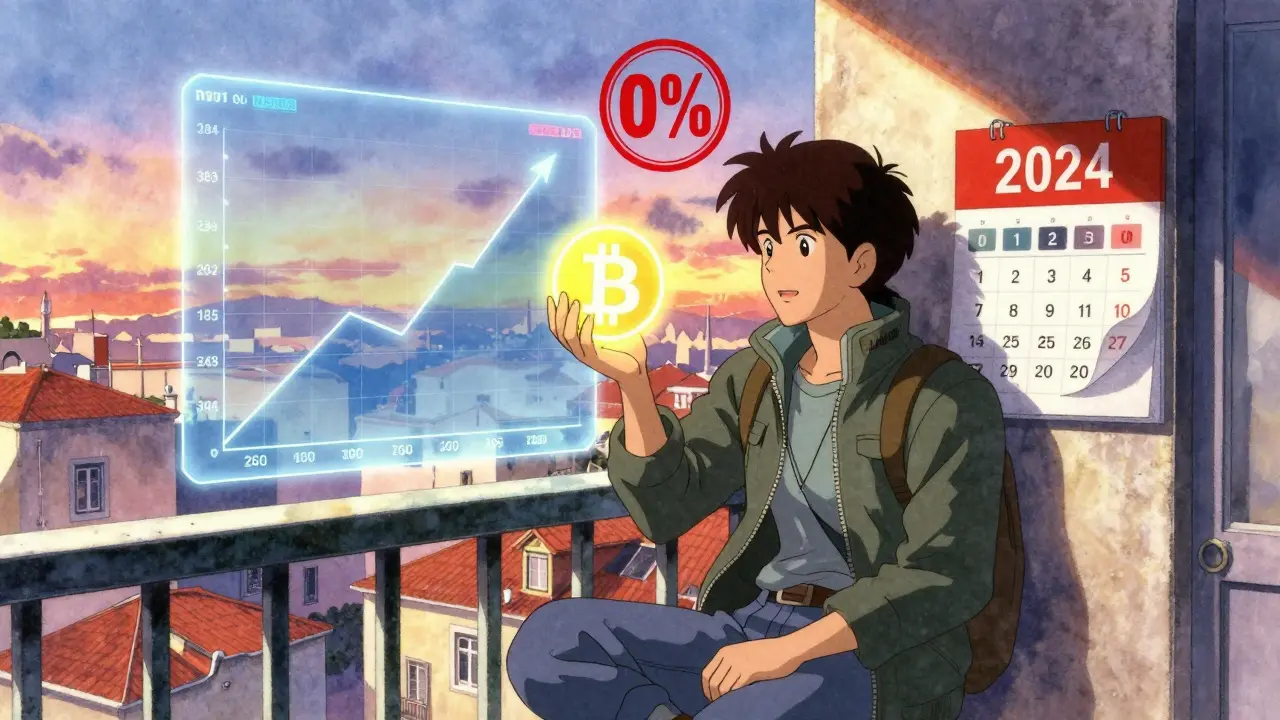
Portugal is still one of the best places in Europe to hold Bitcoin-if you know how to play the rules. Back in 2023, the country changed its tax code, and suddenly, everyone thought the party was over. But here’s the truth: if you’re not trading every week, you’re still paying zero tax on your Bitcoin gains. That’s not a loophole. It’s the law.
How Portugal Taxes Bitcoin (The Real Rules)
Portugal doesn’t have a messy, layered crypto tax system like Germany or France. Instead, it uses three clear buckets under its Personal Income Tax Code (PIT Code). You only pay taxes if you fall into one of these:- Category G (Capital Gains): This is for selling Bitcoin. If you bought it less than 365 days ago and sell it for a profit? You pay 28%. Simple. Flat. No deductions, no brackets. But if you hold it for a full year? Nothing. Zero tax. Not even a reporting requirement.
- Category E (Capital Income): This covers passive income-staking, lending, airdrops. All of it gets taxed at 28%. No exceptions. No hiding. But again, it’s flat. No progressive rates. Easy to calculate.
- Category B (Self-Employment Income): This is for professionals. If you’re mining Bitcoin full-time, running a trading bot with $500k+ volume, or validating transactions as a business? You’re taxed like a freelancer. Rates go from 14.5% up to 53%, depending on your total income. This is where the bite comes.
The key? Time. If you’re not flipping Bitcoin every few months, you’re not paying tax. Most people don’t realize this. They assume all crypto profits are taxed. In Portugal, that’s only true if you’re acting like a trader, not an investor.
Why Portugal Beats Other European Countries
Let’s compare. In Germany, you can also avoid tax if you hold Bitcoin for over a year. But if you sell within that year? You pay up to 45%-and that’s your top income tax rate, not a flat 28%. Plus, Germany taxes crypto-to-crypto trades as taxable events. Swap BTC for ETH? You owe taxes on the gain, even if you didn’t cash out. France? 30% flat tax on all gains-no matter how long you held it. Plus, staking and mining are taxed as income, up to 45%. And they track everything. Portugal doesn’t tax crypto-to-crypto swaps. You can trade BTC for SOL, then ETH, then LTC, and never trigger a tax event. That’s huge. It means you can rebalance your portfolio, chase trends, or hedge without worrying about tax bills. Even the Netherlands, often seen as crypto-friendly, taxes all sales as income. Portugal’s 28% short-term rate is lower than most, and the long-term exemption? It’s unmatched in the EU.What You Need to Track (And What You Don’t)
You don’t need to report every single trade. But you do need to know two things:- When you bought each Bitcoin. The 365-day clock starts the day you acquired it. Not the day you moved it to a wallet. Not the day you got a receipt. The actual purchase date. Use a tool like CoinTracking or Koinly to import your history. Manual tracking? Possible, but risky.
- Whether you’re a professional. If you’re trading 50+ times a month, using leverage, or making your main income from crypto? You’re likely in Category B. That’s where the 53% rate kicks in. Most people don’t cross that line. But if you do, you need to register as self-employed and file quarterly.
Portugal’s tax authority (AT) doesn’t actively hunt crypto holders. They’re still building the tools. But they’re getting better. In 2024, they started requiring banks to flag large crypto-related transfers. So while you’re not being watched today, that could change. Document everything. Keep your purchase receipts, wallet addresses, and trade logs.
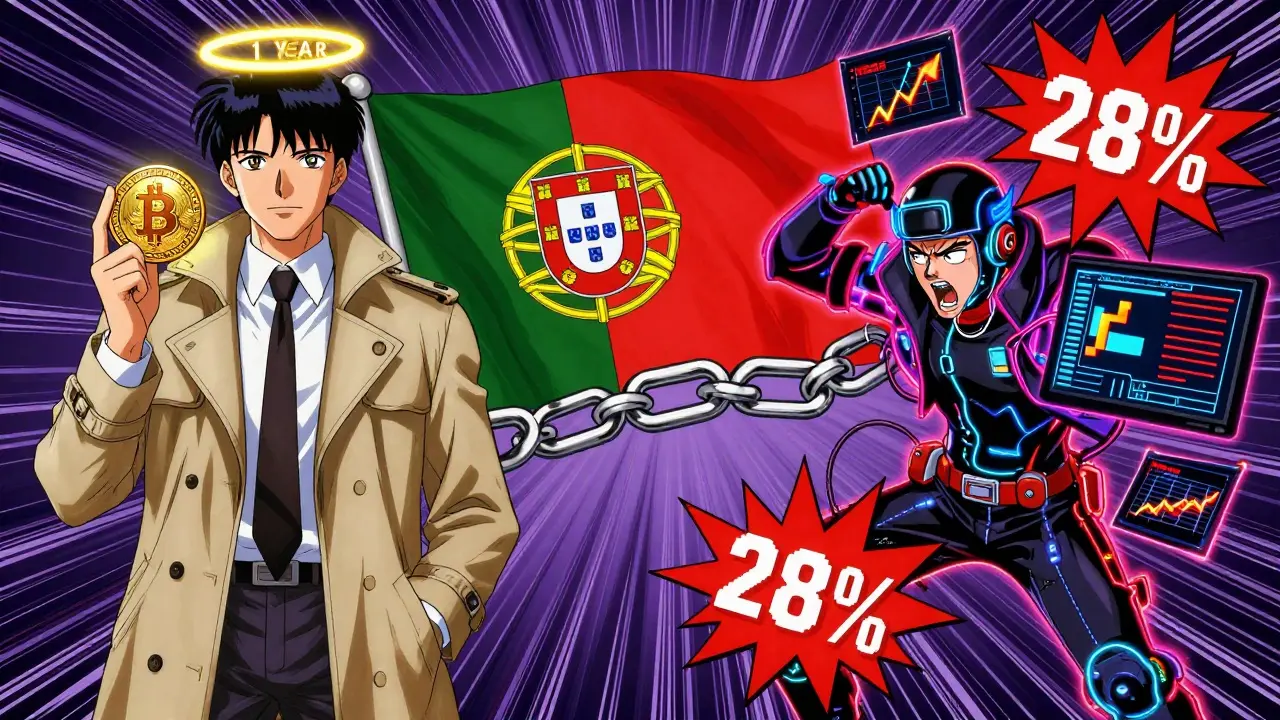
How Digital Nomads Are Using This
Portugal’s Non-Habitual Resident (NHR) program is still active for those who moved before 2024. Even if you’re not eligible anymore, the country’s crypto tax rules work the same for everyone. That’s why thousands of digital nomads moved here-not just for the weather, but for the tax edge. Imagine this: you’re living in Lisbon, earning Bitcoin from remote work, staking ETH, and holding BTC you bought in 2021. You sell it in 2025. No tax. You swap BTC for SOL in 2024? No tax. You earn $5,000 in staking rewards? Pay 28%. That’s it. Compare that to the U.S., where you pay capital gains tax on every trade, or the UK, where you get an annual allowance but pay 10-20% on everything over it. Portugal gives you freedom to grow your portfolio without constant tax friction.Who Should Avoid Portugal’s Crypto Tax System
Not everyone benefits. If you’re a high-frequency trader-say, you’re running algorithms, doing arbitrage, or making 100+ trades a month-you’re probably better off elsewhere. Portugal’s Category B rates (up to 53%) are among the highest in Europe for professional traders. Countries like Switzerland or Malta offer more favorable business structures for active traders. Also, if you’re planning to move to Portugal soon and think you can claim NHR after 2024, you’re out of luck. The program closed to new applicants. But the crypto tax rules? They’re still there. And they’re not going away.
What’s Next for Portugal’s Crypto Tax Policy
There’s no sign the government wants to change this. Why? Because it’s working. Portugal attracts investors, digital nomads, and crypto startups. The economy benefits. The tax revenue from the 28% short-term and passive income rates is steady. The long-term exemption? It’s a magnet. Experts predict minor tweaks-maybe tighter reporting for large wallets or better bank-Crypto exchange data sharing. But they don’t expect the core rules to change. The 365-day rule is too popular. Too simple. Too effective. The only real risk? You. If you don’t track your dates, you might accidentally sell before the year mark and pay 28% when you could’ve paid 0%. Or worse-you start trading like a pro without realizing it, and suddenly owe 53%.Final Advice: Keep It Simple
If you’re a Bitcoin investor who buys, holds, and occasionally sells after a year? Portugal is the best place in Europe to do it. No complex forms. No hidden taxes. No surprise bills. Just clear rules: hold for a year, pay nothing. Earn passive income? Pay 28%. Trade like a business? Pay what you owe. Don’t overcomplicate it. Use a crypto tax tool. Save your purchase receipts. Know your dates. And don’t trade every day unless you’re ready for the 53% rate. Portugal didn’t become a crypto haven by accident. It was built on clarity, simplicity, and fairness. For the average Bitcoin investor, that’s still the best deal in Europe.Is Bitcoin really tax-free in Portugal?
Yes-if you hold it for more than 365 days before selling. Portugal doesn’t tax capital gains on Bitcoin for individual investors who hold long-term. Only short-term trades (under one year) are taxed at 28%. Passive income like staking is always taxed at 28%, and professional trading is taxed as business income.
Do I need to report my Bitcoin holdings to Portuguese tax authorities?
You only need to report if you made a taxable event-like selling Bitcoin within a year, earning staking rewards, or running a crypto business. If you held Bitcoin for over a year and didn’t trade it, no reporting is required. But keep records for at least five years in case of audit.
What if I trade Bitcoin for Ethereum in Portugal? Do I owe tax?
No. Portugal does not treat crypto-to-crypto trades as taxable events. Swapping BTC for ETH, USDT, or any other cryptocurrency is not subject to capital gains tax. This is one of the biggest advantages over countries like Germany or the U.S., where such swaps trigger tax liabilities.
Is staking Bitcoin taxed in Portugal?
Staking rewards are taxed under Category E at a flat 28%, regardless of how long you’ve held the original asset. This applies to all passive income from crypto-lending, yield farming, and airdrops too. But unlike some countries, there’s no additional social charge or progressive rate.
Can I get a Portuguese residency visa by investing in Bitcoin?
Not directly. The Golden Visa program no longer accepts cryptocurrency investments as of 2023. However, you can still qualify for residency by investing in real estate, venture capital funds, or job-creating businesses. Many Bitcoin investors use their crypto profits to fund these qualifying investments while benefiting from Portugal’s tax-free long-term holding rules.





Comments
SUMIT RAI
December 26, 2025 AT 11:28Portugal is basically the crypto wild west 😎🔥 no taxes? sign me up!
Andrea Stewart
December 27, 2025 AT 19:55This is actually one of the clearest explanations I've seen. The 365-day rule is the golden key. Most people think all crypto is taxed everywhere, but Portugal's simplicity is a gift. Just track your buys and don't trade like a day trader. Done.
Josh Seeto
December 28, 2025 AT 05:53Oh wow so if I buy BTC in 2024 and sell in 2025 I pay nothing? That's not tax-free, that's tax-avoidance with a fancy name. 🤡
Kevin Gilchrist
December 29, 2025 AT 03:57I moved to Lisbon last year and honestly? This is why. I bought my first BTC in 2021. Sold half this year after holding 4 years. Zero tax. Zero paperwork. Zero guilt. Meanwhile my cousin in California just got a 1099 for swapping BTC to ETH and is crying into his tax software. Life is good when you're smart. 🥂
Khaitlynn Ashworth
December 30, 2025 AT 06:19So you're telling me I can just sit on crypto for a year and magically not pay taxes? Wow. I guess the government just gives up when the rules are too simple. I'm filing for residency tomorrow. Also I'm pretty sure this is illegal in my country but who cares lol 🤷♀️
surendra meena
December 31, 2025 AT 10:21THIS IS THE MOST IMPORTANT THING YOU'LL EVER HEAR ABOUT CRYPTO IN EUROPE!!!!!!! PEOPLE ARE LOSING MILLIONS BECAUSE THEY DONT KNOW THIS!!!!!! PORTUGAL IS THE ONLY PLACE THAT MAKES SENSE!!!!!! I'M SELLING MY HOUSE IN DELHI AND MOVING TO PORTO TOMORROW!!!!!!
NIKHIL CHHOKAR
December 31, 2025 AT 16:58It's interesting how people celebrate tax avoidance as if it's a moral victory. The system is designed to reward long-term holding, which is fine, but let's not pretend this isn't exploiting a loophole. Other countries tax this because they need revenue. Portugal's model is unsustainable long-term.
Mike Pontillo
December 31, 2025 AT 17:03Hold for a year. Pay nothing. Swap coins. Pay nothing. Stake? Pay 28%. That's it. No forms. No headaches. If you're overcomplicating this you're doing it wrong.
Gavin Hill
January 1, 2026 AT 20:24The real win isn't the tax rate. It's the absence of noise. No one's chasing you for reports. No one's auditing your wallet. You just live. You hold. You trade when you want. That peace? That's the real currency.
Joydeep Malati Das
January 2, 2026 AT 08:08The clarity of Portugal’s framework is commendable. Unlike jurisdictions with convoluted interpretations, the three-category system allows individuals to align their behavior with legal boundaries without ambiguity. A model worth studying.
rachael deal
January 3, 2026 AT 18:55I just started staking and was worried about taxes. This made me so happy!! I'm so glad I moved here. I feel like I can finally grow my crypto without being scared of the IRS breathing down my neck. Thank you for explaining this so clearly!! 💪❤️
Elisabeth Rigo Andrews
January 4, 2026 AT 04:38The passive income tax at 28% is a flat rate? That's actually efficient. Most countries over-engineer this with progressive brackets and social charges. Portugal’s model is minimalist but effective. The real risk is behavioral - not regulatory. Don't become a trader. Stay an investor.
Adam Hull
January 4, 2026 AT 18:09It’s amusing how the crypto community treats Portugal like some kind of crypto utopia. The reality is that this policy attracts speculative capital, not innovation. The government doesn’t care about you. They care about the real estate boom and the influx of wealthy foreigners. Don’t flatter yourself.
Mandy McDonald Hodge
January 5, 2026 AT 22:20i just bought my first btc last month and was so scared of taxes but now i feel like i can finally breathe 😭 thank you for this post!! i’m gonna use cointracking and just hold for a year!! i’m so excited!! 🥹❤️
Bruce Morrison
January 7, 2026 AT 04:35If you're holding long-term and not trading like a day trader, Portugal is the easiest place in Europe to be a crypto investor. No fluff. No drama. Just hold. Keep your dates. Done. No need to overthink it.