Mining Data in On-Chain Analysis: How Blockchain Transactions Reveal Market Truths
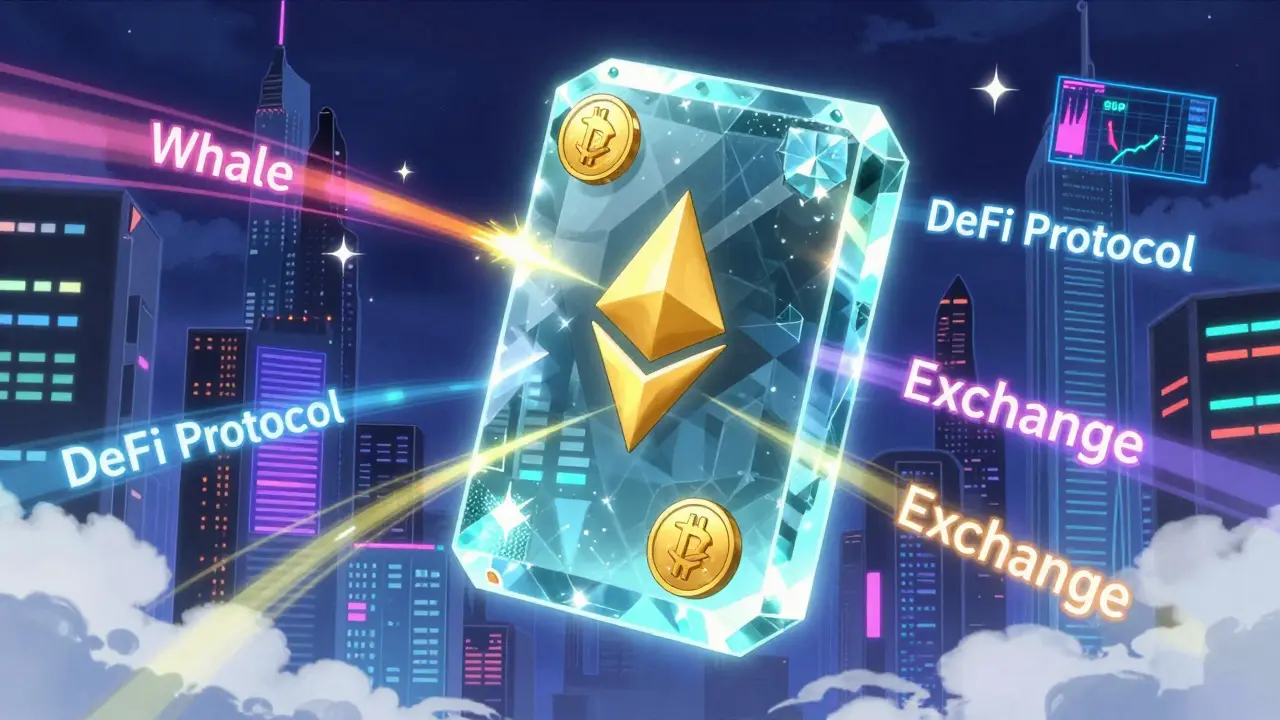
When you send Bitcoin or swap Ethereum tokens, that transaction doesn’t vanish. It gets carved into a public ledger that never forgets. Every number, every address, every timestamp is there - permanently. This isn’t just history. It’s a live feed of what people are actually doing with crypto. Mining data in on-chain analysis means digging into that raw blockchain record to find patterns, signals, and truths that no exchange or news site can hide.
What Exactly Is On-Chain Data?
On-chain data is everything that happens on a blockchain network after a transaction is confirmed. That includes:- Who sent what to whom
- How much was transferred
- When it happened (down to the second)
- How much gas or mining fee was paid
- Which smart contracts were triggered
- Whether a wallet is linked to an exchange, a DeFi protocol, or a known entity
This isn’t guesswork. It’s factual. Once a block is added to Bitcoin or Ethereum, those records are locked in. No one can delete them. No central authority can alter them. That’s why traders, developers, and even regulators rely on this data - it’s the closest thing to truth we have in crypto.
Bitcoin uses a system called UTXO (Unspent Transaction Output), where each transaction input must be fully spent. Ethereum uses an account-based model, like a bank account, where balances update directly. These differences mean the way data is structured and mined varies. But both produce a mountain of usable information.
Why On-Chain Beats Off-Chain Every Time
Think about how most people track crypto prices. They look at Coinbase or Binance volume. But here’s the catch: most trades on those platforms never touch the blockchain. Two users swapping ETH on Binance? That’s just an internal ledger update. No blockchain transaction. No public record.On-chain data cuts through that noise. When a wallet moves $2 million in ETH from one address to another - that’s visible. When a whale sends Bitcoin to a new wallet after months of inactivity - that’s a signal. Glassnode’s 2023 study found on-chain analytics track large wallet movements with 99.998% accuracy. Exchange-based volume estimates? Only 85% accurate. Why? Because exchanges lie. Or at least, they don’t show the full picture.
On-chain data doesn’t care if you’re using a centralized exchange. It sees the real movement. That’s why institutional investors use it to time entries and exits. Retail traders use it to spot trends before they hit Twitter.
Key Metrics That Actually Matter
Not every number on the blockchain is useful. Here are the ones professionals watch:- MVRV Ratio (Market Value to Realized Value): Compares the current market price of all coins to what investors originally paid. If MVRV is high, the market might be overvalued. If it’s low, it could be a buying opportunity. By mid-2023, 68% of institutional reports included this metric.
- SOPR (Spent Output Profit Ratio): Measures whether people are selling at a profit or loss. A SOPR above 1 means most coins are being sold for more than bought. Below 1? People are dumping at a loss - often a market bottom signal.
- NUPL (Net Unrealized Profit/Loss): Shows how much profit or loss is locked in across all coins. Glassnode users reported NUPL accurately called market bottoms within 2.3% on three separate occasions in 2023.
- Whale Movements: Transactions over $100,000. A University of Cambridge study found these predict short-term price moves with 92% accuracy - if you filter out exchange internal transfers.
These aren’t random indicators. They’re built from real blockchain behavior. You can’t fake them. You can’t manipulate them. You can only interpret them.
Tools That Make It Possible
You don’t need to run a full node to mine on-chain data. But you do need the right tools.- Etherscan: Free, open, and reliable. Great for checking Ethereum transactions, token transfers, and smart contract activity. Developers use it daily.
- Blockchain.com Explorer: Best for Bitcoin. Shows real-time block data, miner fees, and address histories.
- Glassnode: The go-to for institutions. Offers metrics like NUPL, MVRV, and Realized HODL Waves. Used by 78 of the top 100 crypto hedge funds.
- Nansen: Focuses on wallet labeling. It can tell you if an address belongs to a DAO, a DeFi protocol, or a known whale. Has 150,000 active users paying $99/month.
- Chainalysis: Used by governments and banks for compliance. Tracks illicit flows and AML risks.
Free tools give you the raw data. Paid platforms turn it into insight. The difference? Time. Nansen’s Smart Alerts, updated in August 2023, cut false positives by 37% using machine learning. That’s the kind of edge you pay for.
The Dark Side: Limitations and Pitfalls
On-chain data isn’t magic. It has blind spots.Privacy coins like Monero? Only 1.7% of transactions are analyzable. That’s because they use ring signatures and stealth addresses. On-chain analysis is useless there.
Then there’s noise. In Q1 2023, 43% of Ethereum’s “activity” came from arbitrage bots - not humans. If you mistake bot trades for real demand, you’ll get the wrong signal. Dr. David Gerard calls this “on-chain fundamentalism” - the mistake of treating transaction volume as economic value.
And fees? They’re a lag. During peak congestion, Ethereum transactions can take 10 minutes to confirm. That means your data is already outdated by the time it’s recorded. High-frequency traders can’t use this in real time.
Even worse - some “whale alerts” are just exchange deposits. A wallet sends 500 ETH to Binance? That’s not a sell signal. It’s a deposit. Nansen and Glassnode now filter these out, but many free tools don’t. That’s why 62% of retail users report false positives in their whale alerts.
Who’s Using This - And Why
Institutional investors use on-chain data to manage risk. Hedge funds track MVRV and NUPL to decide when to enter or exit positions. Banks use it for AML compliance. The SEC says on-chain analysis is acceptable for anti-money laundering checks - as long as you can prove where funds came from.Regulators are catching up. The EU’s MiCA framework now requires stablecoin issuers to monitor on-chain transactions. Walmart uses it to track supply chains - on-chain shipment logs cut audit times by 76%.
For retail traders? It’s a game-changer. One Reddit user said Nansen’s smart money tracking helped them catch the Ethereum staking surge three days before the price jumped. Another used Etherscan’s token tracker to find a new DeFi protocol 14 days before it got listed on CoinGecko.
But here’s the truth: most retail users don’t know how to read this data. Coinbase’s 2023 survey found it takes 80-120 hours of study to get basic proficiency. You need to understand blockchain structure, SQL for querying data, and market context. Without all three, you’re just chasing numbers.

The Future: AI, Privacy, and Cross-Chain
The next wave is AI. 78% of analytics platforms now use machine learning to filter noise, label wallets, and predict movements. Glassnode’s Realized HODL Waves and Nansen’s Smart Alerts are just the start.By 2024, cross-chain analysis will be standard. Right now, you can track Bitcoin on Bitcoin, Ethereum on Ethereum. But what if a whale moves ETH to Solana, swaps it for SOL, then sends it back? Most tools can’t follow that. Chainalysis and others are building bridges.
Privacy is the biggest threat. Zero-knowledge proofs (ZKPs) are coming to Ethereum and other chains. They’ll let users prove a transaction is valid without revealing details. That could make on-chain analysis useless for some use cases.
But here’s the counterpoint: the blockchain’s immutability remains. Even if ZKPs hide the details, the fact that a transfer happened won’t disappear. The future isn’t about hiding data - it’s about understanding context. Are these transfers from real users? Or bots? From wallets tied to institutions? Or mixers? The tools are evolving to answer those questions.
How to Get Started
You don’t need a PhD. But you do need to start somewhere.- Learn the basics: Understand how Bitcoin and Ethereum work. Know the difference between UTXO and account models. Use free resources like CoinMarketCap Academy.
- Use free explorers: Go to Etherscan or Blockchain.com. Look up a wallet. See the transaction history. Try to spot patterns. What happens when gas fees spike? What do large transfers look like?
- Follow one metric: Pick NUPL or SOPR. Track it for 30 days. Learn what high and low values mean. Don’t jump into all metrics at once.
- Compare with price: When NUPL hits 0.8, what happened to BTC price? When SOPR dropped below 0.95? Write it down. Build your own intuition.
- Upgrade when ready: If you’re serious, try Nansen’s free tier. Or Glassnode’s demo. See how labeled wallets change your view.
There’s no shortcut. But there is a path. And it starts with looking at the blockchain - not the headlines.
What’s Next?
On-chain analysis is no longer a niche tool. It’s becoming the foundation for how crypto is understood. From hedge funds to regulators to retail traders - everyone is using it. The question isn’t whether you should care. It’s whether you’re ready to learn how to read it.The blockchain doesn’t lie. But it doesn’t speak clearly either. You have to learn its language. And once you do, you’ll see what no price chart can show you.
Is on-chain data the same as blockchain data?
Yes, they’re interchangeable terms. On-chain data refers to all transactions and activities recorded directly on a blockchain - like Bitcoin or Ethereum transfers, smart contract calls, and miner rewards. It’s called "on-chain" because it’s part of the public, verified ledger. Anything that happens outside the chain - like trades on centralized exchanges - is off-chain and not included.
Can I mine on-chain data for free?
Absolutely. Tools like Etherscan, Blockchain.com Explorer, and Blockchair offer free access to transaction histories, wallet balances, and block data. You can’t get advanced metrics like NUPL or whale movement alerts for free, but you can learn the basics, track wallets, and spot patterns without paying a cent.
Why do some on-chain metrics give false signals?
Because not all transactions reflect real human behavior. Exchange deposits, miner rewards, and arbitrage bots make up a large portion of activity. For example, if a wallet sends 10,000 ETH to Binance, it’s not a sell - it’s a deposit. Many free tools don’t filter these out. Premium platforms like Nansen and Glassnode use machine learning to label wallets and remove noise, which cuts false signals by up to 37%.
Does on-chain analysis work for privacy coins like Monero?
No. Privacy coins like Monero, Zcash, and Dash use advanced cryptography to hide sender, receiver, and amount. Chainalysis reports only 1.7% of Monero transactions are analyzable. On-chain analysis is built for transparency - so it’s ineffective on networks designed to obscure activity.
How do institutions use on-chain data differently than retail traders?
Institutions use it for risk management, compliance, and macro analysis. They track MVRV, NUPL, and long-term holder behavior to time market cycles. Retail traders focus on short-term signals like whale movements and gas fee spikes. Institutions also have access to enterprise APIs, dedicated analysts, and historical datasets that retail users can’t afford. But both groups rely on the same core data - just with different tools and goals.
Is on-chain analysis legal?
Yes. The SEC and EU regulators explicitly accept on-chain analysis as valid for AML (anti-money laundering) compliance. As long as you’re not hacking or decrypting private data - which you can’t do anyway - analyzing public blockchain records is completely legal. In fact, it’s becoming a requirement for stablecoin issuers under MiCA.
What skills do I need to do on-chain analysis?
Start with blockchain fundamentals: understand how blocks, transactions, and wallets work. Then learn SQL - most on-chain data is queried using it. Python helps for automation. But the biggest skill is context: knowing whether a spike in transactions means adoption, speculation, or bot activity. Many people have the tools but lack the judgment to interpret them correctly.




Comments
Richard Cooper
February 27, 2026 AT 18:07on chain data is just a fancy way of saying the blockchain never forgets. i dont need a whole essay to tell me that.
Danny Kim
March 1, 2026 AT 07:06so let me get this straight… we’re supposed to trust a system where every single move is recorded, but the people who built it are anonymous? sounds like a surveillance state with better branding.
Colin Lethem
March 1, 2026 AT 10:26bro this is wild. i checked my old wallet last week and saw a 2019 tx i totally forgot about. like… someone out there knows i bought btc at 8k. not cool.
Michael Rozputniy
March 1, 2026 AT 22:40the government already has access to this data. dont you think theyre using it to track you? every transaction, every wallet, every second. its not transparency. its control. and they call it "truth".
theyre building a digital cage and calling it a ledger.
you think your privacy matters? think again. the blockchain is watching. always.
glassnode? nansen? theyre just the tip of the iceberg. the real players are the ones with backdoor access.
they dont need to hack you. they just need to read the public record.
and when they decide to freeze a wallet? no court order. no judge. just a server update.
you think this is freedom? its the opposite.
they call it decentralized. its just centralized with more steps.
dont be fooled by the math. the power is still in their hands.
every time you send btc, you’re signing a contract with the machine.
and machines dont forgive.
they dont forget.
they just record.
Ryan Burk
March 2, 2026 AT 04:56lol 99.998% accuracy? you mean like how every time a whale moves coins it crashes the market? yeah right. its all rigged. the same 10 wallets move every time. they call it "whale movement" but its just bots controlled by the same group. this whole thing is a pyramid scheme with math.
Cathy Sunshine
March 3, 2026 AT 05:59the irony of treating blockchain as some divine ledger of truth is that it reveals more about human behavior than economic value. we’re not analyzing data-we’re projecting our collective anxiety onto immutable code.
the MVRV ratio? it’s not a metric. it’s a mirror.
we don’t need to know how much profit is locked in-we need to ask why we’re so terrified of loss.
on-chain analysis is the new astrology. we stare at numbers hoping they whisper meaning into our fear.
and yet… we keep looking.
because the truth isn’t in the data.
it’s in the silence between the transactions.
Michelle Xu
March 3, 2026 AT 15:43if you're new to on-chain analysis, start with Etherscan. type in any wallet. see the flow. notice how some addresses send tiny amounts every few days. those are likely personal wallets. large spikes? likely exchanges or whales.
don't overcomplicate it. look for patterns. compare with price action. your intuition will grow.
and yes, you can do this for free. no need to pay $99/month until you're ready.
Shannon Holliday
March 3, 2026 AT 23:09🔥 this is why I love crypto. no middlemen. no lies. just raw truth on a public ledger. 🌍✨
Vishakha Singh
March 5, 2026 AT 10:55as someone from India, I see how on-chain data helps small traders compete with Wall Street. no insider info needed-just observation. I started tracking SOPR last year and caught a bottom before anyone on Twitter did.
the tools are free. the knowledge is yours to build.
you don't need to be a genius. just consistent.
lori sims
March 5, 2026 AT 12:29whale alerts are cool until you realize half of them are just people sending ETH to Binance to buy more ETH. like… that’s not a sell signal. that’s a round trip. and yet every bot screams "BEARISH". it’s like watching a weather app predict rain because a bird flew south.
kati simpson
March 7, 2026 AT 10:46i’ve been reading this stuff for months. i still dont know if the data is telling me something or if im just seeing patterns in noise. maybe its all just random. maybe we’re all just chasing ghosts in a machine.
but… i keep checking.
because what else is there?
Cory Derby
March 7, 2026 AT 20:42for those just starting out: take one metric. one. don’t try to learn NUPL, SOPR, MVRV, and whale movements all at once. pick one. track it for 30 days. write down what happens when it spikes or drops. compare it to price. that’s how you build intuition.
you don’t need a PhD. you need curiosity.
and patience.
and maybe a coffee.
Michelle Mitchell
March 9, 2026 AT 01:03so we're supposed to believe that on-chain data is pure truth but then you say 43% of activity is bots? and 62% of retail users get false signals? so… its mostly lies? why even call it truth?
its like a magic 8 ball that sometimes works.
Sriharsha Majety
March 9, 2026 AT 21:46bro i just use blockchain.com and check if my wallet is still alive. if it shows balance i chill. if it goes to zero i panic. thats my whole strategy. no fancy metrics. just vibes.
christopher luke
March 11, 2026 AT 07:17you guys are overthinking this. blockchain is just a giant public spreadsheet. if you can read a spreadsheet, you can read on-chain data. start simple. check a tx. see where the money went. boom. you’re a detective now. 🕵️♂️💡
Kristi Emens
March 13, 2026 AT 04:35i’ve been using Nansen’s free tier for a month. the wallet labeling is surprisingly accurate. i saw a wallet labeled "DeFi Bot" send 300 ETH to a new address. turned out it was a liquidity rebalancing. no panic needed. just context.
the tools are getting better. we just need to stop treating them like crystal balls.
Mary Scott
March 15, 2026 AT 02:46the real truth? the blockchain doesn’t lie. but the people who analyze it do. every "whale alert" is a marketing push. every "bullish signal" is a pump. they sell you charts so you buy their newsletter.
they’re not revealing truth. they’re selling fear.
Tabitha Davis
March 16, 2026 AT 12:49you call this analysis? i call it witchcraft with python scripts. you’re telling me a number from 2019 predicts a price move today? that’s not data. that’s astrology with a blockchain tattoo.
and dont even get me started on "realized value". who decided that the price you bought at 5 years ago matters? i dont care what i paid. i care what i can sell for.
you’re all just reading tea leaves made of hashes.
Shannon Black
March 17, 2026 AT 17:12in Japan, we have a concept called "mono no aware"-the awareness of impermanence. On-chain data is the opposite: the permanence of motion. Every transaction, every transfer, every gas fee-it’s a footprint in time. We don’t analyze it to predict. We observe it to remember.
Perhaps that’s the real value: not what it tells us about price, but what it reveals about persistence.
Arya Dev
March 18, 2026 AT 22:44...and yet... when the market crashes... everyone goes back to looking at the blockchain... like it's the last church... like if they stare hard enough... the numbers will save them... they don't realize... the blockchain doesn't care... it just records... and then... it waits...
Ryan Burk
March 20, 2026 AT 07:54lol you think institutions use this to manage risk? they use it to manipulate it. they see a spike in SOPR? they dump. they see a dip? they buy. they’re not following the data. they’re weaponizing it.
and you’re all just chasing their shadow.