Layer 2 Transaction Speed and Costs: The Real Guide to Faster, Cheaper Blockchain
Remember the last time you tried to send a small amount of crypto on Ethereum is the second-largest cryptocurrency platform by market capitalization, known for smart contracts and DeFi during peak hours? You probably paid more in network fees than the value of the transaction itself. It’s frustrating, expensive, and frankly, it doesn’t make sense for everyday use. This is exactly why Layer 2 solutions are secondary protocols built on top of primary blockchains to enhance speed and reduce costs through off-chain processing exist. They aren't just a temporary fix; they are the infrastructure that makes blockchain usable for real people.
By 2026, the conversation has shifted from "if" we should use Layer 2s to "which" one fits your needs. Whether you are trading NFTs, using decentralized finance (DeFi), or just sending money to a friend, understanding how these networks handle transaction speed and costs is crucial. Let's break down how they work, why they are faster, and what you actually pay when you move funds.
The Core Problem: Why Layer 1 Is Too Slow and Expensive
To understand the solution, you have to look at the problem. The main blockchain networks, known as Layer 1 (L1), prioritize security and decentralization above all else. This comes with a trade-off: limited throughput. For context, Bitcoin processes about 7 transactions per second (TPS). Ethereum, despite its upgrades, handles roughly 15 to 30 TPS natively. Compare that to Visa, which can process tens of thousands of TPS, and you see the bottleneck immediately.
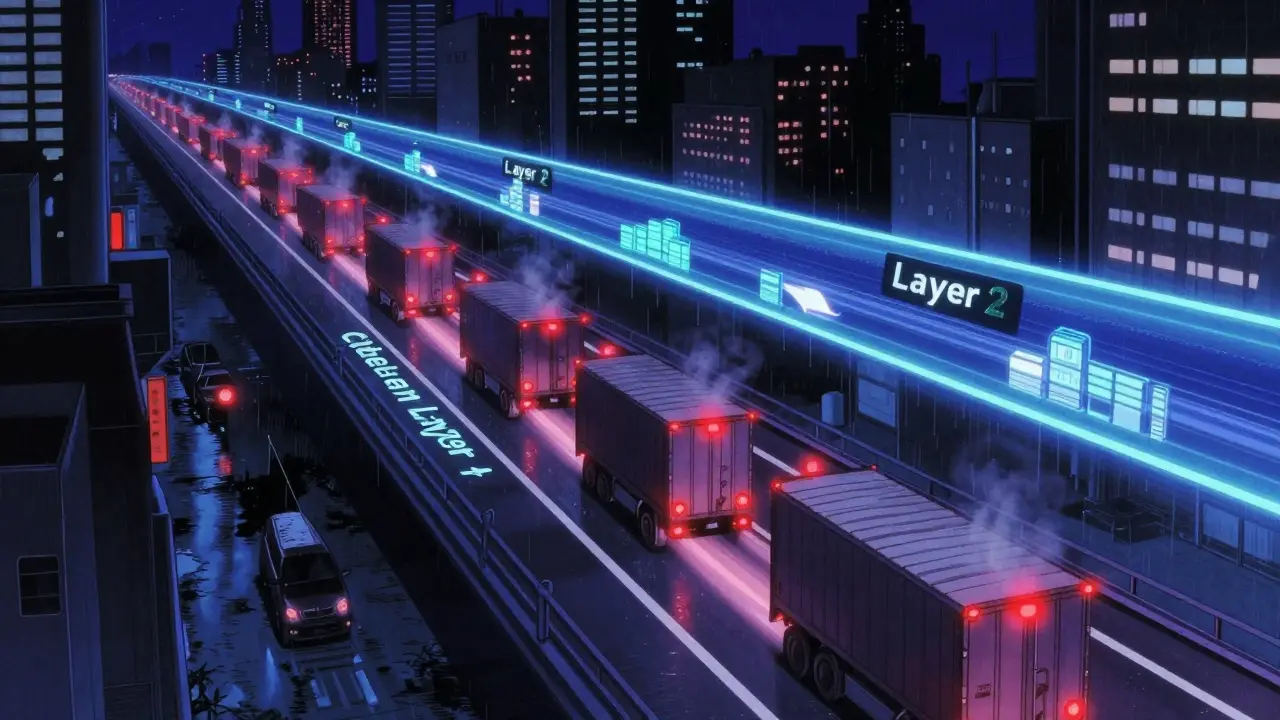
When too many users try to transact simultaneously, the network gets congested. Miners and validators pick the transactions with the highest fees. This creates a bidding war where you pay premium prices just to get your transaction confirmed. In 2021 and 2022, gas fees on Ethereum regularly spiked to $50 or even $100 per transaction. That is not viable for buying a coffee or playing a game. Layer 2 solutions were built to divert this traffic away from the crowded main highway and onto express lanes.
How Layer 2 Boosts Speed and Cuts Costs
Layer 2 protocols don't replace the main blockchain. Instead, they sit on top of it. Think of L1 as the court of law that enforces the final verdict, and Layer 2 as the mediation room where most disputes are settled quickly and cheaply. Only the final result is recorded on the main chain.
This architecture allows Layer 2 networks to achieve massive improvements in two key areas:
- Transaction Batching: Instead of sending every single transaction to the main chain, Layer 2 collects hundreds or thousands of them and bundles them into one summary transaction. This drastically reduces the data stored on L1.
- Off-Chain Computation: The heavy lifting of verifying transactions happens off the main chain. This frees up the main network to focus solely on security and finality.
The result? Transaction speeds jump from minutes to seconds. Costs drop from dollars to fractions of a cent. For example, while Ethereum might take 15 seconds to confirm a block with high fees, a Layer 2 like Polygon is a leading Ethereum scaling framework offering multiple solutions including zkEVM and PoS chains can process blocks in under 2 seconds with negligible fees.

The Two Main Types of Layer 2: Rollups Explained
Not all Layer 2s are created equal. The two dominant technologies driving the current landscape are Optimistic Rollups and Zero-Knowledge (ZK) Rollups. Understanding the difference helps you choose the right network for your activity.
| Feature | Optimistic Rollups | Zero-Knowledge (ZK) Rollups |
|---|---|---|
| Speed of Withdrawal | Slow (7-day challenge period) | Fast (Near-instant verification) |
| Cost | Low | Low to Medium (Computationally intensive) |
| Security Model | Assumes validity unless challenged | Cryptographic proof of validity |
| Examples | Arbitrum, OP Mainnet | Polygon zkEVM, StarkNet, zkSync |
Optimistic Rollups are Layer 2 scaling solutions that assume transactions are valid by default and only verify them if disputed are currently the most popular. Networks like Arbitrum is an optimistic rollup protocol focused on Ethereum scalability and compatibility and OP Mainnet is an optimistic rollup developed by Optimism, part of the Superchain ecosystem dominate DeFi because they are fully compatible with existing Ethereum tools. However, they have a flaw: withdrawing funds back to Ethereum takes up to seven days because anyone can challenge the validity of a transaction during that window.
Zero-Knowledge Rollups are Layer 2 solutions that use cryptographic proofs to verify transaction validity instantly without revealing underlying data solve this speed issue. They generate a mathematical proof that all transactions in a batch are valid. If the proof checks out, the transaction is accepted immediately. This means faster withdrawals and potentially higher security, but the technology is more complex and computationally expensive to run. As hardware improves, ZK-rollups are becoming the gold standard for speed.
Real-World Performance: Speed and Cost Benchmarks
Let’s look at some concrete numbers from 2025 and early 2026. These metrics fluctuate based on network congestion, but the general trend remains clear.
On Ethereum mainnet, a simple token transfer might cost between $2 and $10 depending on demand, taking 15-30 seconds. On Arbitrum One is the flagship network of the Arbitrum ecosystem, widely used for DeFi applications, that same transaction costs less than $0.10 and confirms in under 1 second. Polygon PoS is a sidechain-based scaling solution for Ethereum using Proof of Stake consensus offers similar speeds with block times around 2.1 seconds.
For high-frequency activities like gaming or micropayments, specialized Layer 2s shine. Immutable X is a Layer 2 scaling solution designed specifically for NFTs on Ethereum, offering gas-free minting and trading allows users to trade NFTs with zero gas fees and near-instant settlement. This is impossible on Layer 1. Even newer entrants like Shibarium is a Layer 2 blockchain built for the Shiba Inu ecosystem, focusing on low-cost transactions have entered the space to provide ultra-low costs for specific communities.
The key takeaway is that Layer 2s have moved from theoretical concepts to practical infrastructure. You are no longer choosing between security and usability. You get both.

Choosing the Right Layer 2 for Your Needs
With so many options, how do you decide? It depends on what you are trying to do.
- For DeFi Traders: Stick with EVM-compatible Optimistic Rollups like Arbitrum or OP Mainnet. They have the deepest liquidity and the most established dApps. The 7-day withdrawal window is rarely an issue unless you need to move large sums back to Ethereum urgently.
- For NFT Collectors: Look at Polygon or Immutable X. The ability to mint and trade without paying gas fees is a game-changer for collectors who buy frequently.
- For Developers: Consider ZK-Rollups like Polygon zkEVM or StarkNet if you need instant finality and plan to scale globally. The development tools are maturing rapidly, making migration easier than ever.
- For Everyday Payments: Any major Layer 2 will suffice. Focus on the network with the lowest fees at the moment of transaction. Apps like MetaMask now automatically suggest the cheapest route.
Always check the bridge you are using to move assets between Layer 1 and Layer 2. Bridges are the weakest link in security. Use official bridges or trusted aggregators to minimize risk.
The Future of Layer 2 Scaling
We are still in the early stages of Layer 2 maturity. By 2026, interoperability is the next big hurdle. Currently, moving assets between different Layer 2s (e.g., from Arbitrum to Optimism) can be slow and confusing. Solutions like intent-centric architectures and universal messaging layers are being developed to make cross-L2 transfers seamless.
Additionally, the rise of modular blockchains suggests that Layer 2s will become even more specialized. Some will focus purely on data availability, others on execution, and others on settlement. This specialization will drive costs down further and speeds up higher.
For the average user, this means a future where blockchain interactions feel indistinguishable from traditional web apps. No waiting. No surprise fees. Just fast, secure transactions. Layer 2 technology is the engine making this possible, and it is already here.
What is the fastest Layer 2 network?
Speed varies by network congestion, but Zero-Knowledge Rollups like Polygon zkEVM and StarkNet generally offer the fastest finality due to instant cryptographic verification. Among Optimistic Rollups, Arbitrum and OP Mainnet are highly competitive, with block times under 1 second.
Are Layer 2 transactions safe?
Yes, Layer 2s inherit the security of their underlying Layer 1 blockchain (usually Ethereum). While the transaction processing happens off-chain, the final state is secured by Ethereum. However, risks exist with bridges and smart contracts, so always use reputable platforms.
Why are Layer 2 fees so much lower than Ethereum?
Layer 2s bundle thousands of transactions into a single batch before posting them to Ethereum. This drastically reduces the amount of data stored on the expensive Layer 1 network, allowing costs to be shared among many users, resulting in fractions of a cent per transaction.
Can I use my Ethereum wallet on Layer 2?
Yes, most major Layer 2s are EVM-compatible, meaning wallets like MetaMask, Rabby, or Coinbase Wallet work seamlessly. You simply add the Layer 2 network details to your wallet interface to interact with dApps on that chain.
What is the difference between Arbitrum and Polygon?
Arbitrum is primarily an Optimistic Rollup focused on DeFi and general-purpose computing with strong Ethereum compatibility. Polygon offers a multi-chain approach, including Proof-of-Stake sidechains and ZK-EVMs, catering to a broader range of use cases including enterprise and gaming.