How to Buy Crypto with Fiat in India: Step-by-Step Guide for 2026

Buying cryptocurrency with Indian rupees isn’t illegal - but it’s not simple either. If you’re trying to buy Bitcoin, Ethereum, or any other coin using your bank account or UPI, you’re navigating a maze of taxes, compliance rules, and platform-specific limits. The good news? Millions of Indians are doing it right every day. The bad news? One wrong step can cost you money, time, or worse - your coins.
Is It Legal to Buy Crypto with Rupees in India?
Yes. The Supreme Court overturned the Reserve Bank of India’s 2018 ban in 2020, and since then, buying, selling, and holding crypto has been legal. But legality doesn’t mean freedom. The government slapped a 30% tax on all crypto profits, plus a 4% cess, starting April 1, 2022. That’s one of the highest rates in the world. On top of that, every time you buy crypto with fiat, 1% is automatically deducted as Tax Deducted at Source (TDS) if you’re using a compliant exchange. That’s not optional. It’s built into the transaction.What You Need Before You Start
You can’t just sign up and buy. India’s rules demand identity verification. Here’s what you need ready:- A valid PAN card (Permanent Account Number)
- Your Aadhaar card (government ID linked to biometrics)
- A smartphone with a working camera
- An active UPI ID (like Google Pay, PhonePe, or Paytm)
- A bank account in your name
How to Buy Crypto: Step-by-Step
Follow these steps exactly. Skip one, and you’ll hit a wall.- Choose an exchange - Pick one that supports UPI and complies with TDS. WazirX, CoinDCX, and ZebPay are your safest bets.
- Sign up - Use your email and phone number. Avoid using Gmail aliases or temporary numbers. Exchanges track these.
- Complete KYC - Upload your PAN and Aadhaar. Take the selfie as instructed. This takes 5 to 30 minutes, depending on how fast the system processes it.
- Link your UPI - Add your UPI ID (e.g., yourname@upi). Some exchanges let you link multiple UPI apps. That’s useful if you hit daily limits.
- Deposit INR - Minimum deposit? WazirX lets you start with ₹100. ZebPay and CoinDCX also accept ₹100. Binance India requires ₹500 for bank transfers. UPI deposits are instant. Bank transfers take 1-2 days.
- Buy crypto - Search for the coin you want (BTC, ETH, SOL, etc.). Enter the amount in rupees. Confirm. The 1% TDS is deducted before your coins arrive. You’ll see the final amount credited to your wallet.
That’s it. You now own crypto. But you’re not done. You need to track your taxes.
Top 4 Exchanges for Buying Crypto with Rupees in 2026
Not all exchanges are equal. Here’s what’s working right now:| Exchange | Min Deposit | Payment Methods | Trading Fee | TDS Compliance | Coin Selection | Best For |
|---|---|---|---|---|---|---|
| WazirX | ₹100 | UPI, Bank Transfer | 0.20% (flat) | Yes | 300+ | Beginners, UPI users |
| ZebPay | ₹100 | UPI, Bank Transfer | 0.15%-0.50% (tiered) | Yes | 75 | Mobile users, simple interface |
| CoinDCX | ₹100 | UPI, Bank Transfer | 0.10%-0.40% | Yes | 250+ | Active traders, low fees |
| Kraken | ₹2,000 | Bank Transfer Only | 0.00%-0.16% | No | 500+ | Advanced traders, low fees |
WazirX is the easiest for beginners. ZebPay has the best mobile app. CoinDCX gives you the lowest fees if you trade often. Kraken is powerful but risky - it doesn’t deduct TDS, so you’re on the hook for calculating and paying it yourself. That’s a common trap. Many users forget and end up with tax notices.
What You Must Know About Taxes
This isn’t optional. You will be taxed. Here’s how it works:- 30% tax on profits - If you bought BTC at ₹90 lakh and sold at ₹98 lakh, you pay 30% on the ₹8 lakh gain. No deductions. No offsetting losses.
- 4% cess - Added on top of the 30%. So your effective rate is 31.2%.
- 1% TDS - Every time you buy crypto with rupees, 1% is taken out. This is not your final tax. It’s a prepayment. You still owe the 30% on your yearly profit.
- No loss offset - If you lost money on Ethereum but made money on Bitcoin, you can’t use the loss to reduce your tax bill. That’s unique to crypto in India.
Exchanges like WazirX and CoinDCX now generate annual tax reports you can download. Use them. Don’t guess. The Income Tax Department has access to your transaction data. If you underpay, you’ll get a notice - and penalties.
Security: Don’t Get Hacked
In 2024, Indian users lost over ₹9 crore to crypto theft. Most of it happened because people left coins on exchanges. Exchanges are not banks. They can be hacked. ZebPay had a hot wallet breach in 2024. Binance India has had phishing scams targeting Indian users.Here’s how to stay safe:
- Enable two-factor authentication (2FA) - Use an authenticator app like Google Authenticator or Authy. Never use SMS.
- Set withdrawal whitelists - Only allow transfers to addresses you’ve pre-approved.
- Don’t reuse passwords - If you use the same password for your email and exchange, you’re one leaked password away from losing everything.
- Move large holdings offline - Use a hardware wallet like Ledger Nano S+ (₹11,999). Only keep what you’re trading on the exchange.
95% of coins on Indian exchanges are stored in cold wallets. That’s good. But your account? That’s online. And that’s where hackers strike.

What’s Next? CBDC and Regulation
The Reserve Bank of India launched its own digital currency - the Digital Rupee - in November 2025. It’s still in pilot mode, but it’s a signal. The government isn’t against digital money. It just wants to control it.The proposed Crypto Asset Regulation Bill, still under review since early 2023, could bring clearer rules - or stricter bans. Experts believe India will allow crypto but keep it tightly regulated. That means:
- More exchanges will shut down if they don’t comply with TDS and KYC.
- Foreign exchanges like Coinbase already left in 2023. More may follow.
- Expect more tools for tax reporting and automated compliance.
Don’t wait for perfect regulation. It won’t come. The market is moving fast. 8.1% growth in 2025, 25 million users expected by 2027. If you’re waiting for the government to make it easy, you’ll miss the window.
Real Stories: What Works and What Doesn’t
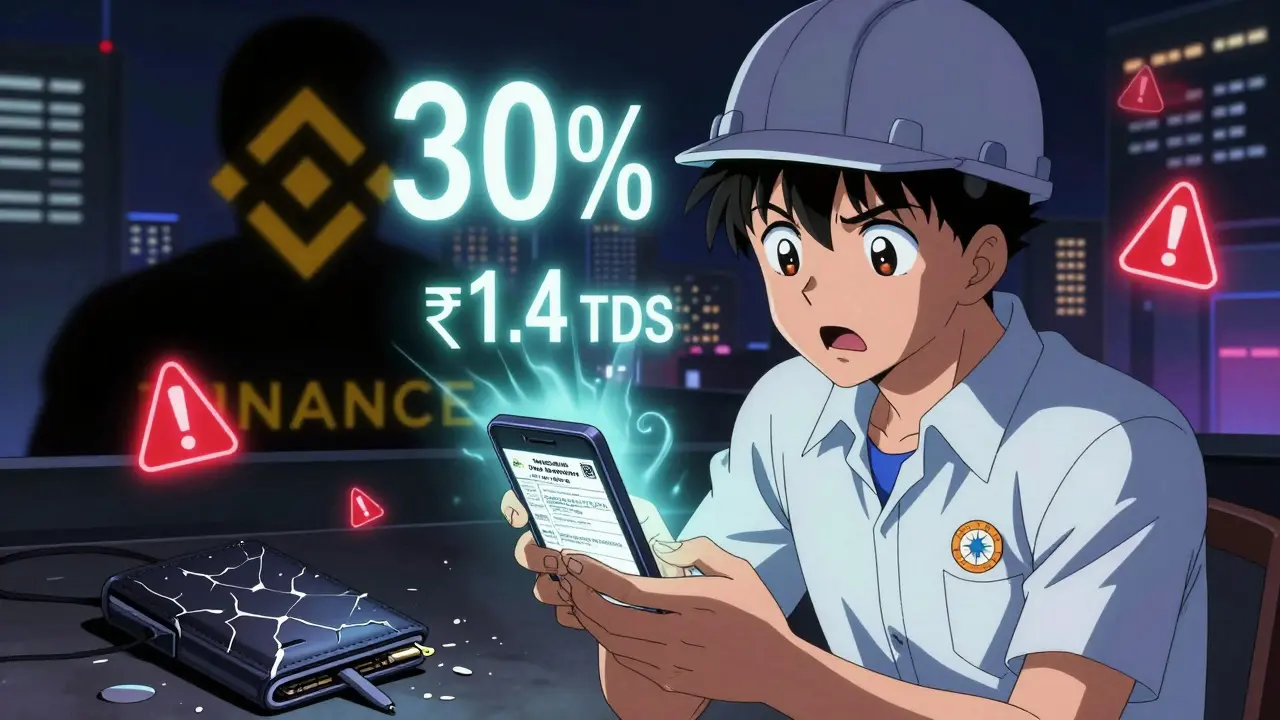
A 19-year-old student in Pune started buying ₹100 of Bitcoin every day on WazirX in 2023. Today, his portfolio is worth ₹2.8 lakh. He didn’t time the market. He just kept buying. A 32-year-old engineer in Bangalore used Binance India because it had more coins. He forgot about TDS. He didn’t track his gains. In March 2026, he got a tax notice for ₹1.4 lakh in unpaid tax. He’s now paying in installments. A couple in Hyderabad used the same password for their email and exchange. A phishing email stole their login. They lost ₹4.2 lakh in ETH and SOL in 48 hours.These aren’t rare. They’re common. Learn from them.
Final Advice: Start Small, Stay Compliant
You don’t need to invest ₹1 lakh to start. ₹100 is enough. Use WazirX or CoinDCX. Do your KYC. Link UPI. Buy your first coin. Watch what happens. Track your transactions. Download your tax report every year.Don’t chase moonshots. Don’t borrow money. Don’t ignore taxes. Crypto in India isn’t a get-rich-quick scheme. It’s a long-term financial tool - if you play by the rules.
India’s crypto future belongs to those who are careful, consistent, and compliant. Not the ones who take shortcuts.
Can I buy crypto with UPI in India?
Yes. UPI is the fastest and most popular way to buy crypto in India. Exchanges like WazirX, ZebPay, and CoinDCX support instant UPI deposits. Transactions settle in under 15 seconds. You need a UPI ID linked to your bank account and a valid KYC on the exchange.
Is crypto trading taxable in India?
Yes. All crypto profits are taxed at 30%, plus a 4% cess. That’s 31.2% total. You also pay 1% TDS on every purchase. Losses cannot be offset against gains. You must report all transactions in your income tax return.
Which exchange is best for beginners in India?
WazirX is the best for beginners. It has the lowest minimum deposit (₹100), instant UPI deposits, simple interface, and built-in tax reports. It’s also the most trusted platform with over 14,000 positive reviews on Trustpilot.
Can I use Binance in India?
Yes, but with risks. Binance India allows trading, but it does not automatically deduct TDS. You must calculate and pay 1% TDS yourself. Many users forget, leading to tax penalties. It’s better for experienced traders who track their taxes closely.
What happens if I don’t pay crypto taxes in India?
You’ll receive a notice from the Income Tax Department. Penalties can include 100% to 300% of the unpaid tax, interest at 1% per month, and in extreme cases, legal action under the Prevention of Money Laundering Act. The government has direct access to exchange data - hiding is not an option.
Should I keep my crypto on an exchange or use a wallet?
For small amounts you’re actively trading, keeping crypto on an exchange is fine. For larger amounts or long-term holds, use a hardware wallet like Ledger Nano S+. Over 70% of Indian users leave coins on exchanges - and that’s where most thefts happen.





Comments
Allen Dometita
January 10, 2026 AT 15:26Just bought my first ₹100 of BTC on WazirX today 🚀
Feels like I just joined the future. No regrets. Start small, stay consistent.
Brittany Slick
January 10, 2026 AT 22:35That feeling when your first crypto purchase feels like planting a seed in a desert… but you *know* it’ll grow. 💚
Stay calm. Stay compliant. You got this.
greg greg
January 11, 2026 AT 10:16Okay so let’s unpack this. The 30% tax on crypto profits with no loss offset is wild - it’s like the government is saying ‘you can win, but you can’t even break even.’
And the 1% TDS on every purchase? That’s not a tax, that’s a friction tax. It’s designed to discourage small investors, not protect the system. And yet, they still allow it. Why? Because they want the revenue, not the compliance. It’s a tax on hope disguised as regulation. Meanwhile, Kraken doesn’t do TDS? That’s not a feature, that’s a liability trap for people who think ‘I’ll just remember to pay it later.’ Spoiler: you won’t. And then the IT department shows up with a spreadsheet and a subpoena. This isn’t finance. It’s a behavioral experiment with real money.
LeeAnn Herker
January 12, 2026 AT 09:24Oh wow, so the government wants to control digital money but doesn’t want to create its own? 😂
Meanwhile, the RBI’s Digital Rupee is out there like a government-approved TikTok for cash.
And you’re telling me I have to pay 31.2% to buy Bitcoin but can’t use losses to offset gains? That’s not taxation. That’s extortion with a spreadsheet.
Also, why are we still using UPI for crypto? It’s literally designed for chai and samosas. This whole system is a glitch in the matrix.
Andy Schichter
January 14, 2026 AT 02:54So you’re telling me I need to spend ₹12k on a Ledger just to not get robbed by some dude in a basement in Bangalore?
Meanwhile, the ‘safe’ exchanges got hacked last year.
So what’s the point? Just keep your money in your bank. At least there, the thieves are polite and send you a letter.
Caitlin Colwell
January 14, 2026 AT 23:02Started with ₹100. Still holding.
That’s all.
Calen Adams
January 15, 2026 AT 14:25WazirX is the only viable option for retail. Period. CoinDCX’s fee structure looks good on paper but the UI is a nightmare for non-devs. ZebPay’s app is clean but the coin selection is a joke. Kraken? Only if you’re ready to file your own taxes like a CPA on Adderall.
And yes, 30% tax sucks - but it’s better than the ban. This is capitalism with a taxman watching over your shoulder. Deal with it or stay out.
Michael Richardson
January 17, 2026 AT 14:13India wants crypto but won’t let you own it.
Classic.
Natalie Kershaw
January 18, 2026 AT 08:48Hey newbies - don’t panic if your KYC gets rejected. Just double-check your selfie. Hold the PAN card flat, smile, and make sure your eyes are open. I had mine rejected because I was squinting from the sun. Took 3 tries. Worth it.
And yes, the 1% TDS feels like a sting - but treat it like a parking ticket. Pay it, move on. Your future self will thank you.
Jacob Clark
January 19, 2026 AT 17:12Wait - so if I buy BTC at ₹9L and sell at ₹9.8L, I pay 30% on ₹8L… but if I buy at ₹10L and sell at ₹9.2L, I get NOTHING? No deduction? No relief? No mercy?
That’s not a tax code. That’s a punishment system.
And then they say ‘it’s for transparency’? Bro, I’m paying 31.2% to be punished for trying to build wealth. What’s next? A ‘crypto joy tax’?
Mujibur Rahman
January 20, 2026 AT 14:25For those coming from abroad - India’s crypto rules are brutal but predictable. Think of it like driving in Mumbai. The rules exist. The enforcement is messy. You adapt or you crash.
Use WazirX. Link UPI. Enable 2FA with Authy. Download your tax report every March. Don’t overthink it. The market doesn’t wait for perfection.
And yes, the 30% tax is insane. But so was buying a phone in 2005. This is phase one.
Danyelle Ostrye
January 22, 2026 AT 00:00I used to think crypto was a gamble. Now I think it’s a test of patience.
Just keep buying. Ignore the noise. Pay your taxes. Sleep well.
Dave Lite
January 23, 2026 AT 13:51Just wanted to add - if you’re using CoinDCX, enable auto-export of your tax report. It’s in Settings > Tax > Download Annual Report. Saves hours.
Also, don’t use SMS 2FA. Ever. Use Authy or Google Authenticator. I’ve seen too many accounts get drained because someone clicked ‘verify code’ from a fake SMS.
Stay sharp. Your coins are worth more than your phone number.
Becky Chenier
January 25, 2026 AT 12:11Interesting framework. I appreciate the clarity. The tax structure, however, raises ethical questions about wealth redistribution and financial inclusion. Is it fair to tax speculative gains at such a rate while labor income has deductions? Perhaps the system needs reform, not just compliance.
Staci Armezzani
January 26, 2026 AT 18:37My mom just asked me how to buy crypto. I walked her through WazirX. She bought ₹500 of ETH. She’s 67. She doesn’t know what a blockchain is. But she knows she wants to be part of the future.
That’s the real story here.
Not the taxes. Not the hacks.
It’s people - regular people - deciding to try.
Tracey Grammer-Porter
January 27, 2026 AT 11:52For anyone scared of the 30% tax - remember this: you only pay it when you sell. So if you’re holding, you’re not paying yet. And if you’re buying small every week? You’re dollar-cost averaging into a system that’s still young.
Don’t fear the tax. Fear missing the window.
Start with ₹100. Do it today.
Katrina Recto
January 28, 2026 AT 10:50Hardware wallet? Nah.
I just use WazirX.
It’s fine.
Tiffani Frey
January 28, 2026 AT 23:42Just a note - if you're using UPI, make sure your UPI ID is tied to your bank account under the exact name as your Aadhaar. I had a 3-day delay because my middle name was abbreviated on my UPI but full on Aadhaar. The system doesn’t forgive typos. Be meticulous.
Tre Smith
January 29, 2026 AT 00:51Let’s be honest: India’s crypto policy is a bureaucratic farce. 30% tax? No loss offset? TDS on every buy? This isn’t regulation - it’s a revenue extraction scheme disguised as financial oversight.
Meanwhile, the government is quietly building its own digital currency to replace this entire system. So why are we playing along?
Answer: because we’re desperate for returns.
And that’s the real tragedy.
Ritu Singh
January 29, 2026 AT 22:42They say it’s legal but they tax you like a criminal. They say UPI is safe but they track every rupee. They say crypto is the future but they ban foreign exchanges. This isn’t innovation - it’s control. The Digital Rupee is the real crypto. Everything else is a distraction.
They want you to think you’re free. You’re not.
kris serafin
January 30, 2026 AT 07:50Bro, just use WazirX. Link UPI. Buy ₹100. Done.
Don’t overthink it. 🚀
Jordan Leon
February 1, 2026 AT 03:01There’s a quiet dignity in following the rules even when they feel unjust. Compliance isn’t surrender - it’s strategy. You’re not choosing between freedom and control. You’re choosing between participation and irrelevance.
And right now, participation still matters.