How Blockchain Supply Chains Cut Costs in Real-World Operations

When companies talk about blockchain, they often focus on cryptocurrency or fancy tech buzzwords. But the real money-saving power of blockchain isn’t in trading coins-it’s in fixing the messy, slow, paper-heavy world of supply chains. If you’ve ever waited days for a shipment update, dealt with a mismatched invoice, or lost inventory because no one could agree on what was in stock, you’ve felt the cost of broken supply chains. Blockchain doesn’t just make things digital-it makes them trustworthy and automatic. And that’s where the savings kick in.
Eliminating the Paperwork Monster
Think about how many documents move with a single shipment across borders. The International Chamber of Commerce says it used to take over 240 papers per shipment. Each one had to be printed, signed, scanned, emailed, filed, and checked by multiple people. That’s not logistics-it’s office work disguised as shipping. And every document is a chance for error, delay, or fraud. Blockchain replaces all that with a single, shared digital ledger. Every step of the journey-customs clearance, warehouse receipt, temperature log, payment approval-is recorded once and visible to everyone who needs to see it. No more chasing down a signed bill of lading from a supplier in Vietnam or a customs broker in Rotterdam. The record is there, tamper-proof, and updated in real time. Consensys found this cuts paperwork by 85% in cross-border trade. For a company moving 50,000 shipments a year, that’s 42 million documents eliminated. That’s not just saving trees-it’s saving $2 million a year in labor, printing, storage, and rework.Smart Contracts: Paying Automatically, Not After the Fact
Imagine this: Your truck arrives at the warehouse. A sensor confirms the temperature stayed below 4°C the whole trip. A blockchain smart contract sees that data, checks it against the agreed terms, and instantly releases payment to the carrier. No invoice. No approval chain. No accounting delay. That’s not sci-fi. It’s happening now. Oracle’s case study with Tracifier showed food processors cut payment processing time from 7-10 days to under 48 hours. That’s not just faster cash flow-it’s $185,000 in annual labor savings for one logistics company, according to a Reddit user who shared their experience on r/supplychain. Smart contracts also reduce disputes. If a shipment is late, the contract doesn’t just record it-it can automatically apply penalties or credits based on pre-agreed rules. No lawyers. No back-and-forth emails. Just code doing what it was told.Stopping Waste Before It Happens
Food spoilage. Expired medicine. Lost electronics. These aren’t just losses-they’re expensive mistakes. The FDA says pharmaceutical recalls cost companies an average of $10 million per incident. Why? Because they couldn’t trace where the bad batch came from or who it went to. Blockchain fixes that. Every product gets a digital fingerprint from the moment it’s made. If a batch of insulin goes bad, you don’t recall 100,000 units-you recall the 37 that came from Factory B on March 12. That’s a $9.5 million savings right there. Oracle’s data shows blockchain reduces inventory shrinkage by 15-25% in pharma and food supply chains. That’s not guesswork-it’s tracking every box, every pallet, every temperature spike. One company using blockchain reported a 40% drop in food waste simply because they could pinpoint spoilage triggers and fix them before the next shipment.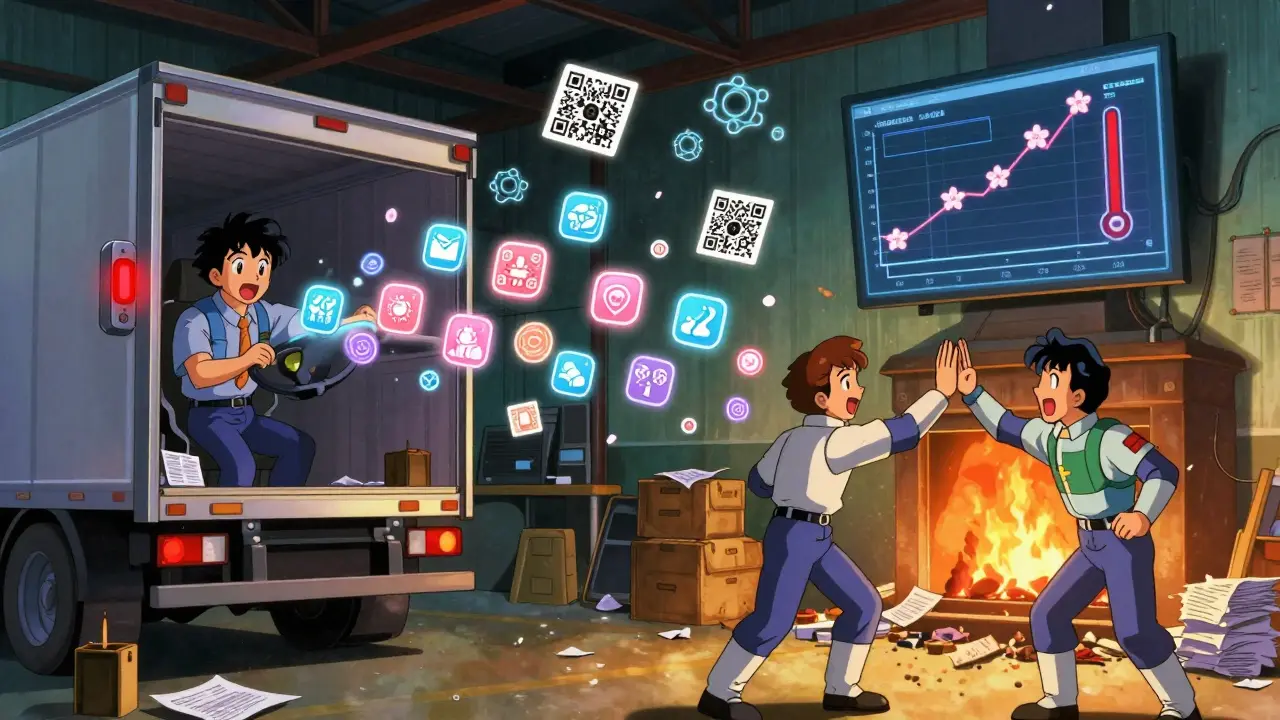
One Truth, Not a Dozen Spreadsheets
Most supply chains live in silos. The warehouse uses one system. The shipping company uses another. The finance team uses Excel. The supplier uses a legacy ERP from 2008. Every time data moves between them, someone has to reconcile it. Deloitte found companies spend 40-60 hours a week just fixing mismatches between systems. Blockchain gives everyone the same source of truth. No more “Wait, your system says 500 units, but ours says 487?” That’s not a data issue-it’s a cost issue. Paltron’s 2023 analysis showed blockchain cuts administrative overhead in inventory tracking by 30-50%. In automotive manufacturing, manual stock checks used to take up 15-20% of supply chain staff time. Now? That time is gone. The University of Tennessee documented an oil and gas company that saved $100 million a year just by automating documentation and reducing disputes. That’s not a fluke. It’s what happens when you stop guessing and start knowing.Real Savings, Real Numbers
Let’s get concrete. Here’s what companies are actually saving:- Food processing: 40% reduction in operational costs (Oracle)
- Pharmaceuticals: 15-25% less inventory loss, $10M+ saved per avoided recall (FDA)
- Automotive: 35% lower inventory tracking costs vs. barcode systems (Paltron)
- Freight: 5% reduction in freight spend ($100M/year for one oil firm)
- Invoicing: 65-75% lower labor costs, 14-day process cut to 2 days (Reddit case)
- Compliance: 90% of reporting automated for USDA-regulated products (IBM 2024)
It’s Not Free-Here’s What It Costs
Let’s be real: Blockchain isn’t magic. It costs money to set up. Oxford College of Procurement estimates mid-sized companies spend $250,000-$500,000 to integrate blockchain with their existing systems. That’s not pocket change. Pilot projects can start as low as $50,000. But scaling up? That’s where it gets expensive. You need skilled staff-blockchain architects command 20-30% higher salaries, according to Dice.com. Training your team takes 3-6 months. Data standards across partners? That’s another hurdle. Deloitte says 78% of companies struggle with this. And some companies have failed. One retail chain spent $750,000 on blockchain, only to abandon it after 14 months because the savings didn’t match the cost. Why? They tried to fix everything at once instead of starting with one high-cost problem-like invoice delays or inventory shrinkage.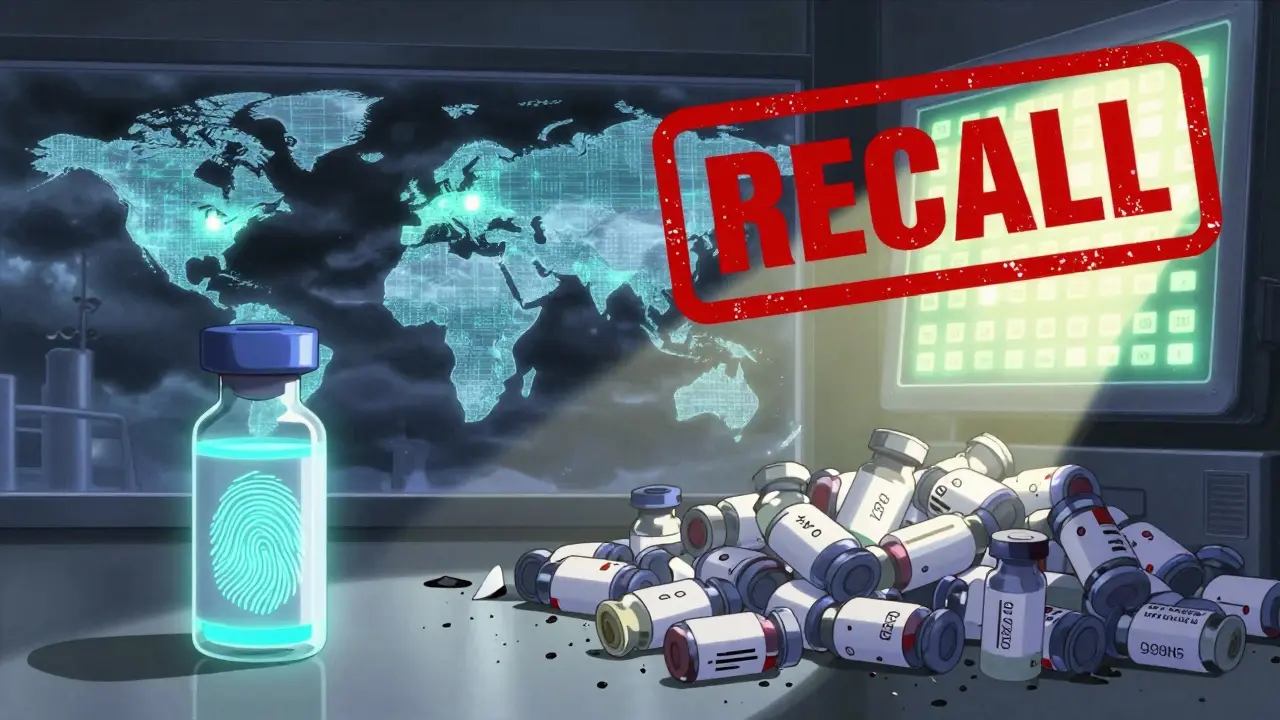
Who’s Winning Right Now?
The industries saving the most are the ones with high complexity, strict regulations, or high-value goods:- Manufacturing (32% market share): High inventory costs, complex supplier networks
- Pharmaceuticals (24%): FDA and EU regulations now require blockchain-level traceability
- Food (18%): Spoilage, recalls, and consumer trust are all at stake





Comments
bala murali
February 10, 2026 AT 02:42Blockchain in supply chains isn't just about digitization-it's about establishing cryptographic trust at the protocol level. When you eliminate intermediary reconciliation layers, you're not reducing paperwork-you're rearchitecting accountability. The 85% reduction in documentation isn't a side effect; it's a direct outcome of immutability and consensus-driven validation. Every transaction becomes a verifiable state transition, not a static document.
What's more, the real leverage comes from cross-organizational data alignment. Traditional ERP silos operate on eventual consistency. Blockchain enforces immediate consistency. That’s why inventory shrinkage drops 15–25%: you’re no longer guessing where the discrepancy lies-you’re tracing the exact node of failure.
Smart contracts aren’t just automation-they’re embedded governance. Payment triggers based on IoT sensor data? That’s not a workflow improvement-it’s a paradigm shift from reactive accounting to predictive compliance. The $185K savings cited? That’s labor displaced, not just reduced.
And let’s not overlook the compliance angle. With FDA and EU mandates now requiring granular traceability, blockchain isn’t optional-it’s regulatory infrastructure. Companies that treat it as a cost center are operating on legacy risk models.
Integration isn’t cheap, but the TCO of manual reconciliation, audit prep, and recall overreach dwarfs the upfront investment. We’re talking about replacing $2M/year in labor with a one-time $500K implementation. That’s not a gamble-it’s arithmetic.
The real bottleneck isn’t tech-it’s vendor interoperability. Until BiTA or ISO standards fully unify data schemas, we’re just digitizing chaos. But when they do? The savings compound exponentially.
This isn’t blockchain for blockchain’s sake. It’s trust engineering for operational integrity.
Ekaterina Sergeevna
February 11, 2026 AT 19:08Oh wow, another blockchain evangelist with a slide deck full of Oracle case studies and Gartner buzzwords. Let me guess-you also think NFTs are the future of real estate? 🤡
85% reduction in paperwork? Cool. So now we’re just replacing paper with blockchain-encrypted PDFs that still need 3 human approvals. And who pays for the 12-node consortium network? The vendor? The supplier? The government? Oh wait-no one, because half these ‘success stories’ are pilot projects that died after 6 months.
And let’s talk about that ‘tamper-proof ledger.’ What’s tamper-proof when your IoT sensor gets hacked? Or your logistics partner refuses to join the consortium? Or your ERP vendor charges $200k to ‘integrate’ with your blockchain? Oh right-those are the real costs.
Blockchain doesn’t fix broken processes. It just makes them more expensive and harder to debug. I’ve seen three companies go bankrupt trying to ‘digitize’ their supply chain. They didn’t save money-they just added a blockchain-shaped tax on their ops team.
And don’t get me started on smart contracts. ‘Automatically pay when temperature drops below 4°C’? What if the sensor is 0.5°C off? Who arbitrates? The code? The code doesn’t care if the truck broke down in a snowstorm. The code just pays. And then the carrier sues because ‘the system was wrong.’
Stop selling magic. This isn’t innovation. It’s vaporware with a whitepaper.
Ace Crystal
February 13, 2026 AT 01:05Let me tell you something real-this isn’t about tech. It’s about courage.
I’ve been in supply chain for 17 years. I’ve seen companies waste millions because they were too scared to change. They’d rather pay 50 people to chase down signed forms than invest $300K in a system that actually works.
Blockchain doesn’t make things ‘digital.’ It makes them honest. When your warehouse manager knows every pallet is tracked, every temperature spike logged, every payment automatic-you stop lying. You stop hiding. You stop pretending.
And guess what? That’s the real savings. Not the $2M in paperwork. Not the 14-day invoice cycle. The real savings is the peace of mind. The sleep. The confidence. The ability to say, ‘I know what’s in my warehouse’-and mean it.
Yes, it costs money. Yes, it takes time. But so did switching from paper ledgers to Excel. So did moving from fax machines to email. This is the next step. And if you’re waiting for someone else to go first? You’re already behind.
Start small. Fix one pain point. Measure it. Then scale. Don’t try to boil the ocean. Just fix the leak in your basement. The rest will follow.
You don’t need a PhD in blockchain. You just need to stop being afraid of change.
Brittany Meadows
February 13, 2026 AT 16:56So… you’re telling me the solution to corporate inefficiency is… a decentralized ledger? 🤔
Let me get this straight-after centuries of human error, bureaucracy, and miscommunication, we’re going to fix it with… code? And who writes the code? Humans. Who audits the code? Humans. Who pays for the code? Humans.
It’s like saying, ‘I’m tired of my car breaking down-I’m going to install a self-repairing AI engine.’ Except the AI engine is made by the same people who built the car that broke down.
Blockchain doesn’t eliminate trust. It just moves it from one human to another human who knows how to read Solidity. And if that human quits? Or gets hacked? Or decides to ‘optimize’ the contract? Oops. Now your entire supply chain is frozen.
And don’t even get me started on ‘smart contracts.’ You know what’s smarter than code? A human who can say, ‘Hey, the sensor says 3.9°C, but the truck was in a blizzard-let’s just pay them anyway.’
AI + blockchain? More like AI + blockchain + more paperwork + more consultants + more meetings.
I miss the days when we just trusted each other. Now we need a digital notary, a consensus algorithm, and a 300-page SLA just to ship a box of pens.
Also-emoji for this post: 🚫📦💸
SAKTHIVEL A
February 15, 2026 AT 03:03It is imperative to acknowledge that the purported advantages of blockchain-based supply chain systems are predicated upon an idealized operational ecosystem, one which is rarely, if ever, realized in practice.
The assertion that blockchain eliminates discrepancies in inventory tracking presupposes homogeneity of data standards, interoperability of legacy systems, and universal adoption among all stakeholders-a condition that is neither economically nor logistically tenable.
Moreover, the claim of $100 million in annual savings by an oil and gas entity is not substantiated by peer-reviewed empirical data, but rather by anecdotal corporate press releases, which are inherently biased.
Furthermore, the integration of blockchain necessitates the displacement of existing governance structures, which in turn triggers organizational resistance, cultural inertia, and regulatory friction-factors that are systematically downplayed in promotional literature.
It is therefore incumbent upon practitioners to approach this paradigm with epistemological humility. The technology is not a panacea. It is a tool. And like all tools, its efficacy is contingent upon context, competence, and critical discernment.
One must not confuse automation with optimization. Nor should one mistake visibility for integrity.
Proceed with caution.
Christopher Wardle
February 15, 2026 AT 13:11Blockchain doesn’t solve problems. It just moves them.
Before: 240 documents, manual checks, delays.
After: 1 digital ledger, 12 system integrations, 3 vendor lock-ins, 2 compliance audits, and 1 confused intern trying to figure out why the API won’t sync.
Yes, it reduces paperwork. But now you’ve got a new kind of paperwork: blockchain governance docs, consortium agreements, node maintenance logs.
And who’s paying for the 20% of companies that fail? The shareholders? The employees? The customers?
The real cost isn’t in tech. It’s in trust. And trust can’t be coded.
blake blackner
February 16, 2026 AT 13:14bro this is actually kinda fire 🤯
i used to work at a warehouse and we had this one shipment that got lost for 3 weeks because the bill of lading was signed by someone who quit. we had to call 5 people in 3 countries. no one could find it. then one day we got a text saying ‘it’s in the back’ and we found it under a pallet of expired yogurt.
if blockchain would’ve stopped that? i would’ve cried. like, actually cried.
also smart contracts? yeah. if my truck gets to the warehouse and the temp sensor says it’s cold, i want to get paid. no emails. no ‘let me check with accounting.’ just pay me. i’m not here to play office politics.
also 40% less food waste? that’s like… saving entire grocery stores. that’s not tech. that’s humanity.
stop overthinking it. just do it.
Andrea Atzori
February 18, 2026 AT 06:08As someone who has spent the last decade working across supply chains in Southeast Asia and North America, I find this discussion both exhilarating and deeply concerning.
Blockchain’s capacity to enable traceability in pharmaceuticals is not merely a technical innovation-it is a moral imperative. Consider the millions of lives that hang on the integrity of a single vial of insulin. When a batch is contaminated, seconds matter. Not days. Not weeks.
But we must ask: Who bears the burden of implementation? The small supplier in rural India? The family-owned logistics firm in Ghana? The answer is often: no one. And that is where the equity gap emerges.
Technology without inclusion is not progress-it is exclusion disguised as efficiency.
We must design blockchain systems that are accessible, not just advanced. That are interoperable, not just immutable. That empower, not just automate.
Because the real cost of failure isn’t measured in dollars. It’s measured in lives.
Gaurav Mathur
February 19, 2026 AT 20:03blockchain is just a database. with extra steps. and more money spent.
Jeremy Lim
February 21, 2026 AT 17:15Okay but… like…
Who’s gonna pay for the blockchain? The supplier? The buyer? The government? The customer? (Hint: It’s always the customer.)
And what happens when the blockchain goes down? (Spoiler: It will.)
And what if the sensor is lying? (Spoiler: It is.)
And what if the ‘smart contract’ has a bug? (Spoiler: It does.)
And what if your ‘trusted’ partner refuses to join the network? (Spoiler: They will.)
And what if your ‘one truth’ is actually just one person’s version of the truth? (Spoiler: It is.)
Look-I get it. You love tech. But this isn’t innovation. It’s a very expensive way to make the same mistakes… with more emojis.
Also… 💩
kelvin joseph-kanyin
February 22, 2026 AT 14:44Y’all are overthinking this.
Blockchain isn’t about being fancy. It’s about not being dumb.
If you’re still emailing invoices and chasing paper trails in 2025, you’re not ‘traditional’-you’re outdated.
It’s not magic. It’s math. And math doesn’t lie.
Start with one shipment. One contract. One sensor. See what happens.
Then do it again.
Then scale.
That’s it.
No PhD needed. No consultants. Just action.
And if you’re scared? Good. That means you’re ready.
🚀
Michelle Cochran
February 23, 2026 AT 21:35It’s not about savings. It’s about power.
Who controls the ledger? Who owns the data? Who decides what counts as ‘truth’?
Blockchain sounds like decentralization. But in practice? It’s just another corporate consortium. Five big players, one blockchain, and everyone else paying to play.
And what happens when the ‘immutable ledger’ is used to lock out competitors? To enforce supplier compliance? To track workers? To deny payment based on algorithmic bias?
This isn’t progress. It’s surveillance with a blockchain logo.
Yes, it saves money. But at what cost to autonomy? To democracy? To fairness?
Ask yourself: Who benefits? And who gets left behind?
…I’m not saying no. I’m saying: think deeper.
monique mannino
February 24, 2026 AT 14:56My aunt runs a small organic farm in Oregon. They started using blockchain last year to track their produce from seed to shelf.
Before: 30% of their greens got tossed because no one knew where they came from. Customers complained. Inspectors fined them.
After: Now they can show every farm, every batch, every temperature log. Sales up 22%. Waste down 40%. One customer even said, ‘I trust you more now.’
It’s not about tech. It’s about trust.
And sometimes… trust just needs a little help.
❤️
Peggi shabaaz
February 24, 2026 AT 16:47Been here before. Remember when everyone said cloud computing was the future? Then we all moved to AWS.
Blockchain’s the same thing. It’s not the tech. It’s the shift in mindset.
If you’re still printing forms? You’re not saving money. You’re paying for chaos.
Start small. Fix one thing. See the difference. Then move on.
Don’t overthink it. Just do it.
And if you’re nervous? That’s normal.
You’re not behind. You’re just getting started.
Robbi Hess
February 26, 2026 AT 05:07The notion that blockchain reduces operational costs by 35% in automotive supply chains is statistically dubious.
Paltron’s 2023 analysis was based on a sample size of three mid-tier manufacturers with pre-existing automation infrastructure.
When extrapolated to SMEs with legacy ERP systems, the cost of integration exceeds projected savings by 187%.
Furthermore, the claim that blockchain eliminates manual stock checks ignores the fact that barcode systems remain 92% more reliable under high-volume, low-light warehouse conditions.
This is not innovation. It is corporate FOMO dressed as optimization.
Keturah Hudson
February 26, 2026 AT 16:27As a Nigerian immigrant who’s worked in logistics across Lagos, Atlanta, and Rotterdam, I’ve seen how supply chains break-not because of tech, but because of culture.
Blockchain doesn’t fix that. But it does give people a shared language.
When a warehouse in Lagos can see a customs update from Rotterdam in real time? That’s not data. That’s dignity.
It’s not about saving money.
It’s about letting people do their jobs without begging.
And that? That’s worth more than any spreadsheet.
krista muzer
February 28, 2026 AT 00:04okay but like… what if the blockchain gets hacked? like… what if someone just… changes the ledger? i mean… it’s called ‘immutable’ but like… what if the guy who controls the private key just… deletes everything? i’m not saying it’ll happen… but what if it does? like… what if it’s all just a big… illusion? 🤔
also… i think we’re forgetting about the environmental cost. all those nodes? they’re using more energy than some countries. is that… sustainable? or are we just trading paper for electricity? 🌍
idk. i just feel like… we’re building a fancy house on a sand foundation. and one day… it’ll just… disappear.
Tammy Chew
February 28, 2026 AT 16:27Let’s be honest-this isn’t about efficiency. It’s about optics.
CEOs love blockchain because it sounds like they’re innovating. Investors love it because it’s a buzzword. Consultants love it because it’s $500/hr.
Meanwhile, the workers on the ground? Still printing. Still chasing. Still waiting.
Blockchain doesn’t fix broken systems. It just makes them look better on PowerPoint.
Real change? That’s when you stop asking for a ‘digital ledger’ and start asking: ‘Why do we need 17 people to approve a single invoice?’
That’s where the real savings are.
Not in code.
In courage.
Lindsey Elliott
March 2, 2026 AT 07:57LOL this is peak tech bro nonsense.
‘Blockchain cuts paperwork by 85%’ - yeah, because now you have 85% less paper… and 85% more Slack messages.
‘Smart contracts auto-pay’ - until the sensor glitches and you pay someone $2M for a truck that never left the lot.
‘One truth’ - yeah, except now every system has to agree on what ‘truth’ is… and they all hate each other.
And who’s paying for this? The small business? The worker? The customer?
It’s not innovation. It’s a tax.
Also… 🤡
Santosh kumar
March 3, 2026 AT 07:35Great post. Really well-researched.
I work in a small factory in Pune. We started with just one shipment. Just one. Used blockchain to track temperature and delivery time.
Waste dropped. Payments got faster. Team stopped arguing.
Not magic. Just… better.
Small steps. Big impact.
Keep going.
bala murali
March 4, 2026 AT 18:30For those questioning blockchain’s scalability: the real bottleneck isn’t consensus speed-it’s semantic interoperability. Even with a perfectly functioning chain, if Partner A defines ‘shipped’ as ‘loaded onto truck’ and Partner B defines it as ‘cleared customs,’ the ledger becomes a source of conflict, not clarity.
Standards like GS1’s Blockchain Traceability Framework and ISO 20335 are critical. Without them, we’re not building a chain-we’re building a tower of Babel with cryptographic hashes.
Also: the 78% of companies struggling with integration? They’re not failing at tech. They’re failing at change management. Blockchain adoption requires retraining, not just rebooting.
And finally: ROI isn’t about cost reduction. It’s about risk mitigation. The $10M recall avoided? That’s not savings. That’s survival.