What is Tharwa (TRWA)? A Guide to the AI-Driven RWA Stablecoin Protocol
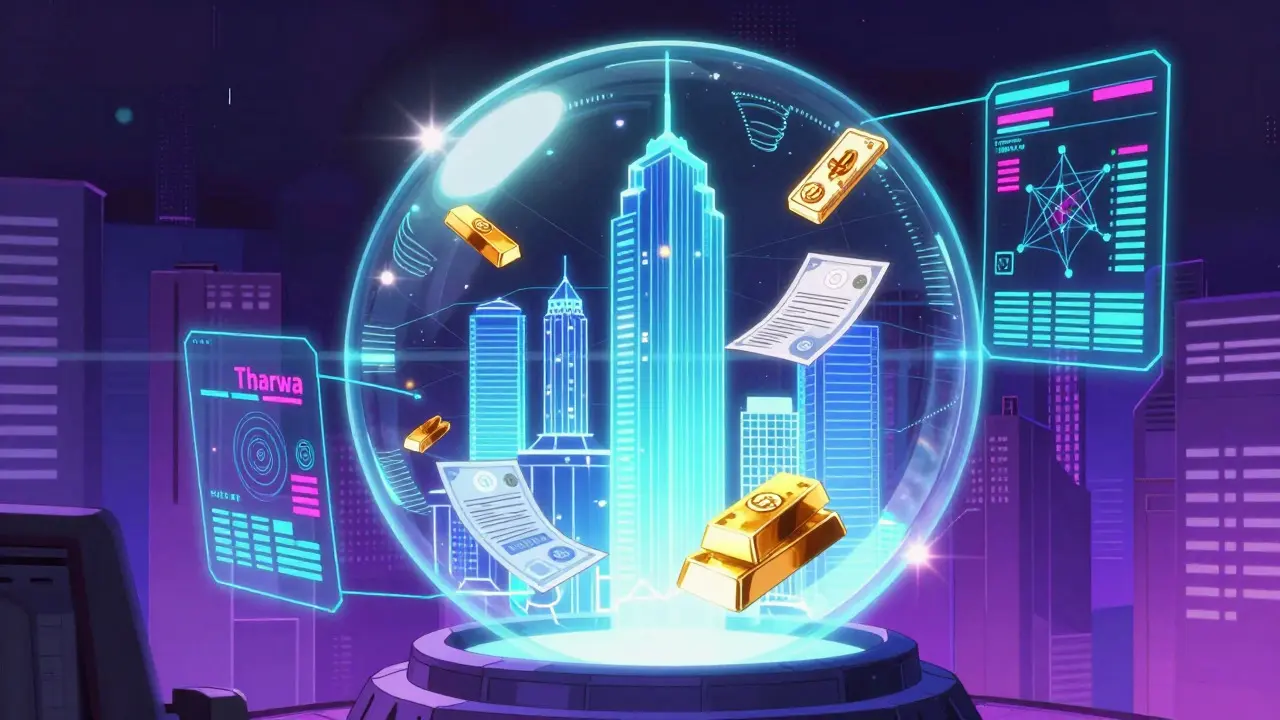
Imagine a stablecoin that doesn't just sit in a bank account earning dust. Now imagine that same coin is backed by real estate, gold, and private credit, managed by an artificial intelligence engine that rebalances itself automatically. That is the core promise of Tharwa. Launched in July 2025, this protocol attempts to solve two major problems in decentralized finance: the lack of yield on stablecoins and the opacity of traditional asset management.
If you have been scrolling through crypto charts lately, you might have seen the ticker TRWA. It is not just another meme coin hoping for viral attention. It represents a specific niche in the blockchain world known as Real-World Asset (RWA) tokenization. But before you connect your wallet, you need to understand exactly what you are buying into. Is it a revolutionary financial tool, or a complex experiment with high volatility? Let's break down how Tharwa works, who it is for, and what the risks actually look like in 2026.
The Core Concept: Bridging Traditional Finance and DeFi
At its heart, Tharwa is a decentralized finance protocol that uses AI-driven portfolio management to back stablecoins with diversified real-world assets. Most people know USDT or USDC. Those coins are backed largely by cash equivalents and short-term government bonds. They are safe, but they don't generate much yield for the holder unless you lend them out elsewhere.
Tharwa takes a different approach. It creates blended vaults containing tangible assets. We are talking about real estate properties, physical gold, private credit instruments, and treasury bills. Instead of locking up one type of asset, the protocol diversifies across these categories. The goal is simple: lower risk through diversification while aiming for higher yields than a standard savings account. This structure is particularly interesting because it brings institutional-grade asset classes onto the blockchain, making them accessible to retail investors who previously couldn't afford entry tickets to private credit markets.
Understanding the Dual-Token Model
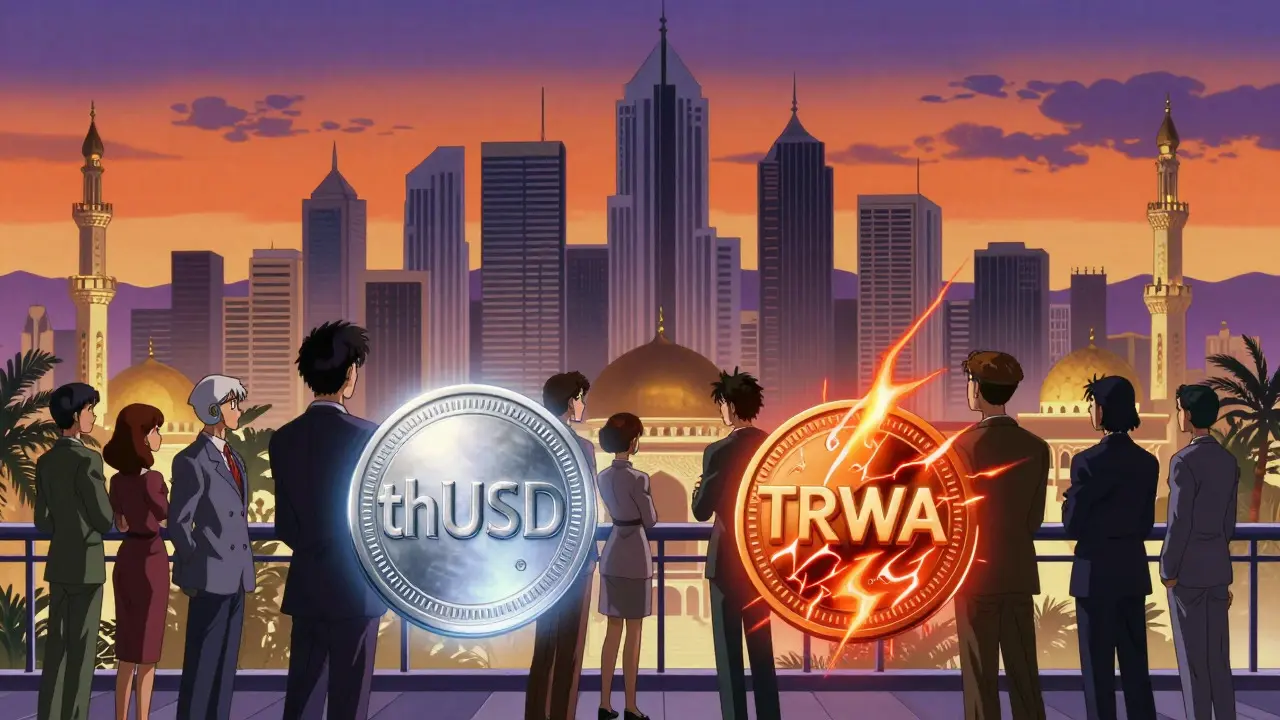
To make sense of Tharwa, you have to separate the two tokens involved. Many new users get confused here, thinking TRWA is the stablecoin. It isn't. The system operates on a dual-token model:
- thUSD: This is the actual stablecoin. It maintains a 1:1 peg with the U.S. dollar. When you hold thUSD, you are holding a digital representation of value backed by those real-world assets we mentioned earlier. If the underlying assets perform well, the stability of the coin remains intact, but the ecosystem generates revenue.
- TRWA: This is the governance and utility token. Think of it as the "stock" of the protocol. Holders of TRWA get access to revenue shares from the fees generated by the ecosystem. It is also used for voting on protocol upgrades and parameter changes.
This separation is crucial. If you want price stability, you look at thUSD. If you want exposure to the growth and fee generation of the platform, you buy TRWA. However, TRWA is volatile. As of late 2025 and early 2026, TRWA has seen significant price swings, trading anywhere from $0.002 to over $0.02. This volatility reflects the market's attempt to value the future earnings potential of the protocol against the current state of adoption.
The AI Engine: How It Manages Risk
Here is where Tharwa gets technical. Managing real-world assets on-chain is hard. Real estate doesn't move instantly. Gold prices fluctuate daily. Private credit has fixed terms. How do you keep a stablecoin pegged when the underlying assets are moving at different speeds?
Tharwa uses an AI-based confluence engine. This isn't just marketing fluff; it is the operational backbone of the protocol. The AI integrates quantitative analysis using Conditional Value at Risk (CVaR) metrics. In plain English, this means the algorithm constantly monitors the risk profile of the entire portfolio. If the real estate sector looks shaky, the AI can trigger automatic rebalancing, shifting weight toward more liquid assets like treasury bills or gold. This happens without human intervention, ensuring that the collateral ratio stays healthy even during market stress.
This dynamic adjustment is a key differentiator. Older RWA protocols often had static backing. If the underlying asset dropped in value, the stablecoin was at risk until humans stepped in. Tharwa’s automated approach aims to prevent that gap, though no algorithm is perfect, especially in black-swan events.

Regulatory Compliance and Sharia Certification
One of the biggest hurdles for crypto adoption is regulation. Tharwa was built with this in mind from day one. The protocol operates under the UAE regulatory framework. This gives it a level of legitimacy that many offshore projects lack. Institutional investors are wary of unregulated entities, so having a clear legal jurisdiction is a massive plus.
More uniquely, Tharwa is Sharia-compliant. This opens up a massive, underserved market. Islamic finance prohibits interest (riba) and excessive uncertainty (gharar). By structuring the yields through profit-sharing mechanisms rather than interest-bearing loans, Tharwa makes DeFi accessible to Muslim investors worldwide. This isn't just a niche feature; it is a strategic advantage that sets Tharwa apart from competitors like Centrifuge or Maple Finance, which haven't prioritized this certification.
Market Performance and Tokenomics
Let's look at the numbers. The total supply of TRWA is capped at 10 billion tokens. As of October 2025, 7 billion were in circulation. The fully diluted valuation sits around $84 million, while the circulating market cap hovers near $59 million. These figures place it in the mid-tier of crypto projects-too big to be ignored, but too small to move global markets single-handedly.
| Metric | Value | Context |
|---|---|---|
| Total Supply | 10,000,000,000 TRWA | Fixed cap, deflationary pressure possible via burns |
| Circulating Supply | 7,000,000,000 TRWA | 70% of total supply available for trading |
| All-Time High | $0.0208 | Reached August 15, 2025 |
| All-Time Low | $0.002174 | Reached July 16, 2025 |
| Daily Volume | $2.3M - $2.7M | Moderate liquidity, suitable for retail traders |
The price action tells a story of discovery. After launching in July 2025, the token hit a high of $0.02 in August, likely driven by hype around the AI and RWA narrative. Since then, it has corrected to the $0.009 range. This is normal for new protocols. The market is testing whether the promised yields and AI efficiency can deliver consistent results. Daily trading volumes of around $2.5 million suggest moderate liquidity. You can buy and sell without slipping the price too much, but large institutional whales might struggle to enter or exit positions quietly.
Risks and Challenges to Consider
No investment is without risk, and Tharwa is no exception. First, there is the complexity factor. Understanding how an AI-managed, multi-asset RWA vault works requires more knowledge than buying Bitcoin. If you don't grasp the difference between thUSD and TRWA, you could easily buy the wrong token for your goals.
Second, there is the execution risk. While the AI engine sounds impressive, it is relatively new. We haven't seen it survive a full bear market cycle yet. What happens if the AI misinterprets a sudden crash in the real estate market? The protocol relies on continuous treasury monitoring and multi-signature approvals to catch errors, but code bugs and oracle failures are constant threats in DeFi.
Third, regulatory arbitrage is a double-edged sword. Being regulated in the UAE is great, but what if other countries decide to crack down on RWA tokens? Cross-border acceptance is still a gray area. If major jurisdictions ban RWA-backed stablecoins, Tharwa's user base could shrink rapidly.
How to Get Started with Tharwa
If you are interested in participating, here is the practical path forward. First, ensure you have a compatible cryptocurrency wallet. MetaMask or similar Web3 wallets work best. Second, complete any necessary KYC (Know Your Customer) procedures. Because Tharwa deals with real-world assets, it has stricter compliance requirements than anonymous DeFi protocols. This is a good thing for security, but it means you aren't fully anonymous.
You can participate in three ways: 1. **Invest in Vaults:** Deposit funds to earn yield from the underlying real-world assets. 2. **Stake TRWA:** Lock up your TRWA tokens to receive a share of the ecosystem fees. 3. **Tokenize Personal Funds:** Apply to bring your own assets onto the platform (available for larger investors). For most retail users, staking TRWA or investing in the thUSD vaults is the most accessible route. Start small. Treat the first few weeks as a learning period. Read the documentation, join the community channels, and watch how the AI rebalancing reports are published weekly.
Future Outlook: Where Is Tharwa Headed?
The roadmap for Tharwa includes expanding the types of real-world assets accepted. Currently, it focuses on real estate, gold, credit, and treasuries. Future updates may include commodities or carbon credits. There are also plans to integrate with additional blockchain networks beyond its current home, which would improve accessibility and reduce transaction costs.
Industry analysts remain cautiously optimistic. The trend toward RWA tokenization is undeniable. As traditional finance becomes more digital, bridges like Tharwa will become essential infrastructure. However, success depends on consistency. Can the AI deliver stable yields over five years? Can the team maintain regulatory goodwill? If yes, TRWA could see significant appreciation as the protocol scales. If not, it risks becoming another forgotten experiment from the 2025 boom.
For now, Tharwa stands out as a sophisticated attempt to merge AI, real-world assets, and blockchain. It is not a get-rich-quick scheme. It is a complex financial instrument that rewards patience and understanding. Whether it fits your portfolio depends on your risk tolerance and belief in the future of regulated DeFi.
Is Tharwa (TRWA) a good investment?
Whether TRWA is a good investment depends on your risk appetite. It offers exposure to the growing RWA sector and innovative AI management, but it carries high volatility and execution risk. It is better suited for investors who understand DeFi mechanics and believe in long-term institutional adoption of tokenized assets.
What backs the thUSD stablecoin?
thUSD is backed by a diversified portfolio of real-world assets including real estate, gold, private credit, and U.S. treasury bills. This multi-asset approach aims to provide greater stability and yield compared to single-asset backed stablecoins.
Is Tharwa Sharia-compliant?
Yes, Tharwa holds Sharia compliance certification. This allows it to operate within Islamic finance principles, avoiding interest-based structures and making it accessible to Muslim investors globally.
How does the AI engine work in Tharwa?
The AI engine uses CVaR-based quantitative optimization to monitor the risk profile of the underlying assets. It automatically rebalances the portfolio across different asset classes (like shifting from real estate to treasuries) to maintain stability and optimize yields without human intervention.
What is the difference between TRWA and thUSD?
thUSD is the stablecoin pegged to the USD, used for transactions and storing value. TRWA is the governance and utility token. Holding TRWA gives you voting rights and a share of the protocol's revenue fees, but it is subject to market price volatility.
Where is Tharwa regulated?
Tharwa operates under the regulatory framework of the United Arab Emirates (UAE). This provides a clear legal structure for the protocol, which is attractive for institutional investors seeking compliance.
Can I lose money with Tharwa?
Yes. Like all crypto investments, TRWA is volatile. Additionally, smart contract risks, regulatory changes, or poor performance of the underlying real-world assets could impact the value of both TRWA and thUSD. Always invest only what you can afford to lose.
Does Tharwa require KYC?
Yes, due to its focus on real-world assets and regulatory compliance, Tharwa requires Know Your Customer (KYC) verification for users participating in vaults or tokenizing personal funds.