Underground Crypto Trading in North Macedonia: How People Bypass the Ban

People in North Macedonia are trading crypto - even though it’s officially banned.
It sounds impossible. The National Bank of the Republic of North Macedonia said in 2017 that trading cryptocurrencies was illegal. They compared it to buying foreign stocks or derivatives, which were already restricted under EU association rules. But if you walk through Skopje’s cafes or scroll through local Telegram groups, you’ll find people talking about Bitcoin, Ethereum, and USDT like it’s just another way to pay for coffee. The ban exists on paper. In practice? It’s ignored.
How the ban works - and why it doesn’t
The 2017 prohibition was clear: no crypto trading. But here’s the twist - the bank never said crypto itself was illegal. They said you couldn’t trade it like a financial instrument through banks or brokers. That loophole became the backdoor. By 2022, the government passed new anti-money laundering laws that actually defined crypto as “virtual assets” and “property.” That’s not a ban. That’s a framework. The rules hadn’t been updated to match reality. So now, crypto sits in legal gray space: technically restricted, but not criminalized.
That’s why traders aren’t afraid. They’re not breaking a law that says “don’t own Bitcoin.” They’re working around a rule that says “don’t use banks for it.” And that’s easy to avoid.
The underground network: P2P platforms that work
There are no local crypto exchanges in North Macedonia. You won’t find a Macedonian version of Binance or Kraken. Instead, traders use global peer-to-peer (P2P) platforms that don’t care about borders.
- Symlix.com lets users buy and sell crypto with cash, bank transfers, or even gift cards. Trades are held in escrow until the buyer confirms payment. No bank account needed.
- LocalCoinSwap supports over 300 payment methods - including cash deposits at local post offices and mobile top-ups. Users filter offers by location, so they only see traders in North Macedonia.
- Paxful and other global P2P sites are also active, with traders using Macedonian dinar (MKD) and even Serbian dinar for cross-border deals.
These platforms don’t ask for ID unless you’re trading large amounts. That’s not because they’re shady - it’s because they’re designed for this exact scenario: people in restrictive countries trading outside the system.
What about banks? They block everything
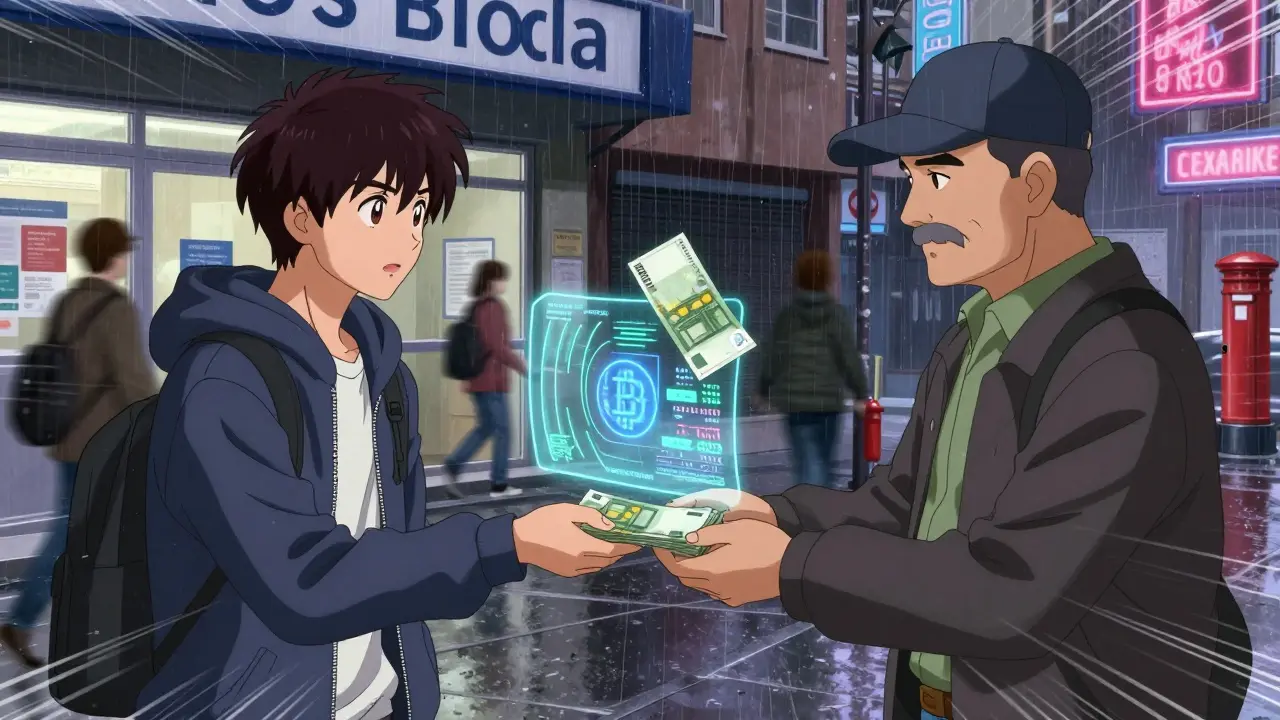
If you try to link your bank account to Coinbase or Kraken, it gets rejected. The banks follow the National Bank’s 2017 warning. So traders can’t use direct deposits. That’s why cash meets are common.
You’ll find people arranging trades in public places: outside Starbucks in Skopje, in front of post offices, or even at university campuses. One Reddit user from Bitola described meeting a trader with €500 in cash, handing it over, and getting Bitcoin sent to their wallet within minutes. “It felt weird at first,” they wrote, “but the escrow system made it safe.”
Some try to use international brokers like Swissquote or Interactive Brokers. They’re regulated, so they’re “legal.” But here’s the catch: Swissquote charges high fees, and Interactive Brokers doesn’t even let you store crypto in their wallet. You have to move it to a personal wallet anyway. So why not just use P2P and save the fees?
Who’s trading - and why
It’s not just speculators. It’s students, freelancers, and small business owners.
One 22-year-old from Tetovo told a local forum he uses crypto to get paid for freelance design work from clients in Germany and the U.S. He gets paid in USDT, converts it to cash via Symlix, and deposits it into his mom’s account. “My bank would freeze my account if I tried to receive USD directly,” he said.
Another user, a 47-year-old shop owner in Bitola, started buying Bitcoin after seeing his cousin in Serbia make money from it. He doesn’t hold it long. He buys when prices dip, sells quickly, and uses the cash to restock inventory. “It’s not gambling,” he said. “It’s just how you get ahead when the economy is stuck.”
BrokerChooser estimates about 42,000 active crypto users in North Macedonia - 2.3% of the population. That’s low compared to the EU average of 5.1%, but it’s growing fast. LocalCoinSwap reported a 300% increase in Macedonian users between 2022 and 2024.
The risks: No safety net
There’s no consumer protection. If a P2P trader disappears after you send cash, you can’t go to the police. There’s no government agency to file a complaint with. The only recourse is the platform’s dispute system - and even that’s not foolproof.
One user on Reddit lost €1,200 after sending money to a scammer who claimed to be a trusted trader. The Symlix support team helped recover half after two weeks. “I learned the hard way,” he wrote. “Always do a test trade under €50 first.”
Another risk? Regulatory whiplash. The ban is still on the books. If the government suddenly decides to enforce it, traders could lose access to their funds. No one knows what would happen - arrests? Asset freezes? Bank account closures? The uncertainty is the biggest danger.
What’s coming next? Regulation is inevitable
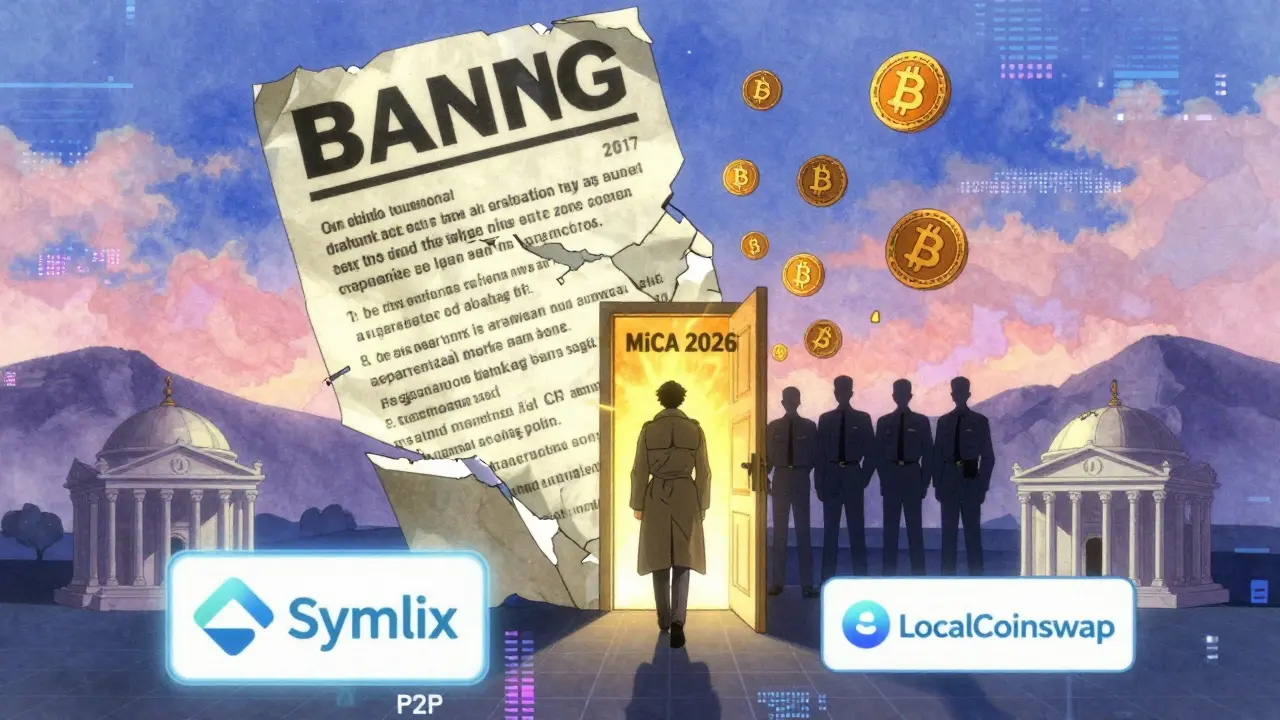
The February 2022 AML/CTF law was a turning point. It didn’t lift the ban - it laid the groundwork for one. Experts from Multilaw and industry analysts agree: North Macedonia is moving toward full crypto regulation, likely aligned with the EU’s MiCA rules by 2026-2027.
That means licensed exchanges, KYC requirements, and maybe even tax reporting. But here’s the irony: by the time the rules are clear, most people will already be trading. The underground market won’t disappear. It will just go mainstream.
For now, the system works because it’s small, decentralized, and invisible to regulators. But that won’t last. The government isn’t ignoring crypto - it’s waiting for the right moment to bring it into the light.
How to trade safely - if you must
If you’re in North Macedonia and want to trade crypto, here’s what works:
- Use P2P platforms only - Symlix and LocalCoinSwap are the most reliable.
- Never skip escrow - Never send crypto before the payment is confirmed in the platform’s system.
- Start small - Do a €20 test trade first to check the trader’s reputation.
- Meet in public - If trading cash, choose a well-lit, busy place. Bring a friend.
- Use Telegram - Join the “MK Crypto” group (1,247 members as of May 2025). They share lists of trusted traders and warn about scams.
- Don’t use local exchanges - There are none. Any site claiming to be a “Macedonian crypto exchange” is a scam.
And remember: you’re not breaking the law by owning crypto. You’re just avoiding the banking system. That’s not illegal. It’s just… inconvenient.
What happens if you get caught?
No one has been prosecuted for trading crypto in North Macedonia. Not once. The authorities don’t have the resources, and they don’t have the political will to go after everyday people. But if you’re using crypto to launder money, tax evasion, or fund illegal activity? That’s a different story.
For now, the system is tolerated. But tolerance isn’t permission. Stay smart. Stay low-key. And keep an eye on the news - because when regulation finally comes, it’ll happen fast.
Is crypto illegal in North Macedonia?
Technically, yes - the National Bank banned crypto trading in 2017. But in practice, no. The government now recognizes crypto as property under anti-money laundering laws. There’s no criminal penalty for owning or trading it, as long as you avoid banks. The ban is outdated, unenforced, and likely to be replaced by formal regulation soon.
Can I use my bank account to buy crypto in North Macedonia?
No. All major banks block transactions to international crypto exchanges. If you try, your payment will be rejected or your account may be flagged. That’s why P2P platforms using cash, mobile payments, or gift cards are the only reliable options.
What’s the safest way to buy Bitcoin in North Macedonia?
Use Symlix or LocalCoinSwap. Filter for local sellers, start with a small trade under €50, use escrow, and meet in public if paying with cash. Avoid any platform that asks for your bank login or promises instant deposits.
Are there any Macedonian crypto exchanges?
No. There are no legitimate, locally operated crypto exchanges in North Macedonia. Any website claiming to be one is a scam. All trading happens on global P2P platforms or through international brokers like Swissquote - which are not based in Macedonia.
Will crypto become legal in North Macedonia soon?
Yes. Experts predict full regulation by 2026-2027, following the EU’s MiCA rules. The 2022 AML/CTF law already laid the foundation. The government isn’t cracking down - it’s preparing to license and tax crypto activity. The underground market will become the official one.





Comments
Raju Bhagat
February 2, 2026 AT 02:24bro this is wild i just found out people in north macedonia are trading crypto like its street food 🤯 i thought only venezuela did this but now im seeing it everywhere
laurence watson
February 3, 2026 AT 02:49This is actually kind of beautiful. People finding ways to empower themselves when the system fails them. I love how decentralized finance lets folks bypass broken institutions. Keep going, North Macedonia.
Pamela Mainama
February 3, 2026 AT 20:54The ban was always symbolic. Real power lies in adoption, not legislation.
Will Pimblett
February 5, 2026 AT 08:28So let me get this straight - the government bans crypto but then passes a law calling it ‘property’? That’s not a loophole, that’s a government having a midlife crisis.
Raymond Pute
February 6, 2026 AT 14:23Look, if you’re using P2P platforms because your country’s banking system is a 1998 dial-up connection, that’s not innovation - that’s desperation dressed up as decentralization. I mean, come on. You’re not building the future, you’re just avoiding your bank’s auto-reply bot.
Meenal Sharma
February 8, 2026 AT 12:39The normalization of unregulated asset exchange under the guise of financial inclusion is a dangerous precedent. One must consider the systemic erosion of monetary sovereignty and the potential for illicit capital flight.
Brianne Hurley
February 9, 2026 AT 08:43OMG I just lost my entire portfolio to a Symlix scammer 😭 and now I’m crying in my yoga pants while sipping oat milk latte. Like… how do people not know this is a trap? This is why I don’t trust ‘peer to peer’ anything. It’s just peer to PAIN.
Rob Duber
February 9, 2026 AT 08:59Imagine walking into Starbucks in Skopje and someone slides you a wad of cash like it’s a spy movie and you just got your Bitcoin wallet punched. That’s not finance - that’s cinematic rebellion. I’m so here for it.
Gary Gately
February 10, 2026 AT 18:41i just bought 0.005 btc with my phone credit lol
Joshua Clark
February 11, 2026 AT 12:15It’s fascinating how regulatory arbitrage operates at the grassroots level - the convergence of informal economies, technological accessibility, and the psychological dissonance between legal frameworks and lived reality creates a perfect storm for decentralized adoption. The fact that individuals are leveraging global P2P infrastructure to circumvent national monetary controls speaks volumes about the inadequacy of top-down financial governance in the digital age.
Brandon Vaidyanathan
February 12, 2026 AT 10:09Let’s be real - if you’re using LocalCoinSwap because your bank won’t touch crypto, you’re not a pioneer, you’re a liability. And if you’re meeting strangers with cash in public? That’s not ‘convenient,’ that’s a waiting room for a headline.
Gareth Fitzjohn
February 13, 2026 AT 10:34Interesting. The ban is paper. The reality is people. That’s how most laws end up.
Katie Teresi
February 14, 2026 AT 16:23This is why America needs to stop being soft. You let a country turn crypto into a black market and suddenly everyone thinks it’s ‘resilience.’ It’s not resilience - it’s chaos with a filter.
Moray Wallace
February 15, 2026 AT 09:57I appreciate the practical advice here. The emphasis on escrow and small test trades is critical. Safety first, always.
Dylan Morrison
February 16, 2026 AT 15:25This reminds me of how people in Nigeria use crypto to send remittances. Sometimes the most beautiful innovations come from the most broken systems 🌍💙
josh gander
February 17, 2026 AT 12:52You guys are doing something really powerful here. You’re not waiting for permission to build a better system - you’re building it anyway. That’s the spirit of crypto. I’m rooting for you. Stay safe, use escrow, and keep those test trades small - you’re not just trading Bitcoin, you’re trading hope.
Akhil Mathew
February 19, 2026 AT 04:05Wait so if you're using Serbian dinar for trades, does that mean cross-border crypto is becoming a de facto regional currency? That's wild.
Sunil Srivastva
February 19, 2026 AT 18:16I’ve been using Symlix for over a year now. Never had an issue. Always check the trader’s history. Start small. And never skip escrow. Simple as that.
Robert Mills
February 20, 2026 AT 12:38Crypto in the Balkans? Yes please 🚀
Joseph Pietrasik
February 21, 2026 AT 03:56ban my ass its just a suggestion at this point
Elizabeth Jones
February 21, 2026 AT 23:32The fact that the government recognizes crypto as property under AML laws while still calling it illegal is the definition of bureaucratic contradiction. It’s not hypocrisy - it’s evolution in slow motion.
Rachel Stone
February 22, 2026 AT 05:24So the ban exists to make people feel like they’re being protected… but everyone just ignores it anyway? Classic.
Rico Romano
February 22, 2026 AT 09:22This is why the West needs to stop romanticizing informal economies. You’re not ‘resisting oppression’ - you’re avoiding financial literacy. If your country can’t provide banking, maybe you should fix your government, not hack around it with P2P cash meets.
Crystal Underwood
February 23, 2026 AT 11:12Let me get this straight - you’re trusting strangers with cash in Starbucks because ‘the system failed you’? Honey, you’re not a crypto warrior. You’re a walking phishing target. And if you think MiCA is coming to save you, you’ve been sleeping through the last decade of EU policy. This isn’t innovation - it’s a dumpster fire with a whitepaper.