Raydium LaunchLab Review: Features, Fees & Comparison with Pump.fun (2026)

Launching a memecoin on Solana used to mean one thing: go to Pump.fun. But that landscape shifted dramatically in April 2025 when Raydium, the leading decentralized exchange on the network, dropped its own answer: LaunchLab. If you are looking for a place to launch micro-cap tokens or trade early-stage gems, you need to know if this platform is just a copycat or if it actually offers something better. The short answer? It’s more complex, more flexible, and significantly different from what you’re used to.
This review breaks down how Raydium LaunchLab works, who it’s actually for, and whether it beats the competition in 2026. We’ll look at the technical specs, the fee structures, and the real-world data from over 900,000 launches processed since inception. By the end, you’ll know exactly where your capital and attention should go.
What Is Raydium LaunchLab?
Raydium LaunchLab is a no-code token creation tool and automatic liquidity migration service designed for the Solana blockchain. Think of it as a bridge between creating a new token and listing it on a major DEX. Unlike traditional exchanges where you have to hire developers and secure liquidity providers manually, LaunchLab automates the entire lifecycle. You create the token, users buy in via a bonding curve, and once it hits a specific value threshold, it automatically migrates to a permanent Raydium AMM pool.
The platform was born out of necessity. In March 2025, Pump.fun ended its integration with Raydium to launch its own DEX, PumpSwap. This move cut off a massive chunk of traffic-Pump.fun had been contributing roughly 41% of Raydium’s AMM revenue in some months. Raydium needed a way to reclaim that dominance without relying on a third party. LaunchLab is that strategic response, built directly into Raydium’s infrastructure to keep liquidity on their rails.
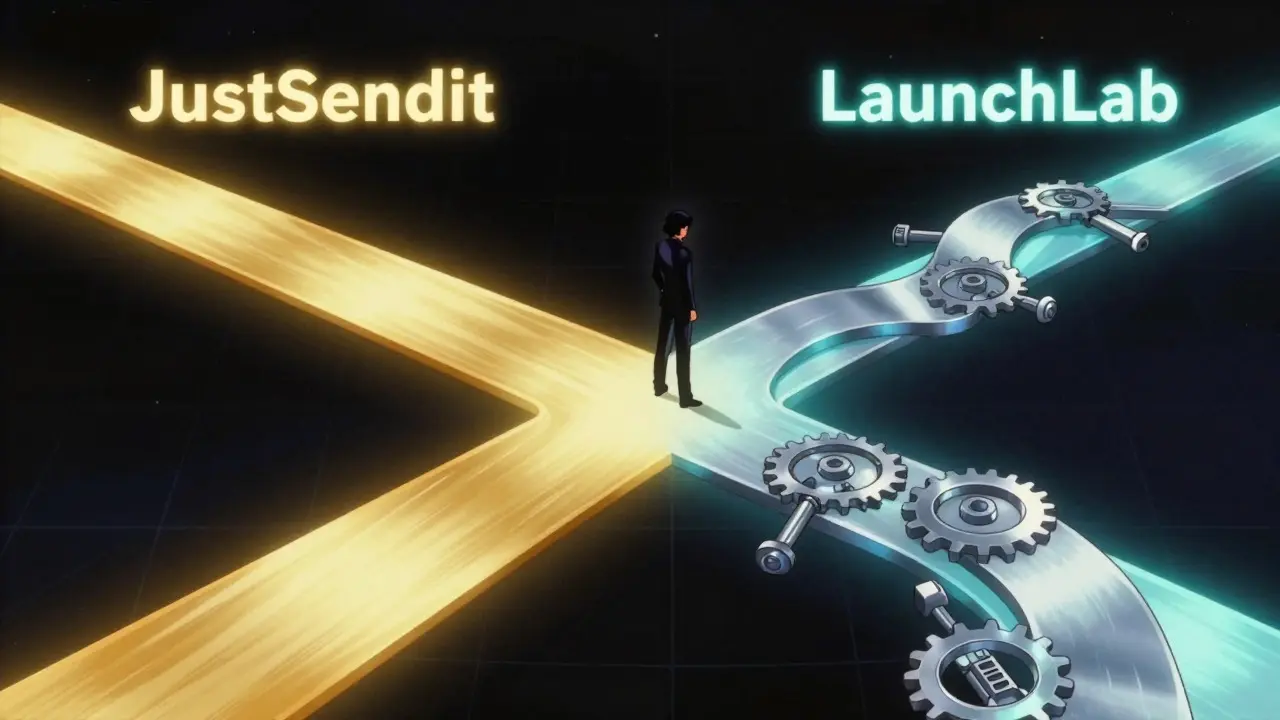
Two Ways to Launch: JustSendit vs. LaunchLab Mode
One of the most significant features of LaunchLab is its dual-mode operation. This isn’t just a marketing term; it fundamentally changes how much control you have over your token’s economics.
- JustSendit Mode: This is the "easy button." It uses default settings for the bonding curve and supply. If you want to get a token live in under two minutes without thinking about math, this is your lane. It’s perfect for quick memes or experimental projects where speed matters more than precision.
- LaunchLab Mode: Here, you take the wheel. You can customize the bonding curve type (linear, exponential, or logarithmic), set custom SOL raise targets (minimum 30 SOL), adjust supply percentages, and even implement vesting schedules with cliff periods. This mode is for creators who understand DeFi mechanics and want to fine-tune their tokenomics to prevent immediate dumps or manage supply inflation.
The choice between these modes dictates your user experience. JustSendit lowers the barrier to entry to near zero, while LaunchLab Mode caters to sophisticated builders who view token launch as a product design challenge rather than just a click-and-go event.
How the Bonding Curve and Graduation Work
The core mechanic of any launchpad is the bonding curve. On LaunchLab, this determines the price of your token as people buy it. As demand rises, the price goes up along the curve. But what happens when the curve ends? That’s where the graduation threshold comes in.
On LaunchLab, a token must reach a market cap equivalent to 85 SOL in raised funds to "graduate." Once this threshold is met, the system automatically migrates the liquidity to a standard Raydium AMM pool. Crucially, the LP tokens are burned upon migration. This means the liquidity is locked permanently, removing the risk of a rug pull by the team pulling out their initial investment. For traders, this is a major trust signal compared to platforms where liquidity remains mutable.
However, the data tells a sobering story. Since its launch, LaunchLab has processed over 900,000 token launches. Yet, only about 1% of those tokens successfully hit the 85 SOL mark to become permanent pools. This highlights the brutal reality of the memecoin market: most tokens fail to gain traction. If you are a trader, knowing this statistic helps you filter out noise. If you are a creator, it emphasizes the importance of community building before you even hit the launch button.
Fee Structure and Revenue Distribution
Transparency in fees is critical when evaluating a platform. Raydium LaunchLab operates on a flat 1% base fee structure. But where does that money go? It’s split into three distinct buckets:
| Allocation | Percentage | Purpose |
|---|---|---|
| Community Pool | 50% | Rewards for ecosystem participants and liquidity providers |
| RAY Buybacks | 25% | Burning RAY tokens to support the native asset price |
| Infrastructure | 25% | Funding development, operations, and maintenance |
This model aligns the platform’s success with the health of the RAY token. Every trade on LaunchLab indirectly supports the buyback mechanism. Additionally, there is a Creator Fee Share feature. After a token graduates, creators earn 10% of the trading fees generated by their token’s pool through Raydium’s Burn & Earn system. This creates a long-term incentive for creators to maintain high-quality projects, as they continue to benefit from their token’s activity well after the initial hype dies down.
LaunchLab vs. Pump.fun: A Direct Comparison
You can’t talk about LaunchLab without addressing its main rival, Pump.fun. While both serve the same purpose, their approaches differ significantly in flexibility and integration.
| Feature | Raydium LaunchLab | Pump.fun |
|---|---|---|
| Quote Tokens | Multiple supported | SOL only |
| Bonding Curve Types | Linear, Exponential, Logarithmic | Standard Linear | Liquidity Migration | Automatic to Raydium AMM | Manual/To PumpSwap |
| Creator Vesting Options | Yes (Customizable) | Limited/None |
| Integration Depth | Native to Raydium Infrastructure | Standalone Ecosystem |
The biggest technical advantage LaunchLab holds is multiple quote token support. On Pump.fun, you’re mostly stuck with SOL pairs. On LaunchLab, you can pair your token with other assets, which opens up more trading strategies and accessibility for users holding different stablecoins or majors. Furthermore, the ability to choose between linear, exponential, and logarithmic curves allows for precise pricing adjustments based on expected demand. An exponential curve might be better for tokens expected to spike quickly, while a linear curve offers a more gradual price discovery process.
From an infrastructure standpoint, LaunchLab benefits from Raydium’s established engine, which processes over 65,000 transactions per second with costs often less than a cent. This ensures that even during high-volume launches, slippage remains manageable and transaction speeds stay snappy.

User Experience and Getting Started
Is LaunchLab easy to use? For the most part, yes. The interface is clean and follows a logical flow. To create a token, you follow these steps:
- Select your mode (JustSendit or LaunchLab).
- Enter basic details: Token Name, Ticker, Description, and Image (recommended size is 128x128 pixels).
- Add social media links to improve discoverability and credibility.
- If in LaunchLab Mode, configure your bonding curve parameters and vesting schedule.
- Confirm wallet ownership and finalize the creation.
The process is streamlined, but the complexity lies in the decisions you make in Step 4. If you choose wrong curve types or set unrealistic raise targets, your token may struggle to graduate. The platform also includes a referral system where you can generate unique links. For every trade made through your link, you earn 0.1% of the volume in SOL. This turns active community members into potential affiliates, helping to drive organic traffic to your project.
Market Context and Future Outlook
As of mid-2026, the Solana memecoin sector continues to be volatile but highly active. LaunchLab has positioned itself not just as a competitor, but as a foundational piece of Raydium’s broader strategy to dominate DeFi infrastructure on Solana. Industry analysts note that LaunchLab represents a systematic response to the gaps in the existing market, offering features that were previously unavailable or required manual workarounds.
The platform’s success hinges on two factors: attracting high-quality launches and improving that 1% graduation rate. If Raydium can incentivize better project curation or provide tools that help creators build sustainable communities, LaunchLab could shift from being a "launchpad" to a "discovery engine." For now, it stands as a robust, technically superior alternative to Pump.fun, particularly for users who value customization and deep integration with the broader Solana DEX ecosystem.
Does Raydium LaunchLab charge a fee to create a token?
No, creating a token on LaunchLab is free. You only pay the standard Solana network gas fees. The 1% fee mentioned in reviews applies to trading volumes once the token is live, not to the act of creation itself.
What happens if my token doesn't reach the 85 SOL graduation threshold?
If a token fails to reach the 85 SOL market cap threshold, it remains on the bonding curve indefinitely. Traders can still buy and sell on the curve, but the token will not migrate to a permanent AMM pool. Liquidity is not locked in the same way as graduated tokens, so there is higher risk of illiquidity or manipulation.
Can I change the bonding curve type after launching?
Generally, no. The bonding curve parameters are set at the time of creation in LaunchLab Mode. Changing them post-launch would disrupt the pricing algorithm and confuse traders. It is crucial to select the correct curve type (linear, exponential, etc.) before finalizing your token setup.
How does LaunchLab compare to Fjord Foundry?
Both platforms offer advanced bonding curve options. However, LaunchLab is natively integrated into Raydium, meaning graduated tokens immediately access Raydium's deep liquidity pools. Fjord Foundry operates as a separate entity, though it also integrates with major DEXes. LaunchLab's edge is its direct connection to Solana's largest DEX infrastructure.
Is LaunchLab safe from rug pulls?
For graduated tokens, the risk is significantly lower because LP tokens are burned, locking liquidity permanently. However, for non-graduated tokens still on the bonding curve, risks remain similar to other launchpads. Always do your own research on the team and community before investing in pre-graduation tokens.





Comments
Carmene Jackson
August 22, 2026 AT 18:34Oh my god, I just read this and now I feel like my brain is melting from all the numbers. Did you know that? It’s so overwhelming when they talk about bonding curves and liquidity pools like it’s a normal Tuesday thing to do.
I spent three hours trying to understand what an AMM pool actually is and I still don’t think I get it. But then I saw that part about the LP tokens being burned? That made me feel safe for some reason, which is weird because usually these things make me anxious.
I guess that means nobody can pull the rug right? Or at least not easily. I hope that’s true. I’ve been burned before, literally and figuratively, by some shady project on another platform.
The fee structure is interesting too. Fifty percent going to the community sounds nice, but where does that money actually go? Is it real money or just points? I need someone to explain this without using words like 'infrastructure' or 'allocation'.
Anyway, thanks for writing this down. It helps to see it laid out like that instead of scrolling through ten different discord servers.
Jade Brown
August 22, 2026 AT 20:12Let’s cut through the fluff here folks. The 1% graduation rate isn't a statistic, it's a massacre. You're looking at a churn rate that would make a SaaS startup weep into their cold brew. Most people treat LaunchLab like it's a lottery ticket with extra steps, but the alpha is in the curve selection.
If you’re running a linear curve on a token that needs explosive early volume, you’re setting yourself up for a slow bleed. Use exponential if you expect a spike, logarithmic if you want to dampen the volatility. The jargon is there for a reason; it’s the difference between a sustainable flywheel and a dead-on-arrival ticker.
Also, stop ignoring the quote token flexibility. Pump.fun locks you into SOL, which is fine if you’re a purist, but if you’re dealing with stablecoin-heavy flows, LaunchLab’s multi-quote support is a massive edge for liquidity depth. Don't sleep on the infrastructure integration either; Raydium’s throughput isn't just marketing speak, it’s the backbone keeping slippage low during those chaotic launch windows.
Jennifer Ulmer
August 24, 2026 AT 18:29I think the best part is how simple it makes things seem. I was worried it would be too hard for regular people, but the JustSendit mode sounds perfect for quick ideas.
It reminds me of how we used to start small projects back in college. You just had to jump in and see what happened. No need to overthink every single detail right away.
I’m glad there are options for both the beginners and the pros. It feels inclusive that way. I hope more platforms start doing this kind of thing where you can choose your level of control.
Kiran Jayaram
August 25, 2026 AT 09:30this whole setup is just a trap for retail degens who think they understand defi better than the devs. the 85 sol threshold is arbitrary nonsense designed to keep liquidity trapped in their own ecosystem while they skim off the top. look at the fee split again. 25% for buybacks? sure. lets pretend that helps the average user holding a micro cap token that goes to zero in 48 hours. its all smoke and mirrors to prop up the RAY price while the actual token holders eat dust. stop pretending this is about innovation. its about market share. pure and simple. wake up sheeple.
Nikki keller
August 27, 2026 AT 02:09There is a certain poetry in the way the bonding curve works, doesn't there? It mirrors the natural rise and fall of attention in our digital age. We build something, it rises, and then it must either sustain itself or fade into the ether. The 1% success rate is harsh, yet it reflects the truth that most ideas do not survive the initial shock of public scrutiny.
I appreciate the clarity of the two modes. It allows for a spectrum of intent, from the spontaneous impulse to the calculated strategy. This duality is rare in platforms that tend to force a one-size-fits-all approach. It respects the user's autonomy, which is a value often overlooked in tech design.
The automatic migration to the AMM pool is also a thoughtful touch. It removes the manual friction that often leads to errors or opportunities for manipulation. By automating the transition, the system ensures a smoother handover, preserving the integrity of the liquidity. It is a small detail, but one that speaks volumes about the platform's commitment to stability.
Ultimately, whether one chooses LaunchLab or its competitors comes down to personal philosophy. Do you prefer the raw, unfiltered chaos of a standalone ecosystem, or the structured, integrated environment of a major DEX? Both have merit, but the choice reveals much about one's risk tolerance and vision for the future of decentralized finance.
miranda gamboa
August 28, 2026 AT 23:03This is huge! The ability to customize vesting schedules is a game-changer for serious builders. It solves the immediate dump problem that plagues so many new launches. If you can lock up supply initially, you protect early investors and signal long-term commitment. That’s exactly the kind of tool we need to mature the sector.
Also, love the referral system. Turning community members into affiliates with that 0.1% cut is smart. It incentivizes organic growth without needing massive ad budgets. It creates a self-sustaining loop of promotion. Great strategic move by Raydium to align incentives across the board.
Melissa G
August 30, 2026 AT 13:21One cannot overlook the cultural shift this represents. For years, the narrative around memecoins has been one of pure speculation, a casino without a house edge. Yet, here we see the introduction of structural mechanics-vesting, curve types, automated migration-that borrow from traditional financial engineering. It is a fascinating hybridization of speculative culture and institutional rigor.
The fact that creation is free, with costs only incurred upon trading, lowers the barrier to entry significantly. This democratizes the act of creation, allowing anyone with an idea to test the waters without significant upfront capital. It is a testament to the ethos of open-source development, where permissionless innovation drives progress.
However, as with any such tool, the responsibility shifts heavily to the user. The complexity of choosing the right parameters requires a degree of financial literacy that many casual participants may lack. Thus, the platform serves not just as a launchpad, but as an educational tool, forcing users to engage with the underlying mechanics of their investments.
Claudio Perrone
September 1, 2026 AT 11:24so basically raydium got scared pump.fun was taking all their cash and built a clone with extra buttons? classic corporate move. i dont trust any of these platforms anyway. they all just want your fees. the fact that they burn lp tokens is cool i guess but only if the token actually survives. which 99% dont. its all a big illusion. wake up people. its just gambling with fancy math. i stick to blue chips. these meme coins are for suckers who think they are crypto wizards. lol.
Aaron Morrissey
September 2, 2026 AT 13:18One must observe the magnificent architectural symmetry of this dual-mode system. It is, in essence, a bifurcation of user agency, allowing the novice to sail the calm waters of 'JustSendit' while the seasoned navigator charts the turbulent seas of 'LaunchLab Mode.' The precision offered in the latter-specifically regarding the logarithmic and exponential curve adjustments-is nothing short of sublime. It transforms the crude instrument of a token launch into a refined artistic endeavor, where every parameter is a brushstroke on the canvas of market sentiment. Truly, a masterpiece of decentralized engineering!
michelle aguilar
September 3, 2026 AT 07:40Finally, a review that actually delves into the nuances, rather than just skimming the surface like so many others do. One must appreciate the depth here. The breakdown of the fee distribution is particularly illuminating; it is rare to see such transparency in these kinds of platforms. The 50% allocation to the community pool is a generous gesture, albeit one that should be scrutinized for its long-term sustainability. After all, generosity without strategy is merely charity, and we are not here for charity, are we? We are here for value. And value, dear reader, is a concept that requires careful, almost obsessive, examination. One simply cannot afford to be careless in this space. The stakes are too high, and the margins for error are non-existent. So, let us bask in the glow of this comprehensive analysis, shall we? It is, quite frankly, a relief to find such thoroughness in a sea of superficiality.
Lance Konig
September 5, 2026 AT 00:09You guys are missing the point. This isn't about features. It's about network effects. Raydium has the liquidity. Pump.fun has the hype. LaunchLab is the bridge. If you think you can just pick one and ignore the other, you're going to get wrecked. The integration is the key. Period. End of story. Stop reading the blog posts and start watching the volume data. That's where the truth lives. Everything else is noise. Just sayin'.
Dina Lazarova
September 5, 2026 AT 16:01While the technical specifications are undoubtedly impressive, one must question the practical utility for the average investor. The complexity of selecting the appropriate bonding curve type suggests a target audience far removed from the casual trader. Furthermore, the reliance on a specific threshold for graduation introduces an element of binary risk that may deter conservative stakeholders. It is a sophisticated tool, certainly, but sophistication often correlates with exclusivity. Whether this exclusionary nature will hinder mass adoption remains to be seen. One hopes that the user interface mitigates this cognitive load sufficiently, but time will tell if the theory translates to practice.
Walker Perry
September 6, 2026 AT 04:14They are trying to centralize decentralization again! Look at the fee structure. Who decides where the money goes? Raydium! Not the people! Not the voters! They take 25% for 'infrastructure' which is just code for 'corporate overhead'. And the buybacks? That's just them propping up their own asset to make it look good. It's a closed loop. A rigged game. You think they care about your token? No. They care about their revenue. Wake up America! Support domestic chains! Stop letting foreign entities like Solana dictate our financial freedom. This is just another step towards total surveillance capitalism disguised as a 'launchpad'.
Alexander Scheel
September 7, 2026 AT 23:53How delightful to see a platform that prioritizes 'transparency' in its fee structure, a word that seems to be increasingly rare in our current moral landscape. One wonders, however, if the transparency extends to the actual execution of these buybacks. After all, intention is one thing, but action is another. It is a subtle distinction, yet one that carries significant weight in the court of public opinion. Let us hope that the promise of community rewards is not merely a hollow slogan, but a genuine commitment to shared prosperity. For in the end, it is not the technology that defines us, but the values we choose to embed within it. A thought worth pondering, wouldn't you agree?
Evelyn Kula
September 9, 2026 AT 10:55Oh, look at us, playing with our little toy cars again! Seriously though, this article is so basic. Anyone who thinks LaunchLab is a 'superior alternative' hasn't looked at the actual TVL war happening right now. It's a distraction tactic. While everyone is busy reading this fluffy piece, the real whales are moving their bags to the next chain. Don't get fooled by the pretty graphs. The matrix is closing in. Stay sharp, people. The truth is out there, and it's not in this blog post. It's in the dark pools. Trust no one. Especially not the guys selling you shovels for the gold rush that already ended.
manish jha
September 10, 2026 AT 13:39In my experience, the key to success lies not in the tool, but in the mindset of the creator. Many fail because they focus on the mechanics rather than the message. The bonding curve is merely a vessel; the content is the soul. If you do not have a clear purpose, no amount of technical optimization will save you. Be mindful of your intentions. The market rewards authenticity, not complexity. Remember this.
Ashley Snyder
September 11, 2026 AT 17:09I really liked how they explained the difference between the two modes. It made me feel like I could actually try it out without feeling lost. Thanks for the clear explanation!
Sarah Hafner
September 13, 2026 AT 02:20Great breakdown! 😊 I've been curious about the vesting options. It's really helpful to see how they compare to Pump.fun. Thanks for sharing this info! 🚀
Susan Kiley
September 13, 2026 AT 20:18Oh, darling, finally a review that speaks my language! 💅 The sheer elegance of the logarithmic curve options is just *chef's kiss*. It's like having a bespoke suit tailored for your tokenomics. Most of these platforms are so... basic. But LaunchLab? It's giving luxury boutique. I'm already drafting my next launch plan. Can't wait to show them who's boss. 💖✨
Gary Straiton
September 14, 2026 AT 14:04THIS IS THE END OF AN ERA! Pump.fun is dead, long live Raydium! The American spirit of innovation has triumphed once again! We don't need foreign dependencies. We need strength. We need dominance. LaunchLab is the hammer that will crush the competition. Buy RAY or stay poor! The revolution is here, and it's powered by Solana! 🔥🇺🇸💪
alex fordy
September 15, 2026 AT 00:09Really appreciate the detailed comparison here. It's always hard to decide between platforms, but seeing the fee splits side-by-side helps a lot. I think the automatic migration feature is a huge plus for peace of mind. 🙌
Nia Franklin
September 16, 2026 AT 05:16Oh wow!! I never realized how much went into the bonding curve stuff!!! It's so cool that you can pick different types!!! Like, why didn't anyone tell me this before?? Now I feel super empowered to make my own token!!! (though I might mess it up lol) thanks for the tips!!! xoxo
Mohamed Shoaeb
September 17, 2026 AT 23:31nice read. i think the 1% stat is scary but also motivating. if you are serious about it you have to put in the work. the tools are there now. just gotta use them right. good luck to everyone launching soon.
Sonia Gomez Gomez
September 18, 2026 AT 07:26So, you think this is fair? Really? Because I feel like the creators are getting the short end of the stick here. All that work, all that community building, and then the platform takes its cut and moves on. Where is the gratitude? Where is the respect for the artist? It feels so cold. But whatever, I guess that's just how business is these days. :)
SHIV SHANKAR KANTA
September 18, 2026 AT 23:55the soul of the coin matters not the code. the code is just the body. the spirit is the community. if you launch without love it dies. if you launch with fire it burns bright. the curve is just a line on paper. the heart is the engine. remember this. the market is a mirror. it shows you what you are inside. be honest. be brave. be true. the rest is noise. silence the ego. hear the call. the path is clear. walk it. do not look back. the destination is within. the journey is the reward. the end is the beginning. cycle completes. peace.