Nothing at Stake Problem in Proof of Stake Explained

Validator Incentive Calculator
Validator Incentive Calculator
Calculate the expected value of supporting a single chain versus supporting multiple forks. See how slashing penalties make supporting multiple forks economically irrational.
How It Works
This calculator demonstrates why slashing conditions make supporting multiple forks economically irrational.
Expected value = (Probability of winning × Reward) - (Slashing penalty if equivocated)
Without slashing, supporting both chains gives maximum reward. With slashing, the penalty makes supporting multiple chains less valuable than supporting a single chain.
Results
Expected reward for supporting only one chain: 0 ETH
Expected reward for supporting both chains: 0 ETH
Decision: Calculate to see recommendation
Calculations based on probability and slashing penalties
The nothing at stake problem is one of the most important challenges in blockchain design - and it’s what makes Proof of Stake (PoS) fundamentally different from Proof of Work. At first glance, PoS seems simpler: instead of burning electricity to mine blocks, you lock up your coins as collateral and get rewarded for helping secure the network. But here’s the catch - if the blockchain splits into two competing versions (a fork), what’s stopping a validator from supporting both chains at the same time? Nothing. Literally. That’s the nothing at stake problem.
Why This Problem Exists
In Bitcoin’s Proof of Work system, miners have to choose one chain to work on. Why? Because mining requires real-world resources - electricity, hardware, cooling. If you split your hash power between two chains, you’re cutting your chances of earning rewards in half. You’re wasting money. So miners naturally gravitate toward the longest chain, the one with the most work behind it. It’s not about loyalty - it’s about economics. PoS doesn’t work that way. A validator doesn’t burn energy. They don’t need special hardware. All they need is their staked coins and a computer. Creating a block on one chain costs the same as creating a block on ten chains. So if a fork happens, why wouldn’t a rational validator try to validate on every possible chain? If Chain A wins, they get paid. If Chain B wins, they get paid. If both chains survive for a while, they get paid twice. There’s no penalty. No cost. Just pure upside. This isn’t theoretical. Back in 2012, when Peercoin launched as one of the first PoS blockchains, this exact issue caused chaos. Validators flooded both sides of every fork. The network couldn’t reach consensus. It was like everyone in a town arguing over which street to take to work - and no one willing to pick one because there’s no penalty for taking both.How PoW Avoids This
Proof of Work naturally solves this problem because of physical constraints. You can’t run two mining rigs at the same time on the same machine and expect to double your output. You can’t split your power bill between two blockchains. You can’t mine on two chains and still get full rewards on both. Think of it like a lottery where you can only buy one ticket. If you buy two tickets for two different draws, you’re doubling your cost - and your odds of winning don’t double. You’re just spending more for no guaranteed gain. In PoS, it’s like you can buy a ticket for every single lottery draw happening at once. And if any one of them wins, you get the prize. So you buy them all. Why wouldn’t you?The Solution: Slashing Conditions
The fix came from one simple idea: punish validators who try to cheat. Vitalik Buterin and the Ethereum team introduced slashing conditions - rules that automatically take away part or all of a validator’s stake if they behave dishonestly. The most common violation? Signing blocks on two different chains at the same time. That’s called equivocation. And it’s grounds for immediate punishment. Ethereum’s Casper FFG protocol (used since The Merge in September 2022) slashes up to 32 ETH if a validator is caught validating conflicting blocks. That’s a $60,000+ penalty at current prices. Even a small mistake - like accidentally signing two blocks at the same height - can cost you 1 ETH. It’s not just about losing money. It’s about making cheating irrational. Why risk losing your entire stake to earn a few extra rewards on a fork that might never win? The math doesn’t add up. The cost of cheating is higher than the reward.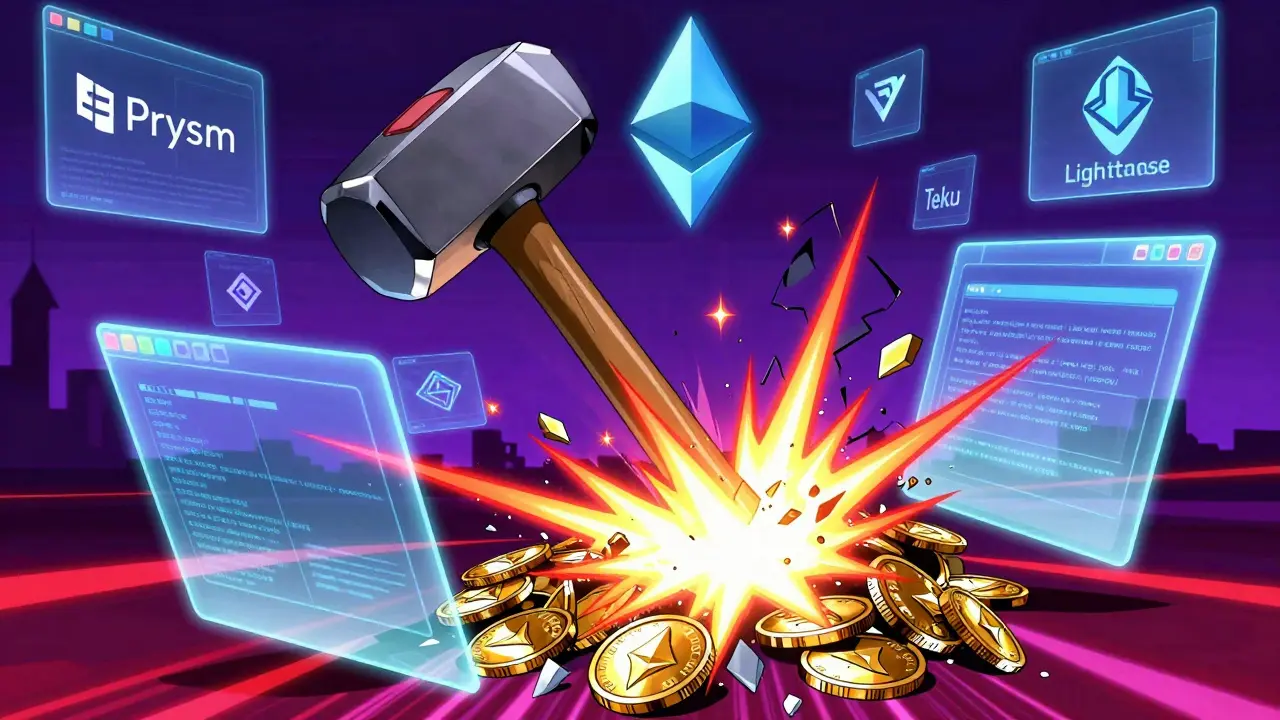
How Slashing Works in Practice
Validators don’t just sit back and hope they don’t make a mistake. They run specialized software - like Prysm, Lighthouse, or Teku - that includes built-in slashing protection. These tools keep a secure log of every block a validator signs. If the validator tries to sign a conflicting block, the software blocks the action before it happens. But mistakes still happen. In late 2022, over 2,300 validators were slashed during a network upgrade because their software wasn’t updated correctly. They weren’t trying to cheat - they just didn’t know how to configure their systems. That’s why the Ethereum community created guides, Discord servers, and documentation to help new stakers avoid these traps. Slashing isn’t just about punishment. It’s about alignment. It forces validators to act in the network’s best interest. If you want to earn rewards, you have to help the chain stay unified. You can’t hedge your bets. You have to pick a side - and stick with it.What About Other Blockchains?
Ethereum isn’t alone. Almost every major PoS blockchain today uses slashing. Cosmos, Polkadot, Solana, Cardano - they all have some form of penalty system. The Blockchain Benchmarking Report from Q1 2023 found that 92.7% of the top 50 PoS networks use slashing to prevent nothing-at-stake behavior. But not all systems are equal. Some use lighter penalties. Others rely on social consensus or reputation systems. Ethereum’s approach is the most aggressive - and the most proven. Since The Merge, there have been dozens of testnet forks and a few minor mainnet disruptions. Not a single case of intentional nothing-at-stake behavior has been recorded. Even when the network splits temporarily - like during a software bug or network delay - slashing ensures that validators don’t exploit the chaos. The chain recovers because everyone has a strong incentive to follow the correct path.
Is the Problem Fully Solved?
Most experts say yes - but with caveats. The nothing-at-stake problem is solved for normal network conditions. It’s solved for everyday forks. It’s solved for accidental misconfigurations. But what if a powerful group of validators - say, a single staking pool controlling 30% of the network - decides to try a long-range attack? Could they go back in time and rewrite history? That’s where checkpointing comes in. Ethereum doesn’t let validators finalize blocks arbitrarily. Instead, it uses checkpoints - trusted anchor points every 64 blocks - that only a supermajority (66%) of validators can approve. Once a checkpoint is finalized, going back further than that becomes impossible without controlling 66% of all staked ETH. That’s not just expensive - it’s practically impossible. A 2023 MIT study analyzed 18 months of Ethereum data and found only 0.0003% of validators showed any behavior that could hint at nothing-at-stake activity. All of it was traced to software bugs - not malicious intent. So yes, the problem is solved. But it’s solved through smart design, not magic. It’s solved because the cost of cheating is higher than the reward.Why This Matters for You
If you’re thinking about staking ETH or any other PoS coin, understanding this problem is critical. You’re not just earning passive income - you’re helping secure a global financial system. If you misconfigure your validator, you could lose your stake. If you don’t understand slashing, you might accidentally help break the chain. It also explains why PoS is so much more energy-efficient than PoW. Ethereum cut its energy use by 99.95% after switching. But that efficiency came with a trade-off: complexity. You can’t just plug in a miner and walk away. You have to run secure software, update regularly, and understand the rules. The nothing-at-stake problem isn’t a flaw in PoS. It’s a design challenge - and Ethereum showed us how to solve it. The solution isn’t perfect, but it’s working. And that’s why PoS is now the backbone of most new blockchains.What is the nothing at stake problem in PoS?
The nothing at stake problem occurs when validators in a Proof of Stake system have no economic penalty for validating multiple competing blockchain forks at the same time. Unlike Proof of Work, where miners must choose one chain due to high energy costs, PoS validators can support every fork at near-zero cost, risking network consensus. This could lead to permanent splits and double-spending attacks if not addressed.
How does Ethereum solve the nothing at stake problem?
Ethereum solves it through slashing conditions in its Casper FFG consensus protocol. If a validator signs conflicting blocks on two forks, their staked ETH (up to 32 ETH) is automatically confiscated. This makes cheating economically irrational. Validators also use slashing protection software to prevent accidental violations.
Can you still get slashed for nothing at stake even if you didn’t mean to?
Yes. Slashing doesn’t care about intent. If your validator software signs two conflicting blocks - even due to a misconfiguration, a network glitch, or outdated software - you can still lose part or all of your stake. That’s why running secure, updated client software and using slashing protection tools is essential for all validators.
Is the nothing at stake problem unique to Ethereum?
No. It’s a fundamental issue in any pure Proof of Stake system without penalties. But most modern PoS blockchains - including Cosmos, Polkadot, and Solana - now use slashing or similar penalty mechanisms. Ethereum’s implementation is the most widely studied and tested, making it the standard for others to follow.
Why doesn’t Proof of Work have this problem?
Proof of Work requires real-world resources - electricity and hardware - to create blocks. Miners can’t split their hash power between two chains without cutting their own rewards in half. The cost of mining makes it irrational to support multiple forks. PoS removes this cost, which is why it needs built-in penalties to prevent the same behavior.
Are there any risks left with PoS after solving nothing at stake?
Yes. While nothing at stake is largely solved, other risks remain - like centralization (if a few staking pools control most of the stake), long-range attacks during extreme network partitions, and validator downtime. But these are separate from nothing at stake. Ethereum’s design has proven that with proper penalties, PoS can be as secure as PoW - without the massive energy cost.





Comments
Kelly Burn
December 10, 2025 AT 18:22OMG this is sooo true 😍 I just started staking ETH and I was like... why would anyone ever fork? Then I read this and my brain exploded 🤯 Slashing is basically the blockchain’s version of a stern mom saying ‘I WILL TAKE AWAY YOUR PHONE’ if you try to cheat. I love it.
Jessica Eacker
December 12, 2025 AT 16:32You don’t need to be a genius to get this. If you’re staking, you’re not just holding coins-you’re holding the chain together. One typo in your config, one outdated client, and boom-your life savings gets slashed. No drama. No warnings. Just cold hard math. Stay sharp.
Kurt Chambers
December 14, 2025 AT 10:23american blockchain good. chinese blockchain bad. why? because usa invented slashing. china just copies. also why do you think china hates crypto? they know if you let people stake, they stop trusting the party. this is war. and we won.
Caroline Fletcher
December 15, 2025 AT 00:26so wait... you're telling me the whole system is just a giant trust fund where if you blink wrong, they take your money? and this is called 'security'? lol. i'm out.
Lloyd Cooke
December 15, 2025 AT 03:46The nothing-at-stake problem is not merely a technical flaw-it is a metaphysical rupture in the ontological architecture of decentralized consensus. In PoW, scarcity is enforced by entropy; in PoS, it is enforced by punishment. The former is natural law; the latter, social contract. One emerges from thermodynamics, the other from the collective will to avoid self-destruction. We are no longer mining blocks-we are negotiating our moral fidelity to the chain, under the gaze of algorithmic justice.
Slashing is not penalty. It is sacrament.
Jessica Petry
December 15, 2025 AT 22:55Of course Ethereum solved it. Because obviously, only a hyper-centralized, over-engineered, VC-backed monstrosity could possibly fix a problem that should’ve never existed in the first place. Meanwhile, real blockchains like Bitcoin just… don’t have this problem because they’re not trying to be everything to everyone. PoS is just proof that engineers love complexity more than they love simplicity. And that’s a tragedy.
PRECIOUS EGWABOR
December 17, 2025 AT 03:49slashing is just a fancy word for ‘you messed up so now we steal your coins’. like, cool. so we’re not trusting the system anymore, we’re just threatening people into compliance? that’s not decentralization. that’s feudalism with a blockchain UI.
Kathleen Sudborough
December 17, 2025 AT 15:06I’m so glad someone finally explained this in a way that made sense! I’ve been staking for a year and I was terrified I’d accidentally get slashed. The slashing protection tools were a lifesaver-Prysm saved me twice when my node glitched. You’re not alone if you’re nervous. Just update your software, enable protection, and join a staking Discord. We’ve all been there. You got this 💪
Vidhi Kotak
December 19, 2025 AT 03:43in india we have 30k validators now. most are newbies. they don’t even know what ‘equivocation’ means. but they still stake. i tell them: ‘update your client. turn on slashing protection. sleep with your laptop open.’ they laugh. then they get slashed. then they cry. then they learn. this is how blockchain grows.
Kim Throne
December 20, 2025 AT 15:50While the economic incentives of slashing effectively mitigate the nothing-at-stake problem under normal operational conditions, the assumption that validators act rationally presupposes perfect information, deterministic network conditions, and homogenous software environments-all of which are empirically untenable. The documented cases of accidental slashing due to misconfiguration suggest that the system’s robustness is contingent upon user competence, not protocol design alone. Further research into adaptive penalty mechanisms and behavioral modeling is warranted.
amar zeid
December 22, 2025 AT 05:19when i first heard about slashing, i thought: ‘this is brutal.’ but then i realized-this is what makes PoS scalable. PoW needs mountains of power. PoS needs just one rule: don’t lie. and if you lie? you pay. it’s elegant. it’s clean. it’s the future. stop comparing it to Bitcoin. it’s not supposed to be the same.
Alex Warren
December 23, 2025 AT 14:54Slashing works because it turns a game theory problem into a cost-benefit analysis. The validator’s expected utility of equivocating is negative. The probability of getting caught multiplied by the penalty exceeds the expected reward from double-signing. Simple. Elegant. Unavoidable. This is why Ethereum’s Casper FFG is the gold standard. No other PoS system has matched its precision.
Ian Norton
December 25, 2025 AT 11:52Let’s be real. Slashing is just a band-aid. The real problem is that PoS centralizes power into the hands of the wealthy. The more ETH you have, the more you can stake. The more you stake, the more you earn. The more you earn, the more you can stake. It’s a Ponzi pyramid with a fancy name. Slashing doesn’t fix inequality. It just makes the rich feel safer while the rest of us risk our savings on a technicality.
Andy Walton
December 26, 2025 AT 05:07bro i got slashed once bc my router died for 2 mins. i cried for 3 days. then i bought a backup router. then i bought a backup backup router. then i bought a generator. now i have 4 nics, 3 batteries, and a vpn tunnel to a friend’s house in another state. this is the new normal. welcome to web3.
Sue Gallaher
December 26, 2025 AT 22:48they say slashing prevents forks but what about the real forks? like when the devs change the rules without voting? who gets slashed then? nobody. because the ones who make the rules never get punished. this whole thing is a scam. they just want your money and your trust. and if you lose it? oh well. you should’ve read the docs.
Jeremy Eugene
December 28, 2025 AT 07:46Thank you for this comprehensive breakdown. The alignment of economic incentives with network integrity is a triumph of protocol design. The transition from PoW to PoS represents not merely an efficiency gain, but a philosophical evolution in consensus mechanisms-from resource expenditure to accountability. The slashing mechanism, while severe, is ethically defensible and statistically effective. This is the future of decentralized infrastructure.
Madison Surface
December 29, 2025 AT 15:55I remember when I first heard about slashing. I thought, ‘This is terrifying.’ But then I realized-it’s not about fear. It’s about responsibility. You’re not just running software. You’re holding a piece of the world’s financial backbone. And if you mess up? You pay. Not because you’re evil. But because the system doesn’t care about your excuse. It only cares about the truth. And the truth is: you have to be ready. Not just technically. Emotionally too. I’m proud to be part of this. Even if I’m scared.