How Liquidity Mining Rewards Work in DeFi

Imagine earning free crypto just by leaving your coins in a digital pool. That’s the basic idea behind liquidity mining. It’s not magic. It’s not mining in the old Bitcoin sense. It’s a smart system built into decentralized finance (DeFi) that pays you for helping trading platforms work better. And it’s been one of the biggest drivers of growth in crypto over the last few years.
What Exactly Is Liquidity Mining?
Liquidity mining is when you lock up your cryptocurrency in a pool so others can trade it. In return, you get paid - usually in the platform’s native token, plus a share of trading fees. Think of it like being a market maker on Wall Street, but without the suit, the desk, or the broker fees. On a decentralized exchange like Uniswap or PancakeSwap, there are no humans setting prices. Instead, there are pools of paired tokens - say, ETH and USDC. When you add your ETH and USDC to the pool, you’re giving traders the ability to swap between them. Without these pools, there’d be no trades. No liquidity means no market. In exchange for your contribution, you get something called LP tokens - liquidity provider tokens. These are digital receipts that prove you own a portion of that pool. You can’t spend them like regular crypto, but they’re your key to earning rewards.How Do You Earn Rewards?
There are two main ways you make money from liquidity mining. First, you earn a cut of the trading fees. Every time someone swaps ETH for USDC in the pool you’re part of, a tiny fee (usually 0.05% to 0.3%) goes to the liquidity providers. That’s your passive income. It adds up over time, especially if the pool is busy. Second, and often more valuable, you earn the platform’s own token. This is where the real excitement (and risk) kicks in. After you deposit your assets into the pool, you then “stake” your LP tokens in a separate section of the app - often called a “farm.” That’s when you start receiving rewards in the form of UNI, SUSHI, CAKE, or whatever token the platform issues. These rewards are distributed daily, sometimes hourly, based on how much of the total liquidity you’ve provided. If you put in 1% of the pool’s total value, you get roughly 1% of the daily token rewards. It’s simple math, but the numbers can look crazy. Some farms offer 50%, 100%, even 300% APY - but those numbers don’t tell the whole story.Why Do Protocols Pay So Much?
You might wonder: why would a startup give away hundreds of thousands of dollars in tokens just to get people to deposit crypto? The answer is survival. New DeFi projects need liquidity to function. Without enough people trading, the price of their token becomes unstable. A small trade can swing the price wildly. That scares off users. So protocols use liquidity mining as a bootstrap tool. They pay early adopters to lock up funds, which creates depth in the market. That depth attracts more traders. More traders mean more fees. More fees mean more incentive for others to join. It’s a flywheel. Uniswap’s 2020 launch of its UNI token was the turning point. Before that, liquidity mining existed, but it was niche. After Uniswap gave away 15% of its total supply to past liquidity providers, the whole industry changed. Suddenly, every new DeFi project had to offer rewards - or risk being ignored.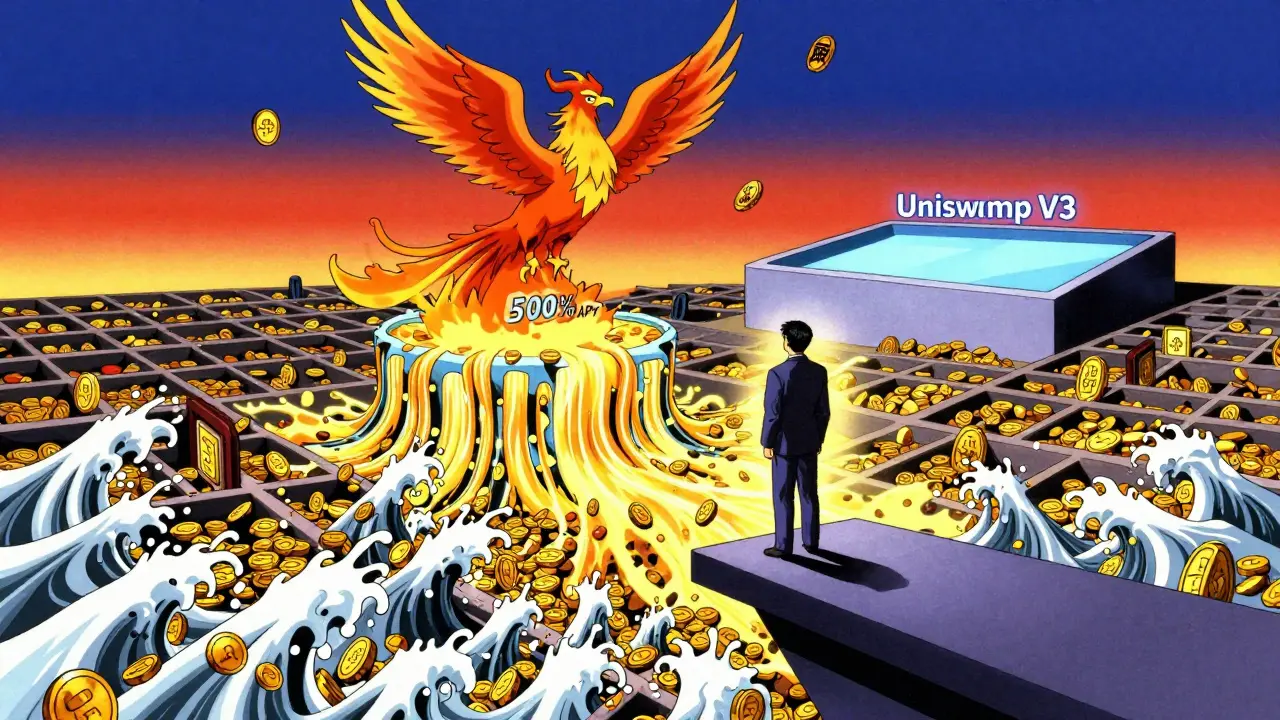
The Hidden Risks: Impermanent Loss and Mercenary Capital
It sounds too good to be true. And sometimes, it is. The biggest risk you face is impermanent loss. This happens when the price of the two tokens in your pool moves apart. Say you put in $1,000 worth of ETH and $1,000 worth of USDC. If ETH doubles in price while USDC stays flat, traders will buy ETH from your pool using USDC. You end up with less ETH than you started with - and more USDC. When you withdraw, your total value might be less than if you’d just held the tokens in your wallet. It’s called “impermanent” because if the prices return to their original ratio, the loss disappears. But if you withdraw while the gap is wide, the loss becomes real. Then there’s the problem of mercenary capital. Many liquidity providers aren’t loyal to any protocol. They jump from farm to farm chasing the highest APY. They’ll lock up their money for a week, claim their rewards, and leave. That’s fine for them. But for the protocol, it means liquidity vanishes overnight. That causes price crashes, panic, and sometimes total collapse. And don’t forget the token price risk. If you’re earning 100 tokens a day, but those tokens are falling 10% a week, you’re losing money even if your APY looks great. Many users have earned thousands in tokens - only to watch them drop 90% in value.What You Need to Get Started
You don’t need to be a coder. But you do need to understand a few basics. First, you need a crypto wallet - MetaMask is the most common. You’ll need some Ethereum (or another chain’s native token) to pay for gas fees. On Ethereum, those can be $10 to $50 during busy times. That’s why many now use Layer 2 chains like Polygon or Arbitrum, where fees are under $0.10. Second, pick a trusted platform. Start with Uniswap, SushiSwap, or PancakeSwap. They’ve been around for years. Their code has been audited. Their communities are active. Avoid new projects promising 500% APY unless you’re ready to lose it all. Third, understand the pool you’re joining. Most DeFi apps show you the token pair, the APY, and the total value locked. Don’t just chase the highest number. Look at the trading volume. High volume means more fees. Low volume means your rewards come mostly from token emissions - which could vanish.
Advanced Tactics: Concentrated Liquidity and veTokens
The game has evolved. Simple liquidity mining is no longer the only option. Uniswap V3 introduced concentrated liquidity. Instead of spreading your funds across a wide price range, you can choose a narrow band - say, between $3,000 and $3,500 for ETH. If the price stays in that range, you earn more fees. But if it moves outside, you earn nothing until it comes back. It’s higher risk, higher reward. Curve Finance took another path with vote-escrowed tokens (veCRV). If you lock your CRV tokens for up to four years, you get boosted rewards and voting power in the protocol. This rewards long-term believers, not short-term speculators. These models are more complex, but they’re also more sustainable. They’re designed to keep capital in place longer, which helps the protocol survive.Is Liquidity Mining Worth It in 2025?
Total value locked in DeFi has dropped from its 2021 peak of over $100 billion to around $50 billion in 2025. That doesn’t mean liquidity mining is dead. It means the hype has settled. The survivors are the ones built on real utility - not just token emissions. Aave, Compound, and MakerDAO still run strong liquidity programs because they offer real lending and borrowing services. The ones that only paid out tokens? Most are gone. The key now is sustainability. Look for protocols that:- Generate real trading volume
- Have transparent tokenomics
- Offer fee-based rewards, not just token dumps
- Use Layer 2 chains to keep fees low
Final Thoughts
Liquidity mining is one of the most powerful tools DeFi has created. It turns passive holders into active participants. It aligns incentives. It builds markets from scratch. But it’s not a get-rich-quick scheme. It’s a financial tool - and like any tool, it can help you or hurt you, depending on how you use it. Start small. Learn the mechanics. Watch how prices move. Track your rewards. And never forget: the best returns often come from patience, not from chasing the highest APY.What’s the difference between liquidity mining and yield farming?
Liquidity mining is a type of yield farming. Yield farming is the broad term for earning crypto rewards by locking up assets. Liquidity mining specifically refers to providing liquidity to trading pools on decentralized exchanges. So all liquidity mining is yield farming, but not all yield farming is liquidity mining - you can also earn rewards by lending or staking alone.
Can you lose money doing liquidity mining?
Yes, you can. The biggest risk is impermanent loss, where the price of your deposited tokens moves significantly, causing your position to be worth less than if you’d just held them. You can also lose money if the reward token crashes in value, or if the protocol gets hacked. High gas fees can also eat into profits, especially on Ethereum.
Which platforms are safest for liquidity mining in 2025?
Uniswap (on Arbitrum or Polygon), SushiSwap, and PancakeSwap remain the most trusted. They’ve been audited multiple times, have large user bases, and offer transparent reward structures. Avoid new, unknown protocols with no track record - even if they promise 1000% APY. Most of them fail within months.
Do I need to pay taxes on liquidity mining rewards?
In most countries, yes. Receiving tokens as rewards is usually treated as taxable income at the time you receive them, based on their market value. When you later sell or trade those tokens, you may also owe capital gains tax. Tax rules vary by country, so consult a crypto-savvy accountant.
Why do some liquidity pools have higher APY than others?
Higher APY usually means the protocol is spending more tokens to attract liquidity - often because it’s new or struggling to gain traction. Established pools like ETH/USDC on Uniswap have lower APY because they don’t need to pay as much - their trading volume keeps fees high. High APY can be a red flag: it may not be sustainable.
How often are liquidity mining rewards paid out?
Most platforms pay rewards daily, sometimes hourly. You don’t have to claim them every day - you can let them compound. But you’ll need to manually claim them on most platforms. Some newer ones auto-compound, but those often come with higher fees or more complex smart contracts.
What’s the best way to minimize impermanent loss?
Use stablecoin pairs like USDC/USDT or DAI/USDC - their prices rarely move apart. Avoid volatile pairs like ETH/DOGE unless you’re experienced. You can also use concentrated liquidity pools (like Uniswap V3) to limit your exposure to price swings. And always compare your potential losses against the rewards - sometimes the fees alone make it worth it.