How Leverage Risks Can Destroy Crypto Trading Accounts
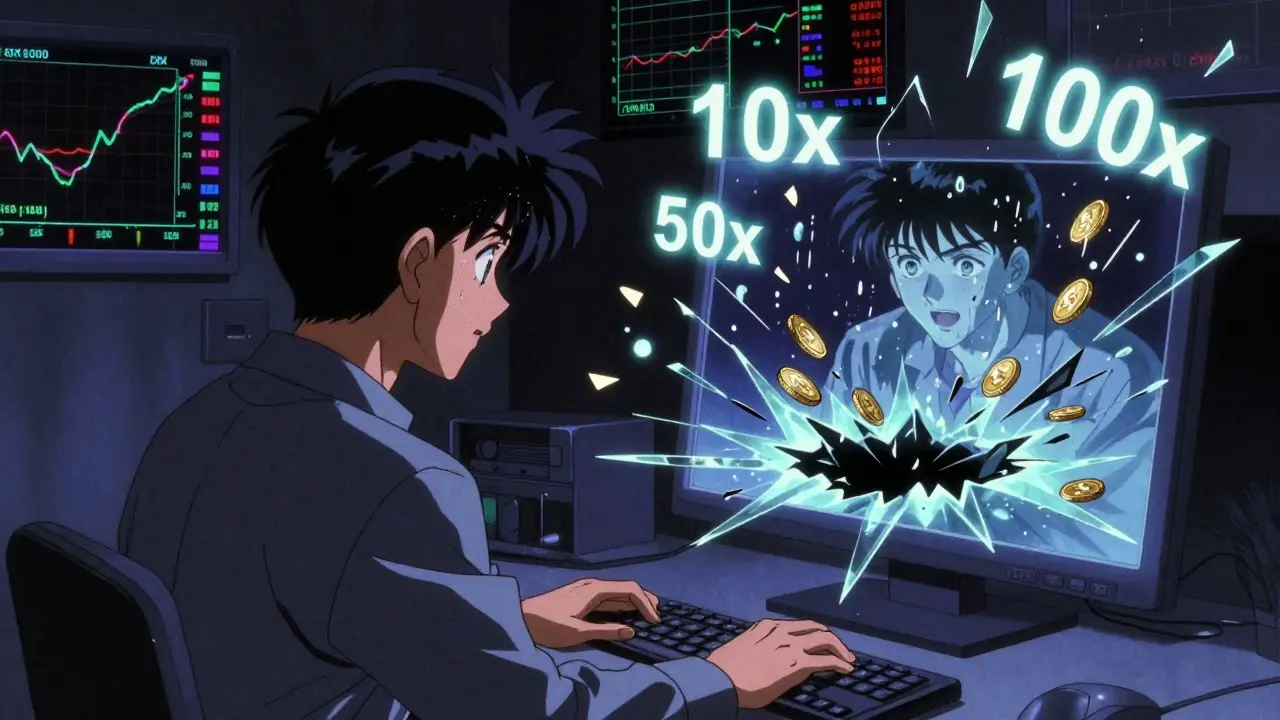
Leaving your money in a crypto wallet is one thing. Using leverage to bet big on price swings is another - and it’s where most traders lose everything. Leverage lets you control a much larger position than your actual balance. With 10x leverage, $1,000 becomes $10,000 in buying power. With 50x? That same $1,000 controls $50,000. Sounds powerful, right? But here’s the truth: leverage doesn’t make you richer. It just makes you faster at losing money.
How Leverage Turns Small Moves Into Total Losses
Crypto prices don’t move like stocks. They jump. One minute Bitcoin is at $62,000. The next, it’s at $60,500 because a whale sold a huge chunk or a regulatory rumor hit Twitter. That 2.4% drop doesn’t mean much if you’re holding. But if you’re using 25x leverage, that’s a 60% loss on your margin. And if you’re at 50x? That same move wipes out your entire position before you can even click "close".Liquidation isn’t a warning. It’s an automatic execution. Exchanges don’t wait. They don’t call you. They just close your trade the second your margin falls below the maintenance level. And during high volatility - which is almost always in crypto - slippage means your stop-loss might not even trigger at the price you set. You might think you’re safe at $61,000, but the market gaps down to $60,200 in a second, and your stop gets filled at $59,800. You lose more than you planned. And with leverage, that extra loss compounds fast.
The Five Hidden Risks No Beginner Talks About
- Market Volatility Risk: Bitcoin swings 5-15% in a day. Solana? 20%. Leverage multiplies every tick. A 3% move against you with 30x leverage means you’re down 90%. You’re not trading price. You’re trading volatility.
- Liquidation Risk: This isn’t theoretical. In May 2021, over $8 billion in leveraged positions were wiped out in one day when Bitcoin dropped 30%. Traders who thought they had "enough margin" got erased. No second chances.
- Margin Call Pressure: When your position starts losing, the exchange demands more collateral. If you can’t deposit fast enough - because you’re asleep, offline, or just out of cash - your position gets liquidated. There’s no grace period.
- Emotional Risk: Leverage turns fear into panic and greed into obsession. You see a 20% gain in 10 minutes. You think, "I can do this forever." Then you lose 15% in the next hour. You double down. You average down. You ignore your plan. That’s how accounts die.
- Counterparty Risk: What if the exchange freezes withdrawals? What if their system crashes during a flash crash? Binance, FTX, BitMEX - all have had moments where users couldn’t access funds. If you’re leveraged and the platform fails, you’re not just losing your trade. You’re losing your capital.
Why Most People Lose - And How They Do It
The biggest mistake? Using too much leverage too soon. Beginners often think: "If 5x is good, 50x must be amazing." That’s not how it works. Wundertrading found that traders using over 5x leverage on their first trades had a 92% failure rate within 30 days. The ones who survived? They started with 2x or 3x. They learned how the market moved. They built discipline.Another deadly habit: averaging down on losing positions. You go long BTC at $60,000 with 20x leverage. It drops to $58,000. Instead of cutting losses, you add more. Now you’re holding $20,000 worth of position with only $1,000 in margin. If it drops another 1%, you’re gone. You didn’t fix your mistake. You made it 10x worse.
And then there’s trading without a plan. No entry. No exit. No stop-loss. Just "I feel like it’s going up." That’s not trading. That’s gambling with borrowed money. And in crypto, the house always wins.

How Real Traders Survive (And Why You Shouldn’t Copy Them)
Professional traders don’t use 100x leverage. They don’t bet 20% of their account on one trade. They don’t trade every hour. They use:- 1-2% risk per trade: If your account is $10,000, you risk no more than $100-$200 on any single leveraged position. That means even if you lose 10 trades in a row, you still have 80% of your capital left.
- Isolated margin: This locks your risk to just the funds you put into one trade. If it liquidates, only that trade dies. Your whole account stays safe.
- Stop-losses with buffer: Set your stop-loss 1-2% below your entry, not right at the edge. Crypto gaps. You need room.
- Profit-taking: Don’t wait for the moon. Take 50% off at 5% profit. Lock in gains. Reduce exposure. Let the rest ride with a trailing stop.
- Trading only during high-liquidity hours: Avoid trading during weekends, holidays, or late-night hours when volume is low. That’s when whales move the market.
And they don’t trade every day. They wait for setups. They study. They track on-chain data, funding rates, and open interest. They know when the market is over-leveraged - and they stay away.
The 24/7 Trap
Stock markets close. Crypto doesn’t. That means while you’re sleeping, a Chinese regulator could drop a tweet. A major exchange could freeze withdrawals. A whale could dump 500 BTC. And your leveraged position? Gone. No warning. No chance to react.Traders who think they can "monitor all day" are fooling themselves. No one can watch screens 24/7 without burning out. And when you’re tired, you make mistakes. You ignore alerts. You miss liquidations. You panic and close a winning trade too early.

DeFi Leverage? Even Riskier
Some traders move to DeFi protocols like Aave or dYdX for leverage. They think it’s "decentralized," so it’s safer. It’s not. Smart contracts can have bugs. Liquidity pools can dry up. Governance tokens can crash. And if a protocol gets hacked? Your leveraged position vanishes - and there’s no customer support to call.In 2024, a DeFi leveraged yield strategy lost $47 million in a single exploit because a flash loan attack manipulated the price feed. No exchange. No human. Just code. And your money? Gone.
Who Should Even Try This?
If you’re new to crypto - don’t. If you’re trading with money you can’t afford to lose - don’t. If you don’t understand how funding rates work - don’t. If you’ve never lost money trading - don’t. You haven’t learned yet.Leverage isn’t a tool for making money. It’s a tool for testing discipline. And 95% of people fail that test.
There’s no secret strategy. No indicator that guarantees wins. No "leverage hack." The only edge you have is risk management. And most traders don’t even know what that means.
If you want to trade crypto successfully, start without leverage. Learn how the market moves. Learn how to read volume. Learn how to control your emotions. Build a track record. Then, after months - or years - of consistent small wins, maybe, just maybe, try 2x or 3x leverage. Not 50x. Not 100x. Not even 10x.
Because in crypto, the fastest way to get rich is to stay alive long enough to get rich.
What is the safest leverage ratio for beginners in crypto trading?
The safest leverage ratio for beginners is 2x or 3x - if you choose to use leverage at all. Many experienced traders avoid leverage entirely until they’ve traded spot markets for over a year with consistent profitability. Starting with low leverage lets you learn how price action, margin, and liquidation work without risking your entire account. Never use more than 5x until you’ve backtested your strategy and understand exactly how much volatility you can handle.
Can stop-loss orders protect me from liquidation?
Stop-loss orders help - but they don’t guarantee protection. During extreme volatility, markets can gap past your stop-loss price. If Bitcoin drops from $62,000 to $60,000 in 10 seconds, your stop at $61,500 might execute at $60,200. That’s slippage. And with high leverage, that extra 1.3% loss can be the difference between survival and liquidation. Always set stop-losses with a buffer, and use isolated margin to limit your exposure.
Why do so many traders get liquidated during big price drops?
Because most traders use too much leverage and don’t manage their margin properly. When Bitcoin crashes 20% in a day, everyone holding 20x, 50x, or 100x positions gets wiped out at once. Exchanges don’t pause liquidations during crashes - they accelerate them. The more traders are over-leveraged, the more violent the liquidation cascade becomes. This is why $8 billion got wiped out in one day in May 2021. It wasn’t bad luck. It was systemic overexposure.
Is it possible to recover after a total account loss from leverage trading?
Yes - but it’s rare. Most people who lose everything never trade again. Those who do recover usually start from scratch with zero leverage, trade spot markets for months, rebuild discipline, and only consider leverage again after proving they can consistently make small profits without risk. Recovery isn’t about finding a better strategy. It’s about fixing your mindset. Leverage doesn’t fix bad habits - it amplifies them.
Are there any legal restrictions on crypto leverage trading?
Yes. Several countries have banned or restricted high-leverage crypto trading. The UK, Singapore, and Hong Kong have capped leverage at 10x or lower for retail traders. The U.S. doesn’t allow leverage trading on most major exchanges for non-accredited users. In the EU, ESMA limits leverage to 2x for retail crypto traders. Always check your local regulations before trading. Using platforms that offer 500x leverage may violate laws in your country.
What’s the difference between isolated and cross margin?
Cross margin uses your entire account balance as collateral for all open leveraged positions. If one trade goes bad, it can drag down your whole account. Isolated margin limits collateral to just the funds you allocate to one trade. If that trade liquidates, only that position is lost. Isolated margin is safer for beginners because it prevents a single bad trade from wiping out your entire balance.
Final Thought: Leverage Is a Weapon, Not a Tool
Leverage isn’t evil. But it’s not for everyone. It’s like driving a race car on a crowded street. You can go fast. You can win. But one mistake - one misjudged turn - and you’re done. Most people don’t need to drive that fast. And most people who try, end up in the ditch.If you’re reading this because you want to make quick money - walk away. If you’re reading this because you want to understand risk - good. You’re already ahead of 90% of traders.





Comments
Caitlin Colwell
January 11, 2026 AT 07:37I wish more people understood this. I lost everything once with 20x and never looked back. Now I just buy and hold. Sleep is overrated but not as overrated as leverage.
Denise Paiva
January 11, 2026 AT 16:46Leverage is not a tool it is a psychological experiment in self destruction disguised as financial engineering. The market does not care about your margin requirements your dreams or your late night trading sessions it only cares about liquidity and the next big whale.
Charlotte Parker
January 11, 2026 AT 18:57Oh wow so you're saying that if you gamble with borrowed money you might lose it? Groundbreaking. Next you'll tell me fire is hot and water is wet. Let me grab my Nobel Prize in Common Sense.
Calen Adams
January 12, 2026 AT 04:34Bro this is why I only trade isolated margin with 2x max. You think you're scalping alpha but you're just feeding the order book. Open interest spikes? That's not a signal that's a death rattle. Always check the funding rate before you even think about opening a position.
Valencia Adell
January 13, 2026 AT 15:01You think this is about risk management? No. This is about people who can't handle the fact that they're not special. They think they're the next Satoshi because they bought BTC at 30k. Leverage doesn't kill accounts. Ego does.
Sarbjit Nahl
January 14, 2026 AT 14:32The concept of leverage is not inherently flawed it is the human interpretation of it that is flawed. In classical economic theory leverage amplifies both utility and risk. The error lies not in the instrument but in the ignorance of the actor. One must transcend the material to understand the metaphysical implications of margin calls
Paul Johnson
January 16, 2026 AT 12:18I made 100k in 3 days with 50x then lost it all in 2 hours. Now I just trade spot. People who say leverage is bad are just jealous because they dont have the balls to go all in. You think you're safe with 2x? Thats just slow suicide
Meenakshi Singh
January 18, 2026 AT 07:29DeFi leverage is the real nightmare 💀 One day you're earning 400% APY the next your entire position is gone because a smart contract glitched. No one to call no refund no mercy. Crypto is not finance it's a survival game.
Kelley Ramsey
January 19, 2026 AT 00:55I'm so glad someone finally said this! I've been trying to explain this to my friends for months. Please please please start with spot. Learn the rhythm of the market. The charts will whisper to you if you're patient. And remember: slow and steady wins the race!
Sabbra Ziro
January 20, 2026 AT 22:38This is the most balanced take I've seen in months. I used to think leverage was the key to freedom. Now I see it as a trap wrapped in a promise. I'm so grateful for posts like this. It helps people like me avoid the abyss.
Kip Metcalf
January 21, 2026 AT 20:50I used to trade 100x. Now I just watch. The market doesn't care if you're watching or not. But you care. And that's the difference.
Natalie Kershaw
January 22, 2026 AT 03:55Isolated margin + 2x + trailing stop = my holy trinity. I'm not trying to get rich overnight. I'm trying to not die before I get rich. And trust me that's way harder than it sounds.
Jacob Clark
January 22, 2026 AT 06:35I've been trading since 2017. I've seen three bull runs. I've seen people cry over liquidations. I've seen entire communities collapse. And here's the truth: the people who win aren't the ones with the best indicators. They're the ones who didn't press the button.
Jon Martín
January 23, 2026 AT 00:27You ever hear that saying 'the market is a mirror'? Leverage doesn't reveal your strategy. It reveals your soul. If you're desperate reckless or impatient it will eat you alive. And it won't even feel bad about it.
Mujibur Rahman
January 23, 2026 AT 11:39In the UK they capped leverage at 10x for good reason. The average retail trader doesn't understand funding rates open interest or liquidation cascades. This isn't about freedom it's about protecting people from themselves. And frankly I'm glad they did.
Danyelle Ostrye
January 24, 2026 AT 18:05I used to think I was smart because I could predict swings. Turns out I was just lucky. Now I trade 1x and sleep at night. The market will still be there tomorrow. So will I.
Jennah Grant
January 25, 2026 AT 19:30The real danger isn't leverage it's the culture around it. Reddit threads YouTube gurus Telegram groups all pushing 50x as the only path to wealth. That's not education that's exploitation. You're not a trader you're a product.
Dave Lite
January 27, 2026 AT 09:58I lost 80% of my portfolio in 2022 with 25x. I cried for a week. Then I started studying on-chain metrics. Now I trade 3x with stop-losses and never touch weekends. Recovery isn't about getting back. It's about changing who you are.