ERC-1155: The Multi-Token Standard That Changed Blockchain Gaming
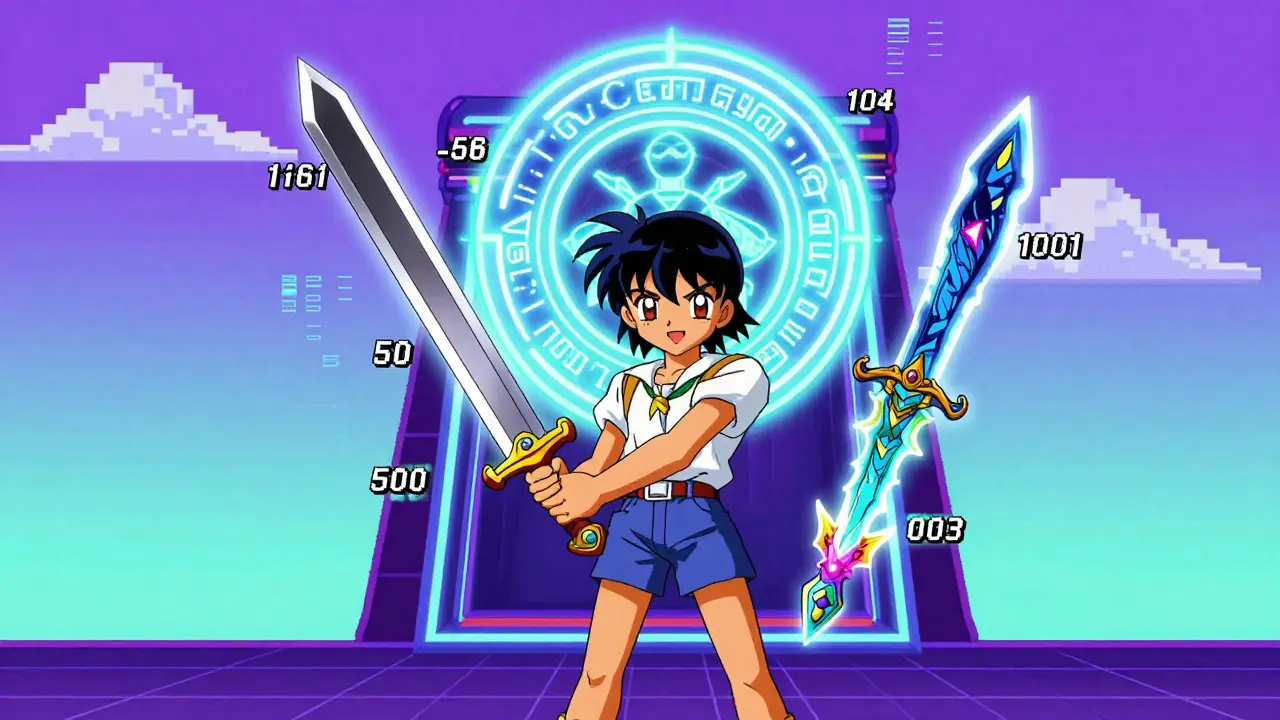
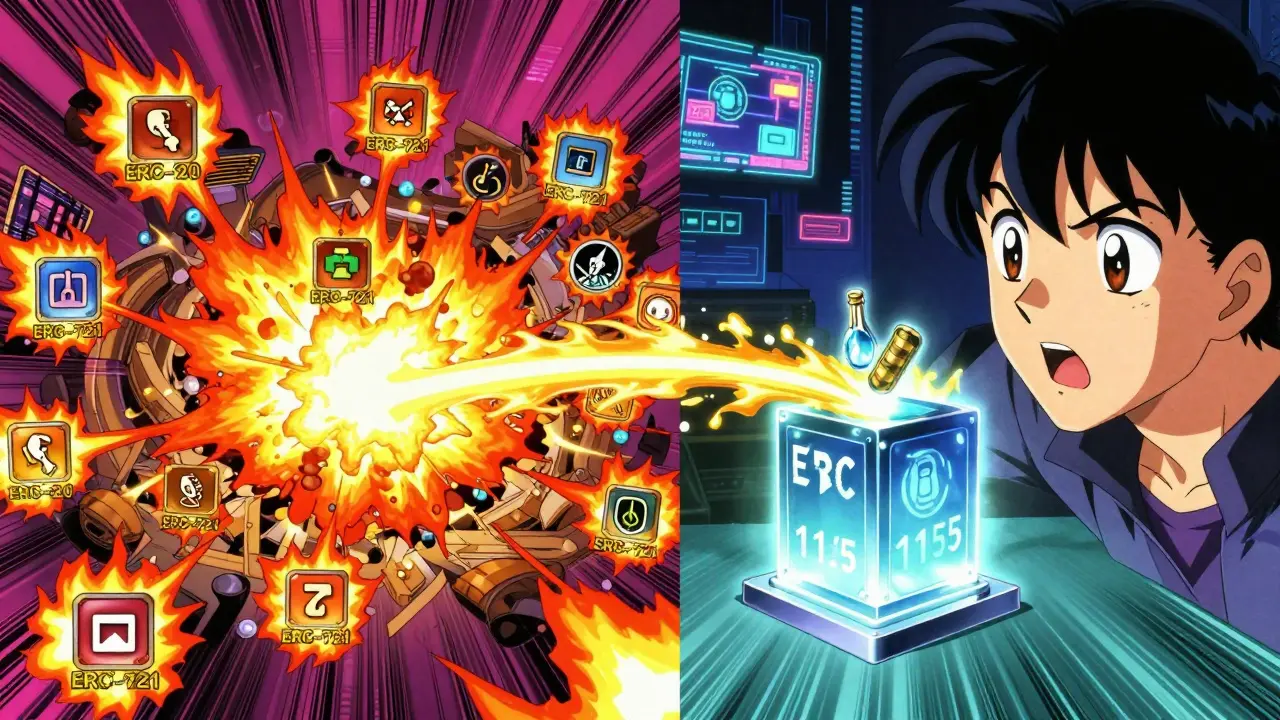
Imagine you’re building a game where players can own dozens of items: common swords, rare armor sets, and one-of-a-kind legendary weapons-all on the blockchain. Before ERC-1155, you’d need three separate smart contracts: one for coins (ERC-20), one for common gear (another ERC-20), and one for each unique weapon (ERC-721). That’s not just messy-it’s expensive. Each contract deployment costs hundreds of dollars in gas. Every time a player trades an item, you pay again. ERC-1155 fixes this. It lets you manage all of it-fungible tokens, NFTs, and everything in between-in one contract.
What Exactly Is ERC-1155?
ERC-1155 is a smart contract standard on Ethereum that allows a single contract to handle multiple types of tokens at once. Unlike ERC-20 (which only handles identical, interchangeable tokens like coins) or ERC-721 (which only handles unique, one-of-a-kind NFTs), ERC-1155 can do both-and more. It can even manage semi-fungible tokens, like a limited-edition item where the first 100 copies are identical, but after that, each one becomes unique.
This isn’t just a tweak. It’s a complete rethink. Instead of having hundreds of separate contracts for different items, you now have one. Each token type is identified by a unique number, called a token ID. Token ID 1001 might be a common wooden sword. Token ID 1002 could be a silver sword with only 50 copies. Token ID 1003? That’s the one legendary dragon-slaying blade, and only one exists.
It was proposed in June 2018 by Witek Radomski from Enjin and became official in January 2019. Since then, it’s become the backbone of blockchain games like Enjin’s Minecraft plugin, where over 1.2 million in-game items have been transferred using ERC-1155-with 92% less gas cost than using separate ERC-20 and ERC-721 contracts.
How ERC-1155 Saves You Money
Gas fees are the biggest pain point in Ethereum. Sending one NFT via ERC-721? Around 70,000 gas. Sending 10 different NFTs? That’s 700,000 gas-plus the cost of 10 separate transactions. With ERC-1155, you can send all 10 in one batch for about 115,000 gas. That’s over 80% cheaper.
Here’s the math: If you’re a game developer and players trade 100 items per day, using ERC-721 would cost you roughly $400 a day in gas at $30 per ETH. With ERC-1155? Around $65. That’s $100,000+ saved per year just on transaction fees.
Batch transfers are the secret weapon. ERC-1155’s safeBatchTransferFrom function lets you send multiple token IDs and amounts in a single transaction. You don’t need to call the transfer function 10 times. You call it once. The blockchain processes it all together. This isn’t just convenient-it’s what makes large-scale token economies possible.
Fungible, Non-Fungible, Semi-Fungible-All in One
What makes ERC-1155 powerful isn’t just that it can handle multiple tokens. It’s that it lets you define how each token behaves.
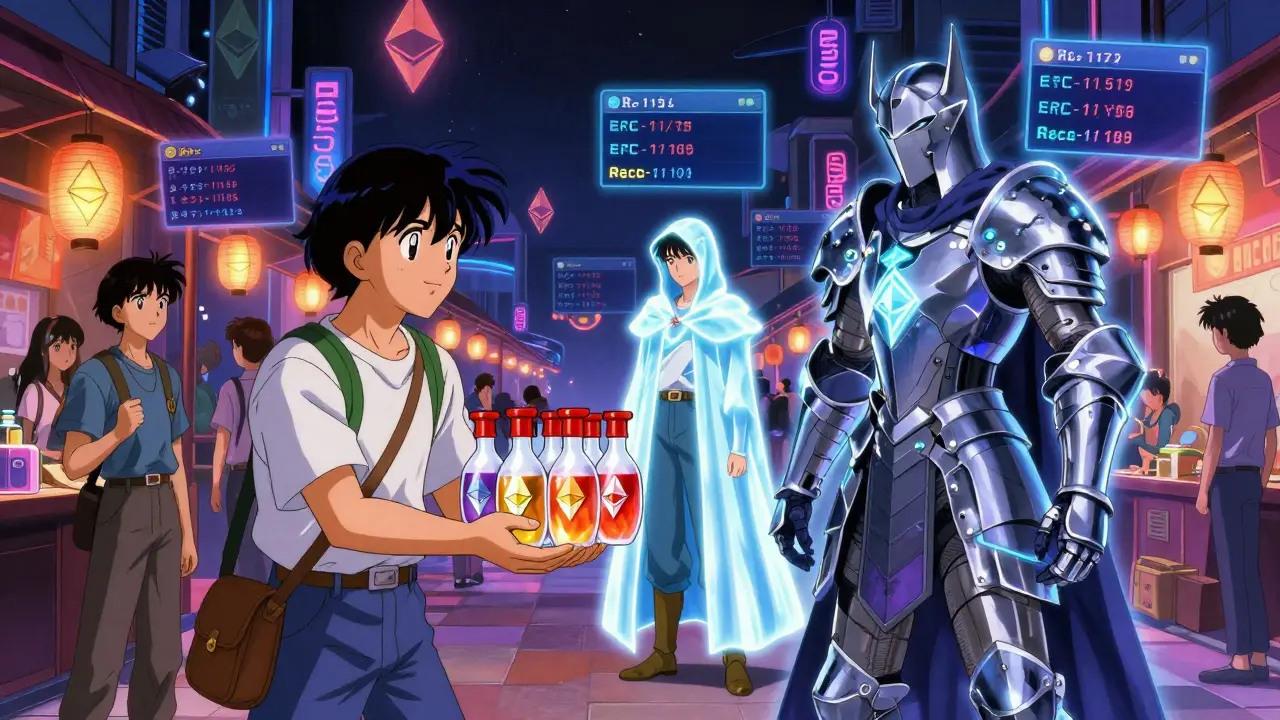
- Fungible: Token ID 500 is a healing potion. There are 10,000 of them. Any one is the same as another. Players can trade them freely.
- Non-fungible: Token ID 501 is a unique cloak worn by the game’s first 100 players. Only one exists. It’s a status symbol.
- Semi-fungible: Token ID 502 is a limited-edition armor set. Only 50 were made. All 50 are identical at first-but once you equip one, it becomes permanently linked to your account. No one else can use it. It’s fungible until used, then it’s NFT.
This flexibility is why gaming platforms love it. In traditional games, items are locked inside the game’s server. With ERC-1155, players truly own them. And because everything is in one contract, the game can easily let players trade items across different game modes, servers, or even other games built on the same standard.
How It Works Under the Hood
At its core, ERC-1155 uses a two-part balance system: address => token ID => balance. For each wallet address, the contract tracks how many of each token ID they hold. That’s different from ERC-721, which only tracks whether you own a token or not. With ERC-1155, you can own 12 of Token ID 1001 and 3 of Token ID 1002-all in the same contract.
Key functions include:
balanceOf(address, uint256 id)- Checks how many of a specific token ID a wallet holds.balanceOfBatch(addresses[], ids[])- Checks balances for multiple token IDs at once.safeTransferFrom(from, to, id, amount, data)- Transfers a specific token type and amount.safeBatchTransferFrom(from, to, ids[], amounts[], data)- Transfers multiple token types in one go.
There’s also the onERC1155Received hook, which lets a receiving contract (like a marketplace or another game) verify it’s ready to accept the tokens. This prevents accidental transfers to wallets that can’t handle them.
Metadata is stored per token ID, not per contract. So each item can have its own image, name, and description. A sword doesn’t need to share the same artwork as a helmet. This makes it easy to update or expand your game’s inventory without redeploying anything.
ERC-1155 vs ERC-20 vs ERC-721
It’s not always about picking the best standard. It’s about picking the right one for your use case.
| Feature | ERC-20 | ERC-721 | ERC-1155 |
|---|---|---|---|
| Token Type | Fungible only | Non-fungible only | Fungible, NFT, semi-fungible |
| Contract Count | One per token | One per NFT collection | One for all tokens |
| Batch Transfers | No | No | Yes |
| Gas Cost for 10 Transfers | ~450,000 gas | ~700,000 gas | ~115,000 gas |
| Decimal Precision | Yes | No | No |
| Metadata Flexibility | Per contract | Per contract | Per token ID |
ERC-20 is still the best for simple currencies. ERC-721 is still the go-to for pure art NFTs because of its long-standing compatibility with marketplaces like OpenSea. But if you’re building a game, a virtual world, or any system where multiple asset types interact-ERC-1155 wins.
Real-World Adoption
ERC-1155 isn’t just theory. It’s live and growing.
- Enjin uses it for its Minecraft plugin, managing over 1.2 million in-game items with 92% lower gas costs.
- OpenSea supports ERC-1155 collections, letting creators sell mixed packs of fungible and NFT items in one listing.
- Major blockchain games like The Sandbox and Splinterlands use it to handle currency, gear, and rare skins-all in one contract.
- Fortune 500 companies are testing it for loyalty programs, where points, digital coupons, and exclusive items are bundled together.
DappRadar reports that 73% of new blockchain gaming projects now use ERC-1155 as their primary standard-up from just 41% in 2021. On Polygon and BNB Chain, it’s even more dominant because gas is already low, and efficiency matters even more.
Challenges and Risks
It’s not perfect. The complexity is real.
Developers report spending 15-25 extra hours learning ERC-1155 compared to ERC-20 or ERC-721. The OpenZeppelin audit of 2022 found 68% of ERC-1155 contracts had at least one security flaw-mostly around access control or incorrect input validation. One 2021 exploit cost a gaming platform $250,000 because a token ID was mishandled during a trade.
Marketplace support isn’t universal. Some platforms still don’t display ERC-1155 NFTs correctly. Developers often have to write custom code to make their items show up on OpenSea, Rarible, or Magic Eden.
And there’s no built-in minting function. You have to build it yourself. That means if you don’t know what you’re doing, you might accidentally let anyone create unlimited tokens.
But the tools are getting better. OpenZeppelin’s ERC1155 contract (used in 89% of deployments) is now the gold standard. Community support on Discord and Reddit is active. Stack Overflow answers are faster than ever. If you use OpenZeppelin’s library and follow their docs, you avoid 90% of the pitfalls.
Getting Started
If you’re a developer ready to try it:
- Use OpenZeppelin’s
ERC1155contract as your base. Don’t write from scratch. - Define your token IDs carefully. Use a consistent numbering system (e.g., 1000-1999 for weapons, 2000-2999 for armor).
- Store metadata as JSON files on IPFS or Arweave, linked by token ID.
- Test batch transfers early. Use Remix or Hardhat to simulate sending 5-10 tokens at once.
- Implement the
onERC1155Receivedhook if your contract accepts incoming tokens.
Most developers start with a simple prototype: one fungible token and one NFT. Once that works, adding more is easy.
What’s Next?
ERC-1155 is evolving. The Ethereum Foundation is working on integrating it with account abstraction (ERC-4337), which could cut gas costs another 30-40% by letting users pay fees with tokens instead of ETH.
Proposals like EIP-6059 aim to make metadata handling even more flexible. And it’s not just Ethereum anymore-NEAR Protocol and Binance Smart Chain have their own versions.
By 2025, Gartner predicts ERC-1155 will power 55% of all blockchain gaming asset transfers. That’s not a guess-it’s the natural result of efficiency. When you can manage dozens of item types in one transaction, with one contract, for a fraction of the cost, there’s no going back.
ERC-1155 didn’t just improve token standards. It made complex, player-owned economies possible. And that’s why it’s the future-not just for games, but for any digital world where ownership matters.
Is ERC-1155 better than ERC-721 for NFTs?
It depends. If you’re making a single collection of unique digital art, ERC-721 is still simpler and has wider marketplace support. But if you’re building a game or app with hundreds of NFTs plus currency and items, ERC-1155 is far more efficient. It lets you bundle NFTs with fungible tokens in one contract, saving gas and simplifying logic.
Can ERC-1155 tokens be traded on OpenSea?
Yes. OpenSea supports ERC-1155 collections, but not all features work perfectly out of the box. You may need to manually verify metadata or use a compatible wallet like MetaMask. Some advanced features, like batch selling, require custom integration.
Do I need to know Solidity to use ERC-1155?
If you’re just buying or using ERC-1155 items, no-you only need a wallet. But if you’re creating or deploying an ERC-1155 contract, yes. You need to understand Solidity, smart contract structure, and how to handle token IDs, transfers, and metadata. Tools like OpenZeppelin’s library help, but you still need to know what you’re configuring.
What’s the difference between semi-fungible and non-fungible tokens?
Semi-fungible tokens start as identical copies-like 100 copies of a special event ticket. Once someone uses one, it becomes locked to their account and can’t be transferred again. At that point, it acts like a non-fungible token. Non-fungible tokens are always unique from the start-like a one-of-a-kind painting.
Why doesn’t ERC-1155 have decimal precision like ERC-20?
ERC-1155 treats all balances as whole numbers by design. It’s simpler and avoids confusion in mixed token systems. If you need fractions, you can simulate them by using smaller units-like representing 1 coin as 1000 units. Most games and apps handle this by scaling values internally.
Is ERC-1155 only for gaming?
No. While gaming is the biggest use case, it’s also used in loyalty programs, event tickets, digital collectibles, supply chain tracking, and even virtual real estate. Any system that needs to manage multiple types of digital assets-fungible and non-fungible-in one place benefits from ERC-1155.


Comments
Katie Teresi
January 29, 2026 AT 06:15ERC-1155? More like ERC-1155-rip-off-for-etherscan-ads. Real NFTs are one-of-a-kind, not some cheap bundle of trash you can batch transfer. This isn’t innovation-it’s corporate laziness dressed up as progress.
Aaron Poole
January 30, 2026 AT 23:02Actually, this is way more elegant than juggling 50 contracts. I’ve built both-ERC-721 for art, ERC-1155 for games. The gas savings alone make it worth it. Plus, semi-fungible items? Genius. Imagine limited-edition skins that become unique after equip. That’s the future.
josh gander
February 1, 2026 AT 20:54Man, I remember when we had to deploy a new contract for every damn sword in the game. 70k gas per trade? No thanks. ERC-1155 is the reason my game didn’t go bankrupt. Batch transfers are a godsend. I can send 12 items in one tx now-used to take 12 separate clicks, 12 gas fees, and a prayer. 🙏
Ramona Langthaler
February 2, 2026 AT 13:38lol u think this is good? usa devs think theyre smart but its just more complexity for no reason. why not just use solana? so much cheaper. also who even cares about gas when you can just mint free nfts? this is so 2021.
Dahlia Nurcahya
February 2, 2026 AT 13:57Hey, I just want to say this is one of the clearest breakdowns I’ve seen on ERC-1155. The semi-fungible example? Perfect. I’m a dev who’s been scared of this standard, but now I get it. Thanks for making it feel approachable. 🙌
laurence watson
February 4, 2026 AT 11:15I’m not a dev, but I collect in-game items on my kids’ Minecraft server. We’ve got 30+ items from Enjin. Knowing they’re truly mine-on-chain, transferable, even if I switch servers-it feels different. Like owning a real baseball card instead of a screenshot. Thank you for making this real for players.
Raju Bhagat
February 4, 2026 AT 18:19yo i just saw a guy sell a dragon sword on opensea for 5 eth and it was erc-1155 and i cried man like this is the future right?? everyone in india is building games on this now and its wild we got 200k users last month and gas is like 0.01 usd
Sunil Srivastva
February 5, 2026 AT 02:52Been using this since 2020 in my indie game. The metadata per token ID is a game-changer. No more centralized JSON files. IPFS + ERC-1155 = true ownership. Also, batch transfers saved me $8k last year. Worth every hour of learning.
Elizabeth Jones
February 5, 2026 AT 11:03It’s fascinating how this standard mirrors real-world economics: fungible goods (like currency), unique heirlooms (NFTs), and conditional ownership (semi-fungible). It’s not just code-it’s a new social contract for digital property. Thoughtful design.
Rachel Stone
February 5, 2026 AT 16:34Wow. So we’re impressed by a standard that’s basically ‘multiple tokens in one file.’ Next they’ll tell us a zipper is revolutionary because it holds two things at once.
Dylan Morrison
February 6, 2026 AT 05:17Imagine if we applied this to education. One contract for diplomas, certificates, badges, and course credits-all in one. Students own their entire learning journey. 🌍📚 Maybe blockchain isn’t just for gaming… it’s for identity.
Jerry Ogah
February 6, 2026 AT 09:40They say ERC-1155 is efficient. But what about the 68% of contracts with security flaws? This isn’t progress-it’s a minefield. And now everyone’s rushing in because ‘gas is cheap’-until someone gets hacked and loses their life savings. Wake up.
Devyn Ranere-Carleton
February 7, 2026 AT 22:06wait so if i have 100 healing potions and i send 50 to someone… does the contract track that i now have 50 left? or do i need to manually update it? also what if i typo the token id? 😅
Joseph Pietrasik
February 8, 2026 AT 05:40ERC-1155? More like ERC-1155-why-did-i-learn-solidity-again. I spent 3 weeks debugging a batch transfer and now i hate everything. Also why does opensea still not show my semi-fungible armor properly? smh
Richard Kemp
February 9, 2026 AT 00:33Used this for my digital art gallery. Made 1000 copies of a print (fungible), then turned 5 into unique signed versions (NFT). Works perfect. Only thing? Forgot to lock the minting after launch. Oops. Learned the hard way. Always audit.
Edward Drawde
February 11, 2026 AT 00:20so u guys are excited about saving gas but what about the environmental impact? mining eth still uses more power than argentina. this is just greenwashing with code.
Gareth Fitzjohn
February 11, 2026 AT 22:52Interesting read. I’ve been watching this space for a while. The batch transfer feature is genuinely useful, especially for marketplaces. But I agree with the security concerns. It’s a powerful tool, but power without discipline is dangerous.
Robert Mills
February 13, 2026 AT 06:30THIS IS THE FUTURE. 🚀 Stop using ERC-721 for games. Just stop. Your wallet will thank you. Your bank account will cry tears of joy. Go build something amazing.
Joshua Clark
February 13, 2026 AT 19:00I’ve been working on a blockchain-based loyalty program for a retail chain, and ERC-1155 is the only thing that made it viable. We bundle points (fungible), exclusive discounts (semi-fungible), and VIP access passes (NFT) into one contract. Customers love it. Backend devs? Less stressed. Management? Happier. It’s not perfect, but it’s the most elegant solution we’ve found.
Dylan Morrison
February 13, 2026 AT 23:43What if we applied this to cultural heritage? Imagine a single contract holding digital replicas of artifacts, with provenance, access rights, and usage licenses-all tied to a token ID. A museum could let you ‘own’ a piece of history without owning the physical object. That’s poetry in code.
Pamela Mainama
February 14, 2026 AT 08:16So cool to see this used beyond games. I work in rural education-we’re testing digital badges for kids who complete projects. ERC-1155 lets us give out certificates + unlockable content in one go. Simple, secure, and real.
Raymond Pute
February 15, 2026 AT 13:36Of course you’re all celebrating this. Because you’re the same people who thought DeFi yield farming was ‘financial innovation’ before the rug pulls. ERC-1155 is just another layer of abstraction for people who don’t understand that true ownership means control-not a smart contract that can be paused, upgraded, or revoked by some dev with a GitHub repo and a Discord server. You’re not owning anything. You’re just renting a digital label on a centralized server. Wake up.
Nickole Fennell
February 15, 2026 AT 21:02Ugh, another ‘this is the future’ post. Can we PLEASE stop pretending blockchain solves everything? My cousin lost $12k because his ‘unique NFT’ got hacked. Nobody’s auditing. Nobody’s caring. You’re not building a revolution-you’re building a casino with extra steps.