BTCC Crypto Exchange Review: Is It Right for Korean Traders in 2025?
When you're looking for a crypto exchange in South Korea, you probably think of UPbit, Bithumb, or Korbit. They're everywhere-on TV, in apps, in your friend’s phone. But what if you're not just buying Bitcoin to hold? What if you're trading futures, chasing leverage, or need deeper liquidity than local exchanges offer? That’s where BTCC comes in. It’s not a Korean exchange. It doesn’t support Korean Won. And it won’t make your life easier if you’re new to crypto. But for experienced traders, it’s one of the few platforms that actually delivers what Korea’s domestic exchanges can’t.
What BTCC Actually Is (And What It’s Not)
BTCC started in Shanghai in 2011 as BTC China, one of the first major crypto exchanges in the world. After China banned crypto trading in 2017, BTCC shut down its local operations and moved its HQ to London. Today, it’s a global platform with no legal presence in South Korea. That means no Korean-language app, no KRW deposits, no local customer support team based in Seoul. You’re dealing with an international exchange that happens to serve Korean users-not a Korean exchange. This isn’t a flaw. It’s a design choice. BTCC doesn’t want to compete with UPbit on convenience. It wants to compete on power.Trading Features That Set BTCC Apart
BTCC offers spot trading, but that’s not why serious traders use it. The real draw is its futures market. You can trade perpetual contracts on over 60 cryptocurrencies-including BTC, ETH, SOL, and DOGE-with leverage up to 100x. Compare that to UPbit’s 5x maximum, and you start to see why Korean professionals turn to BTCC. You’ve got two margin options: USDT-margined (settled in Tether) and coin-margined (settled in the actual crypto). Most traders use USDT because it’s stable and avoids the volatility of using BTC as collateral. The platform also offers tokenized futures on stocks and commodities like Apple shares and gold-all settled in USDT. That’s something no Korean exchange offers. The trading engine is fast. It handles 100,000 transactions per second with an average execution time of 1.2 milliseconds. In practice, that means your orders fill exactly where you want them, even during high volatility. Professional trader Lee Sang-hoon tested BTC/USDT futures liquidity on BTCC and found 12.7 times more depth at key price levels than on any Korean exchange.Fees and Volume
Fees are straightforward: 0.1% for both makers and takers. But if you trade more than $50 million per month, fees drop to 0.02% maker and 0.04% taker. That’s competitive with Binance and OKX. Daily futures volume on BTCC averages $4.2 billion, far outpacing UPbit’s $1.8 billion in spot volume. For traders who care about slippage and order execution, that liquidity matters. But here’s the catch: you can’t deposit Korean Won. Not directly. Not through bank transfer. Not with a credit card. You have to buy USDT or BTC first on another exchange-like Kraken or Binance-then send it to BTCC. That adds time, cost, and complexity.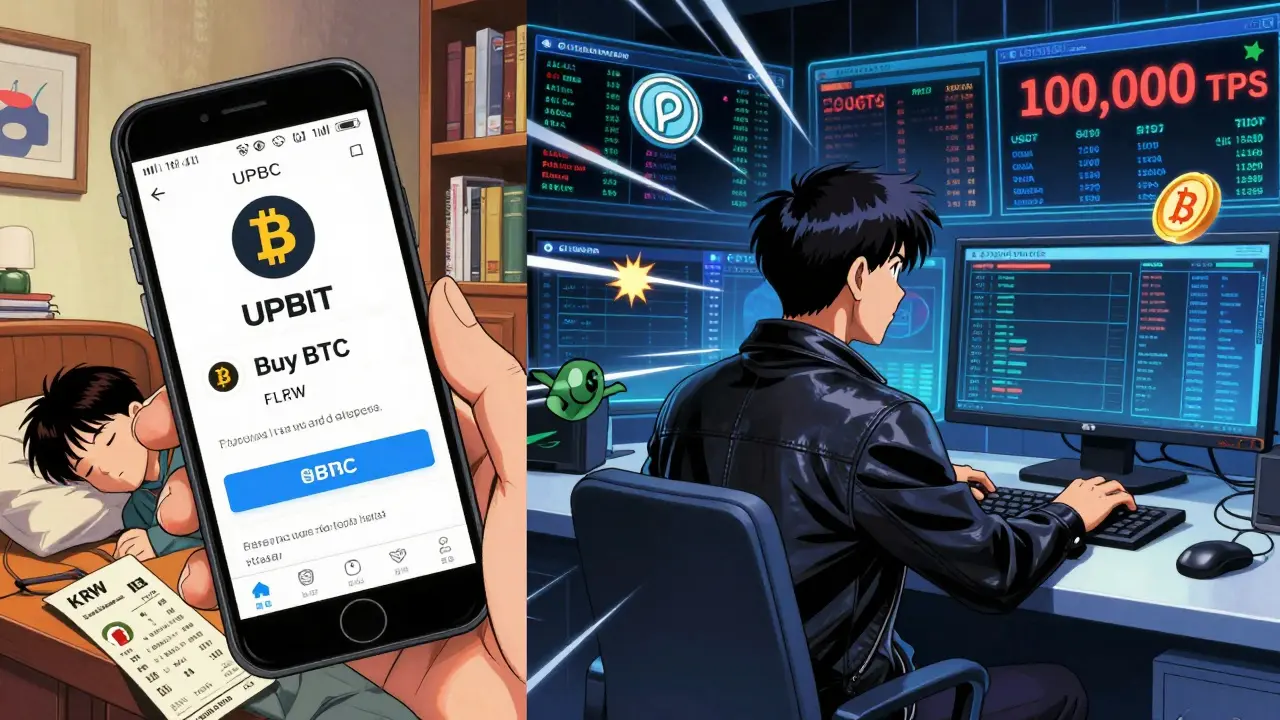
Security and Compliance
BTCC keeps 98% of user funds in cold storage. It uses multi-signature wallets and requires two-factor authentication. In 2025, CryptoSecurity Labs gave it a 4.1/5 security rating, higher than most Korean exchanges. It also publishes proof-of-reserves monthly, which is rare in the industry. But here’s the problem: BTCC doesn’t have a Korean financial license. That means it can’t offer services that licensed exchanges can-like tax reporting aligned with Korea’s 22% capital gains tax, or automatic KRW withdrawals. Financial analyst Kim Ji-ae pointed out that Korean users have to manually track every trade and calculate taxes themselves. That’s a nightmare for anyone who doesn’t use third-party tax software.Why Korean Users Struggle with BTCC
Most Korean users don’t hate BTCC. They just find it frustrating. Onboarding takes 36 to 48 hours. You need a passport. You can’t use your Korean resident registration number. That’s fine if you’re a global citizen. But if you’re a 28-year-old office worker in Busan trying to get started, it’s a barrier. UPbit lets you sign up in 15 minutes with your ID card. Customer support response time for Korean users averages 18 hours. Compare that to UPbit’s Discord server, which has over 87,000 members and real-time help. BTCC has one Korean-language Telegram group with 3,241 members. That’s not a community. That’s a whisper. The mobile app? The English version works fine. The Korean version? Machine-translated, clunky, full of errors. A CrypTOK survey of 1,247 Korean users found only 43% rated the localization as “adequate.” UPbit scored 89%. And then there’s the funding problem. South Korea limits international bank transfers to 50 million KRW per day (about $36,000). If you need to move more, you have to split it across multiple days or use third-party services-which often fail. A 2025 survey by the Korean Blockchain Association found 68% of BTCC users had at least one failed deposit because of banking restrictions.
Who Should Use BTCC?
BTCC isn’t for beginners. It’s not for people who want to buy Bitcoin and forget about it. It’s not for anyone who expects Korean-language support or instant KRW deposits. It’s for:- Traders who need leverage higher than 5x
- Those who want access to tokenized stock and commodity futures
- Users who already hold USDT or BTC and want to trade with deep liquidity
- Professional traders who care about execution speed and order book depth
What’s Changing in 2025-2026?
BTCC announced in October 2025 that it’s integrating Ripple’s ODL system to speed up USDT conversions. Internal tests show this could cut onboarding time by 28%. That’s a big deal for Korean users who currently wait days to fund their accounts. Also, BTCC plans to open a Seoul-based compliance team by Q2 2026. That doesn’t mean KRW deposits are coming. But it does mean they’re at least thinking about local regulations. The Financial Services Commission in Korea has been pushing for stricter rules on foreign exchanges. The proposed 2026 Digital Asset Framework Act could force BTCC to either get licensed or stop serving Korean users entirely. Deloitte Korea’s analysis says BTCC’s market share in Korea is currently 1.7%. If they get a local entity, it could grow to 3.2% by 2026. Without it? It’ll stay below 2%.Final Verdict
BTCC isn’t the best crypto exchange for most Korean users. If you’re just starting out, stick with UPbit or Korbit. They’re easier, faster, and built for you. But if you’re serious about trading-especially futures with high leverage-BTCC is one of the only platforms that gives you the tools you need. The lack of KRW support is a pain. The poor Korean localization is frustrating. The compliance risks are real. But for advanced traders who already have crypto and want deeper markets, faster execution, and leverage up to 100x? BTCC still has no real competitor in Korea. It’s not the obvious choice. But for the right person, it’s the only choice.Can I deposit Korean Won (KRW) directly into BTCC?
No, BTCC does not support direct Korean Won deposits. You must first buy USDT or BTC on another exchange like Kraken or Binance, then transfer it to your BTCC wallet. This adds time and complexity, especially compared to local exchanges like UPbit or Korbit that allow instant bank transfers in KRW.
What’s the maximum leverage on BTCC compared to Korean exchanges?
BTCC offers up to 100x leverage on perpetual futures contracts. In contrast, Korean exchanges like UPbit, Bithumb, and Korbit are capped at 5x leverage under local regulations. This makes BTCC the only viable option for traders seeking high leverage in the South Korean market.
Is BTCC safe to use in South Korea?
Yes, BTCC has strong global security practices: 98% of funds are in cold storage, multi-signature wallets are used, and it publishes monthly proof-of-reserves. However, it lacks a Korean financial license, meaning it doesn’t comply with Korea’s Virtual Asset User Protection Act. This creates regulatory risk for Korean users, especially if new laws restrict foreign exchanges.
Does BTCC support Korean language?
BTCC’s website and app have machine-translated Korean, but it’s poorly done. Customer support doesn’t offer Korean-language agents. The mobile app’s Korean version scored only 2.6/5 in user clarity tests. Most Korean users report confusion and frustration with the interface. UPbit and Bithumb, by contrast, offer full Korean support with native apps and local help desks.
Can I use BTCC for tax reporting in Korea?
No, BTCC does not provide tax reports aligned with South Korea’s 22% capital gains tax system. You must manually track every trade, calculate profits and losses, and file taxes yourself using third-party tools like Koinly or CoinTracker. This is a major burden compared to Korean exchanges that auto-generate compliant tax documents.
What’s the daily trading volume on BTCC compared to Korean exchanges?
BTCC averages $4.2 billion in daily futures volume. UPbit, the largest Korean exchange, averages $1.8 billion in daily spot volume. While direct comparisons are tricky (futures vs. spot), BTCC’s liquidity for leveraged trading far exceeds anything available in Korea. This attracts professional traders who need deep order books to execute large positions without slippage.
Is BTCC planning to launch in Korea officially?
BTCC has announced plans to establish a Seoul-based compliance team by Q2 2026, but it has not confirmed plans to obtain a Korean financial license or add KRW deposits. Without licensing, BTCC remains in a legal gray zone under South Korea’s evolving digital asset regulations. Future restrictions could limit or block access for Korean users.
How long does it take to verify my account on BTCC as a Korean user?
As a Korean user, account verification on BTCC takes 36-48 hours on average. You need to submit a passport and proof of address. This is much slower than UPbit or Korbit, where verification with a Korean ID card takes 15-30 minutes. The delay is due to international KYC processes and lack of local identity verification systems.





Comments
Alison Hall
December 29, 2025 AT 23:07BTCC is for traders who treat crypto like a job, not a hobby. If you're still figuring out how to use a wallet, stick with UPbit.
Daniel Verreault
December 30, 2025 AT 14:44100x leverage is wild but also a one-way ticket to bankruptcy if you dont know what ur doing. i saw a guy lose 80k in 3 mins on btcc last month. no cap.
Vernon Hughes
January 1, 2026 AT 14:05They dont even have a decent Korean app. Machine translated text with typos? Thats not localization. Thats laziness.
Andy Reynolds
January 2, 2026 AT 03:10For the people saying BTCC is too complicated: youre right. But so is driving a manual transmission. That doesnt mean its not better when you know how to use it.
Antonio Snoddy
January 3, 2026 AT 21:31Think about it. We live in a world where your bank account can be frozen by a government decree, but your BTC on BTCC? Its yours. No one can touch it unless you give them the keys. The fact that you have to jump through hoops to fund it is a feature, not a bug. It filters out the noise. The people who make it through are the ones who actually understand what theyre doing. The rest? Theyre just chasing memes and hoping for a moon.
The regulatory gray zone isnt a flaw. Its the entire point. If BTCC played by Koreas rules, it would be just another exchange with 5x leverage and tax reports auto-generated by someone who doesnt know what a long position is. The pain of onboarding? Thats the price of freedom. The lack of KRW support? Thats the firewall between you and your emotional impulses.
People dont get it. They want convenience. But convenience is the enemy of mastery. You want to trade futures with real depth? You want to hedge gold with crypto? You want to execute 100 BTC orders without slippage? Then you accept the friction. You accept the 48-hour KYC. You accept the broken Korean UI. You accept the fact that your support ticket will sit for 18 hours. Because on the other side of that friction? You get power. Real power. Not the kind that comes with a shiny app and a local customer service rep who says "sorry" 12 times before giving you a 30-second answer.
BTCC isnt for Koreans. Its for the Koreans who refuse to be limited by borders. Who refuse to be capped at 5x leverage because some bureaucrat thinks theyre too dumb to handle more. Who refuse to let tax software decide what their risk profile should be. Thats not a niche. Thats a movement.
And if you think its risky? Good. You should. Risk is the only thing that separates gamblers from traders. The ones who make it? They dont complain about the UI. They just keep trading.
dayna prest
January 5, 2026 AT 19:52BTCC is the crypto equivalent of a black leather jacket with no zipper. Looks cool. Hard to put on. And youll probably get stopped by the cops just for wearing it.
Ryan Husain
January 7, 2026 AT 08:22The liquidity difference is staggering. I traded both UPbit and BTCC during the SOL pump last month. On UPbit, my 50 BTC order moved the price 3%. On BTCC? It filled at my limit with 0.1% slippage. That’s not a preference. That’s a necessity for anyone trading over $10k per trade.
Rajappa Manohar
January 7, 2026 AT 11:46btcc good for pros but korean users need krw deposit. its 2025 why still no krw?
Khaitlynn Ashworth
January 8, 2026 AT 03:47Oh wow BTCC is "powerful"? So is a chainsaw. That doesn’t mean you should use it to trim your hedges.
And let’s be real - if you’re trading 100x leverage, you’re not a trader. You’re a gambler with a spreadsheet. Congrats, you lost your house. Again.
NIKHIL CHHOKAR
January 9, 2026 AT 13:03Let me get this straight - you’re praising a platform that doesn’t comply with your country’s tax laws? That’s not smart. That’s reckless. And now you’re telling people to manually track every trade? That’s not freedom. That’s a tax audit waiting to happen.
If you’re going to use BTCC, at least use Koinly. But honestly? Just stick with UPbit. You’ll sleep better.
Haritha Kusal
January 10, 2026 AT 20:56btcc is like a sports car - fast and loud but you need to know how to drive it. if you just want to go to grocery store, buy a sedan.
nayan keshari
January 12, 2026 AT 17:49They dont even have a proper Korean translation. The app says "your wallet is ready" as "your wallet is readyy" with three Ys. I’m not kidding. This is what they call global expansion?
Jacky Baltes
January 14, 2026 AT 10:20The real question isn’t whether BTCC is good. It’s whether Korea should let foreign exchanges operate in this gray zone at all. If we’re serious about protecting retail users, we shouldn’t be praising platforms that skirt our laws. We should be demanding better from our own exchanges.
Amy Garrett
January 14, 2026 AT 10:32btcc is the only place i can trade apple stock as a crypto pair. no other korean exchange even comes close. worth the hassle.
Alex Strachan
January 15, 2026 AT 11:04So BTCC is "the only choice" for pros... but you need a passport, 2 days to verify, and a crypto broker just to fund it? Sounds like a 2013 startup. Not a 2025 platform. 😂
rachael deal
January 15, 2026 AT 15:47I switched from UPbit to BTCC last year. Lost my first $5k. Then I learned. Now I make more on BTCC than my job. The friction? Worth it.
Mike Pontillo
January 16, 2026 AT 14:10100x leverage? That’s not trading. That’s gambling with a degree in delusion.
Joydeep Malati Das
January 18, 2026 AT 11:10BTCC’s security is impressive. But security alone doesn’t make a platform sustainable. Without regulatory alignment, it’s a house built on sand. Korea’s rules exist for a reason.
Johnny Delirious
January 18, 2026 AT 22:09As a financial services professional, I must emphasize: BTCC operates in a regulatory gray zone that poses systemic risk to retail participants. The absence of compliance with the Virtual Asset User Protection Act is not a technical limitation - it is a governance failure. Users who engage with BTCC do so at their own legal and financial peril, regardless of the platform’s technical merits.
christopher charles
January 19, 2026 AT 15:22I’ve used BTCC for 2 years. Never had a withdrawal issue. Security is solid. The app? Yeah, the Korean version sucks. But I use the English one - no problem. And the 100x leverage? Game changer. I’ve made 3x my initial deposit. No regrets.
Mike Reynolds
January 20, 2026 AT 02:04Just want to say - if you’re thinking about using BTCC, make sure you’ve got a solid tax strategy lined up. I used CoinTracker and it saved me from a nightmare. Don’t wing it.